
The Sancta Camisia (Veil of the Virgin)
Marian relic, traditional venerationThe principal surviving fragment is shown permanently in a chapel of the ambulatory
Diocese of Chartres and cathedral traditionChartres Cathedral is a major Marian Gothic cathedral known for its medieval stained glass, labyrinth, crypt, towers, and long life as a place of pilgrimage.
Chartres is the clearest place in Europe to learn how a great church teaches. It was raised as a Marian cathedral, and almost everything in it points to the Virgin: the sculpture of the portals, the blue and ruby of the windows, the relic shown in a chapel behind the choir, and the pilgrim road that ended at its door. Begin the way pilgrims did, from the outside in, reading glass, stone, and light together.
A cathedral has stood on this hill since the early Middle Ages, drawing pilgrims to a Marian relic. After a fire in 1194 spared the relic, the present High Gothic cathedral rose with remarkable speed, and its windows have come down to us largely intact. UNESCO singles out this survival: most of the 12th and 13th century stained glass is still in place.
The building works as one teaching environment. The Royal Portal sets out salvation in stone at the threshold, the nave carries the eye toward the altar through walls of colored light, the crypt holds an older layer of prayer beneath, and the labyrinth turns the floor itself into a path.
Four things carry most of the cathedral's meaning. Notice them in order.
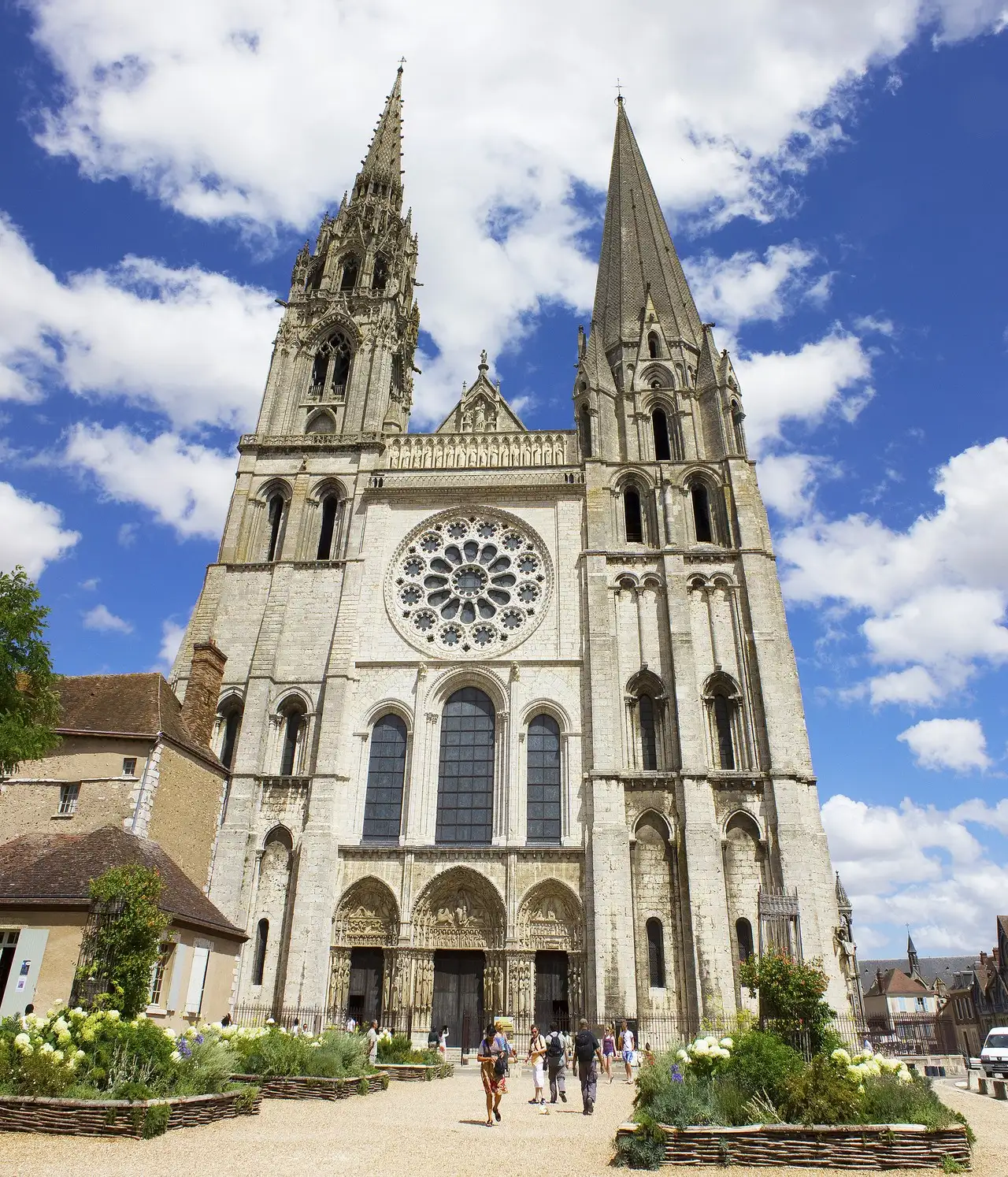
The west Royal Portal teaches before you enter: Christ in majesty and the life of the Virgin.
The windows are a catechism in light, with the famous Chartres blue at the center.
Pilgrims came for the Sancta Camisa, venerated as the Virgin's veil, and the cathedral grew around it.
The labyrinth lets the body pray what the building says, a slow walk toward a center.
Chartres is one of the clearest examples of a Gothic cathedral planned as a single theological whole.
Its medieval stained glass is among the most complete to survive anywhere in Europe.
Chartres rewards slowness. Its meaning is cumulative, gathered window by window and portal by portal, and it is still first of all the cathedral of a living diocese rather than a museum of glass.
The west doorways are one of the great achievements of early Gothic sculpture. Read them from the parvis before going in: Christ in majesty at the center, with the life of Christ and the Virgin around him.
The reason Chartres is unique. Most of the medieval glass survives, so the nave still fills with the light its builders intended. Give your eyes time to adjust before reading it.
The Blue Virgin, a 12th century panel reset into a later window, is the most loved image in the cathedral and the clearest place to see the famous Chartres blue.
Set into the nave floor, it offered pilgrims a path of prayer toward a center. It is often covered by chairs and uncovered only on certain days, so check before you come.
Traditionally venerated as a veil worn by the Virgin Mary, the relic drew pilgrims here for centuries and shaped the cathedral around it. The principal surviving fragment is shown permanently in a chapel of the ambulatory, behind the choir.
A late medieval statue of the Virgin and Child on a pillar on the north side of the choir, ringed with candles. If the glass is what visitors come for, this is where pilgrims stop.
The crypt runs beneath almost the whole cathedral and is older than the Gothic church above it. It holds the chapel of Notre-Dame de Sous-Terre and the deep well known as the Puits des Saints-Forts. It can only be seen on a guided visit.
Reopened in September 2024 after a long restoration, the fourteenth-century chapel at the east end now shows around a hundred and fifty works from the cathedral's treasury. It is a separate ticketed visit.
Enough to read Chartres in the right order: portals, then nave, then its most famous glass. Keep it simple and unhurried.
A slower visit that takes in the great window cycles, the crypt's older layer of prayer, and the labyrinth if it is uncovered.
Chartres is a Marian pilgrimage cathedral, not only a monument. If you can return, plan around Mass, quieter hours, or an evening, and let the building be prayed rather than toured.
Start outside with the Royal Portal and the two contrasting spires, then enter and give your eyes time to adjust before reading the glass. Find Notre-Dame de la Belle Verriere, and check on the day of your visit whether the labyrinth is uncovered and whether the crypt, towers, or evening prayer are open.
The principal surviving fragment is shown permanently in a chapel of the ambulatory
Diocese of Chartres and cathedral traditionPublic devotion in the cathedral
Cathedral and UNESCO documentationFocus of pilgrim devotion
Diocese of ChartresWalked in prayer on the days it is uncovered
Cathedral visitor informationMass and prayer in the crypt chapel
Diocese of ChartresA ticketed visit rather than a place of devotion
Centre des monuments nationaux and the Diocese of ChartresSource note Traditional attributions are presented as tradition, with documentation named where it exists.
Written from the official cathedral site of the Diocese of Chartres, the Centre des monuments nationaux pages for the towers and the Saint-Piat treasury, and C'Chartres Tourisme, with the Wikimedia image provenance given in the credits. The relic tradition, the labyrinth, and claims about sacred geometry are given at the level of certainty the sources support and no higher.
August 5, 2026
Use this for corrections, broken links, missing places, and planning ideas.