
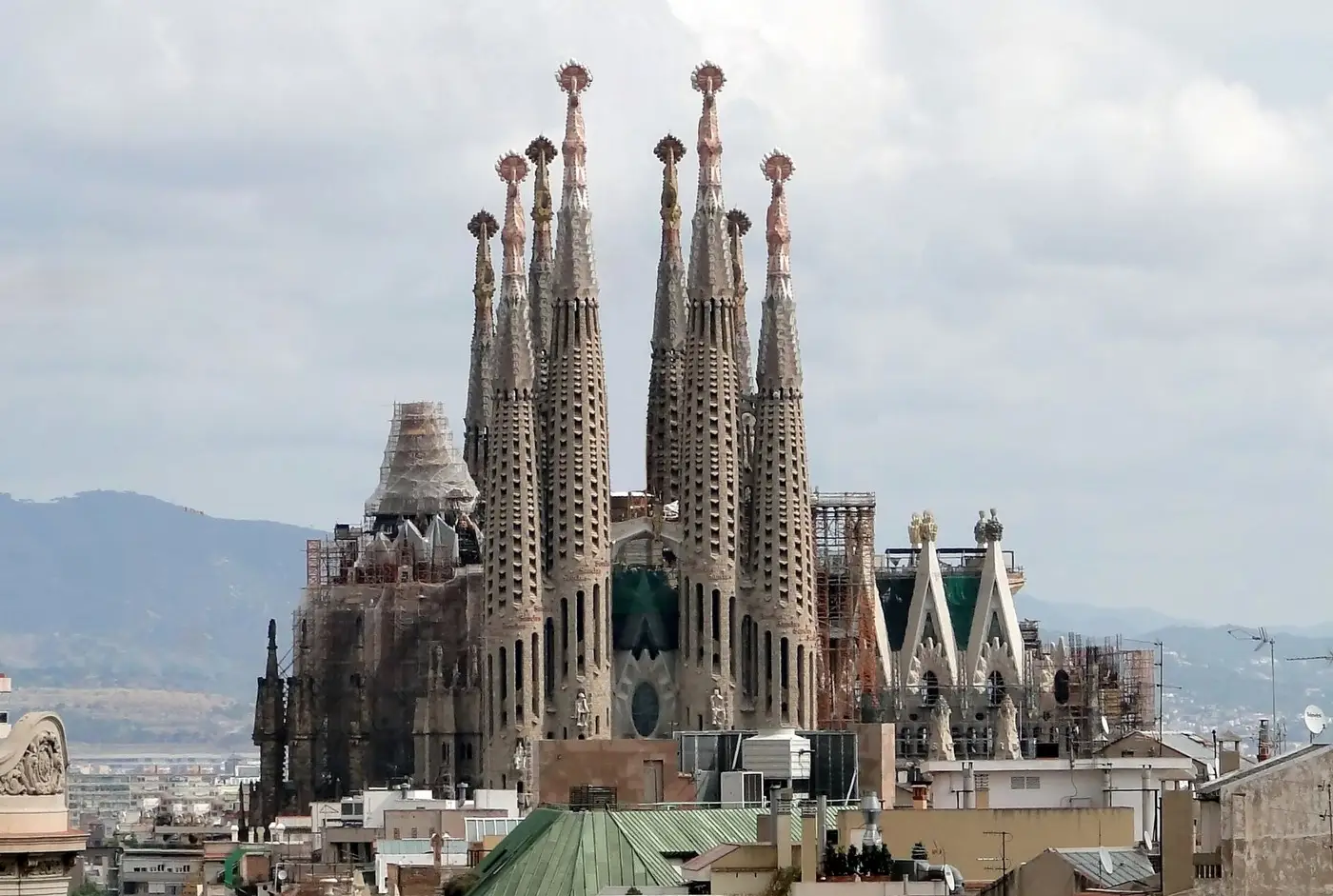
Sagrada Familia
The Sagrada Família is Barcelona’s great expiatory basilica of the Holy Family, designed by Antoni Gaudí as a theological work of architecture still rising toward completion.
- Location
- Barcelona, Spain 41.4036° N · 2.1744° E
- Type
- Minor basilica and expiatory church Modernista basilica designed by Antoni Gaudí
- Dedication
- The Holy Family
Gaudi's Basilica of the Holy Family
The Sagrada Familia is a consecrated basilica and an expiatory church, not only Barcelona's most famous monument. Here architecture is catechesis: the Nativity, Passion, and Glory facades, the branching columns, the colored light, and the rising towers are built to teach the faith. Read Antoni Gaudi as a believer who gave the last years of his life to this work as an offering. Eternal Roam reads the building less as spectacle than as prayer.
An Expiatory Church Still Being Built
Construction began in 1882, and Gaudi took charge in 1883, devoting himself to the basilica until his death in 1926. Pope Benedict XVI consecrated the church and named it a minor basilica in 2010. On 20 February 2026, the exterior of the central Tower of Jesus Christ was completed with the final arm of its cross; Pope Leo XIV blessed it on 10 June, the centenary of Gaudi's death. At 172.5 metres, the tower makes the Sagrada Familia the tallest church in the world. The basilica remains under construction: interior work continues in the tower, and other major elements still await completion.
This is neither Gothic revival nor ordinary modern architecture. Gaudi used geometry drawn from nature, branching stone columns, symbolic facades, and a hierarchy of towers to build a church that teaches through the experience of light and space.
How to read the Sagrada Familia.
The basilica is a single argument in stone and light. Read it in four movements.
The Nativity Facade
Gaudi's own facade, dense with Scripture, nature, and joy, telling the birth and childhood of Christ.
The Passion Facade
Stark and angular, built after Gaudi's death to his vision, presenting the suffering and death of Christ.
The forest of the nave
Branching columns and colored light turn the interior into an image of creation ordered toward worship.
The hierarchy of towers
The towers rise in order toward the central Tower of Jesus Christ, with Mary, the Evangelists, and the Apostles around it.
Pope Benedict XVI consecrated the church and declared it a minor basilica in 2010.
Antoni Gaudi was declared Venerable in 2025; his cause for canonization gives the basilica special interest for pilgrims.
The danger is to visit only Barcelona's famous monument. It is a consecrated basilica, an expiatory church raised by donations, and a place where Gaudi's faith is written into stone, color, and structure.
What to notice.
-
The Nativity Facade
Gaudi's own facade, completed in his lifetime, crowded with Scripture, plants, and animals telling the birth and childhood of Christ. Read it slowly from the outside before entering.
-
The Passion Facade
On the opposite side, stark and angular, built to Gaudi's design after his death. Its severity is deliberate, set against the joy of the Nativity Facade.
-
The nave and its branching columns
Inside, the columns rise and divide like trees into a stone forest, carrying the vaults and turning the nave into an image of creation at prayer.
-
The light, by time of day
The stained glass is tuned by color and orientation, warm tones to the west, cool to the east, so the interior changes through the hours. The light is part of the architecture.
-
The towers
When tickets, time, and mobility allow, a tower visit gives a closer view of the spires and the city. The central Tower of Jesus Christ now crowns the hierarchy.
-
The crypt and Gaudi's tomb
Beneath the apse, the crypt holds the tomb of Antoni Gaudi, declared Venerable in 2025, and remains a place of prayer within the working basilica.
- That this is a consecrated basilica and an expiatory church, built by donation as an offering, not a museum.
- How the interior columns branch like trees and the windows wash the nave in shifting color through the day.
- The deliberate theology of the facades: birth, death, and glory, read as one Gospel around the building.
- That Gaudi is buried in the crypt and was declared Venerable in 2025; the work is the labor of generations, still unfinished.
How much time, and what to do with it.
-
Facades and nave
4 ordered stopsWith a timed ticket, read the Nativity and Passion facades from outside, then enter and let the light of the nave settle before you move.
- The Nativity Facade from the street
- The Passion Facade
- The nave and its branching columns
- The changing light of the windows
-
Add a tower and the museum
4 ordered stopsAdd a tower visit, if your ticket and mobility allow, and the museum that explains Gaudi's method and the long building project.
- Both facades and the nave
- The crypt and Gaudi's tomb
- A tower visit
- The basilica museum
-
Come for the Mass
3 ordered stopsThe basilica celebrates an international Mass on Sundays and holy days of obligation. Plan around it to experience the Sagrada Familia as the church it was built to be.
- International Mass, Sundays and holy days at 9 am
- Quiet prayer in the nave
- The crypt and Gaudi's tomb
Entering as a pilgrim, not a tourist.
Book a timed entry through the official site and arrive on time. Begin by reading the facades from outside, then let the interior light settle before you move. If you attend Mass, follow the basilica's current liturgical guidance, and remember that tourist routes and tower access can change as construction continues.
- International and parish-style Masses according to current schedule
- Prayer in an active basilica
- Ticketed visits with official entry times
- Tower visits when available
- Major liturgical celebrations in Barcelona
Plan around timed tickets, Mass, and ongoing work.
- Entry
- Timed tickets, official site only
- Mass
- Sundays and holy days, 9 am, free
- Towers
- Separate, limited, mobility-dependent
- Status
- Active basilica, still under construction
Additional schedule notes
Construction
- The exterior of the central Tower of Jesus Christ was completed in February 2026 and blessed in June; the basilica remains under construction, so confirm current access and routes on the official site.
What pilgrims come to venerate here.
Tomb and Burial
- Antoni Gaudi, the basilica's architect, declared Venerable by the Church in 2025, is buried in the crypt of the Sagrada Familia.
Relics and Sacred Tradition
- The basilica is an expiatory church, built through private donations as an offering of faith rather than from public or diocesan funds.
Sacred Objects
- The Nativity Facade expresses the birth and childhood of Christ in a dense language of Scripture, nature, and joy.
- The Passion Facade presents the suffering and death of Christ with stark, angular force.
- The interior columns and light turn the nave into a forest-like image of creation ordered toward worship.
- The towers are planned as a hierarchy of Christ, Mary, the Evangelists, and the Apostles.
Plan around this place.
Current-status verification: 2026-07-14. The official Basilica reports the exterior of the Tower of Jesus Christ completed on 20 February 2026, its blessing on 10 June, and a height of 172.5 metres. It remains under construction. Source: https://sagradafamilia.org/en/-/el-papa-lleo-xiv-presideix-la-missa-solemne-de-commemoracio-del-centenari-de-la-mort-d-antoni-gaudi-i-beneeix-la-torre-de-jesucrist
July 14, 2026
Photo credits
- Hero. Bernard Gagnon / Wikimedia Commons (CC BY-SA 3.0). Source. CC BY-SA 3.0.
- A Forest Built for Worship. Joseolgon / Wikimedia Commons (CC BY-SA 4.0). Source. CC BY-SA 4.0.
- Where to Pause. Yair Haklai / Wikimedia Commons (CC BY-SA 3.0). Source. CC BY-SA 3.0.