
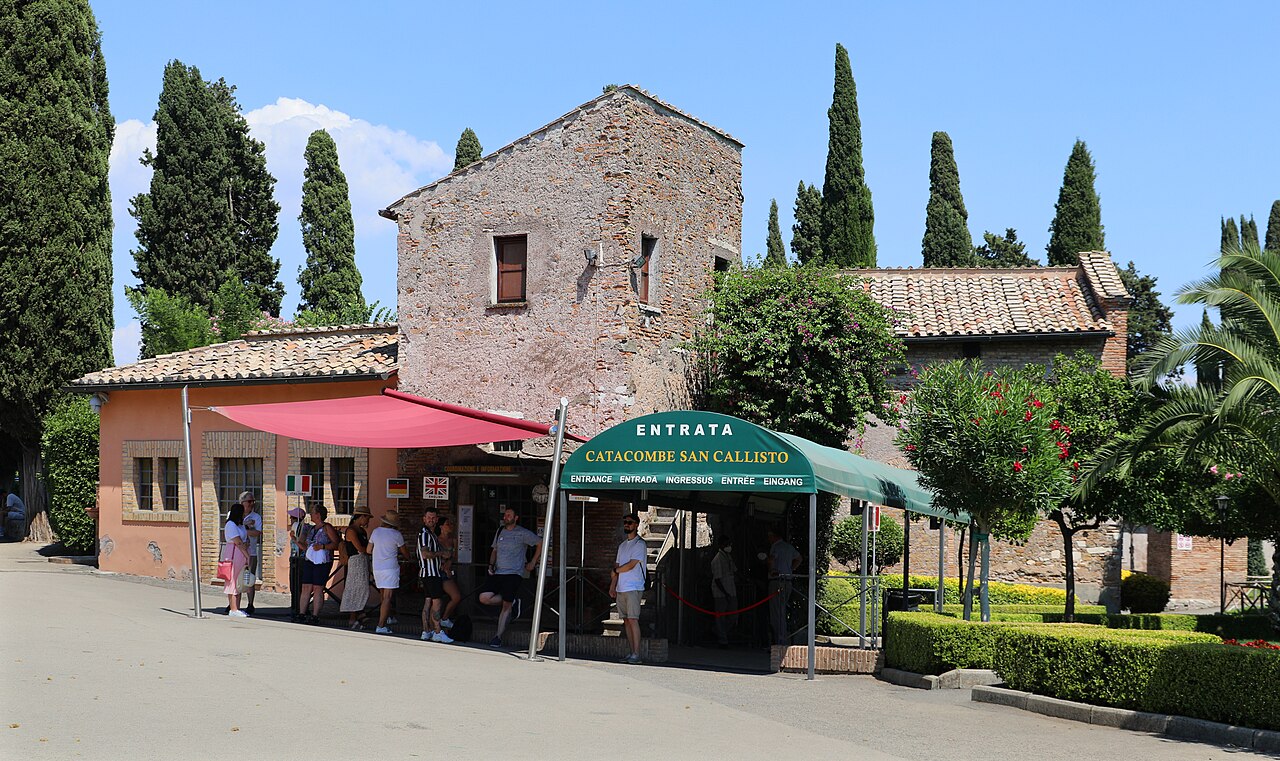
Catacombs of San Callisto
The largest and most historically central of the Roman catacombs: the official cemetery of the Church of Rome from the late second century, the Crypt of the Popes, the early burial place traditionally associated with Saint Cecilia, and some of the earliest Christian frescoes preserved in Rome.
- Location
- Rome, Italy 41.8530° N · 12.5156° E
- Type
- Early Christian catacomb complex; sacred archaeological site of the Holy See Underground Christian cemetery on multiple levels, with cubicula, arcosolia, and decorated chambers cut into the volcanic tuff of the Via Appia
- Sacred character
- Early Christian burial complex associated with Pope Saint Callixtus I, the popes of the third century, and Saint Cecilia
- Time Needed
- 1 hour to half a day
The Cemetery of the Church of Rome
Come here to read Rome from beneath the basilicas. The Catacombs of San Callisto are the official cemetery in which the Church of Rome buried its bishops and faithful from the late second century. The Crypt of the Popes preserves the original burials of most of the third-century popes, several of whom died as martyrs; the Crypt of Saint Cecilia keeps the memory of the saint before her translation to Trastevere; and the Cubicula of the Sacraments show how the earliest Christian generations in Rome already prayed in the language of baptism and the Eucharist.
From a Roman Cemetery to the Official Burial Place of the Church
By the late second century, the Christian community in Rome needed its own burial places outside the walls. The cemetery on the Via Appia grew under Pope Callixtus I and became the official burial place of the popes in the third century. Several bishops of Rome were buried here after martyrdom, and Saint Cecilia was traditionally buried near them before her relics were translated to Trastevere. The galleries were rediscovered in the nineteenth century by Giovanni Battista de Rossi and are now entrusted to the Salesians under the Pontifical Commission for Sacred Archaeology.
The catacombs are cut into volcanic tuff on several levels of narrow galleries, loculi, cubicula, and arcosolia. The Crypt of the Popes, the adjacent Crypt of Saint Cecilia, and the Cubicula of the Sacraments give the visit its order. Above ground, the small basilica and Salesian welcome area prepare the descent.
San Callisto served as the official cemetery of the Church of Rome from the late second century.
The Crypt of the Popes and the Crypt of Saint Cecilia make the visit a descent into early papal and martyr memory.
The Cubicula of the Sacraments preserve some of Rome's earliest Christian frescoes, with baptismal and Eucharistic imagery.
The catacombs are not a museum and they are not a curiosity. They are a Catholic burial place where the popes and martyrs of the early Church of Rome were laid in the ground and where the faithful prayed beside their tombs. The Pontifical Commission for Sacred Archaeology asks visitors to read them in that key. A serious pilgrim visit pays close attention to the popes who governed and suffered for the Church of Rome in the third century, to the witness of Saint Cecilia, and to the way the earliest Christian art in Rome already speaks in the language of the sacraments.
What to notice.
-
The Crypt of the Popes
A small rectangular chamber with the third-century papal inscriptions still set into the walls, recovered in the nineteenth century by Giovanni Battista de Rossi. Pause here long enough to read it as the original burial place of the bishops of Rome of an entire generation.
-
The Crypt of Saint Cecilia
Directly off the Crypt of the Popes, with traces of early fresco decoration and the marble copy of Maderno's statue. This is the early burial place traditionally associated with the saint before the translation of her relics to Santa Cecilia in Trastevere.
-
The Cubicula of the Sacraments
Some of the earliest Christian frescoes preserved in Rome, with baptismal and Eucharistic imagery from the third century. Read them as catechesis painted on the walls of a burial place, not as decoration.
-
The small basilica of the popes Sixtus and Cecilia in the upper area
Pause here before descending. The above-ground building gathers the patronal memory of the catacombs and prepares the pilgrim for the visit below.
-
A short stretch of the Via Appia Antica beyond the entrance
Walk a section of the ancient road after the tour to read the catacombs within the wider burial landscape of the early Church of Rome. The basalt paving and the surviving tombs along the road give the visit its proper setting.
- That this is the official cemetery of the early Church of Rome, not simply a famous catacomb. The Crypt of the Popes preserves the original burials of most of the third-century bishops of Rome, several of whom were martyred under Decius and Valerian.
- That Saint Cecilia is venerated here as the early burial memory of a Roman virgin martyr, and that her relics were translated by Pope Paschal I in the early ninth century to Santa Cecilia in Trastevere. The two churches read together rather than as alternatives.
- That the relics of most of the popes buried here were translated to other Roman churches over the centuries. The catacombs are the original martyrial and pontifical burial memory, not an intact treasury of relics.
- That the earliest Christian frescoes in Rome, in the Cubicula of the Sacraments, already speak in the language of baptism and the Eucharist. The faith of the early Church is visible on the walls of its burial places.
- That the visit is by guided tour only, that photography is generally not permitted underground, and that the catacombs are treated as a sacred place rather than as a museum or attraction.
How much time, and what to do with it.
-
The guided visit underground
4 ordered stopsThe three movements that hold the visit together, in the order the tour follows them.
- The small basilica of the popes Sixtus and Cecilia, in the upper area
- The Crypt of the Popes
- The Crypt of Saint Cecilia
- The Cubicula of the Sacraments
-
Above and below
5 ordered stopsThe guided tour, with time in the upper gardens and a short walk of the ancient road beyond the entrance.
- The small basilica of the popes Sixtus and Cecilia
- The Crypt of the Popes
- The Crypt of Saint Cecilia
- The Cubicula of the Sacraments
- A stretch of the Via Appia Antica beyond the entrance
-
The two churches of Saint Cecilia, read together
3 ordered stopsThe catacomb as her first burial memory, then the basilica in Trastevere where her relics are venerated today.
- The Crypt of Saint Cecilia at San Callisto, her first burial memory
- The Crypt of the Popes and the Cubicula of the Sacraments
- Santa Cecilia in Trastevere, where her relics rest beneath the high altar
Treat the catacombs as a guided pilgrim visit rather than a self-paced museum. Arrive early, walk the upper area before descending, listen carefully in the Crypt of the Popes and the Crypt of Saint Cecilia, and pause in the Cubicula of the Sacraments. After returning to the surface, walk a short stretch of the Via Appia Antica or continue to a related site so the visit reads as part of the wider geography of the early Church of Rome.
How to visit well.
Access to the catacombs is only by guided tour, in several languages, led by the Salesian community. Confirm current opening days, hours, and ticket arrangements on the official site before planning around the visit. The complex is closed on Wednesdays and during part of the winter season; tours typically last about thirty to forty-five minutes underground and the temperature inside is cool year-round. Photography is generally not permitted inside the galleries. The site is reached from central Rome by bus or taxi along the Via Appia, and pairs naturally with a wider walk of the Via Appia Antica archaeological park.
- Booking and Access The catacombs are seen only by guided tour, in several languages, led by the Salesian community. Confirm current opening days, hours, and tickets on the official site first. The complex is closed on Wednesdays and during part of the winter.
- Arrive Early Reach the upper area at least fifteen minutes before the tour and walk to the small basilica of the popes Sixtus and Cecilia before descending. The building above ground gathers the memory of the catacombs and prepares the visit below.
- Underground Tours last about thirty to forty-five minutes and the galleries are cool year-round. Photography is generally not permitted. Listen carefully in the Crypt of the Popes and the Crypt of Saint Cecilia, where most of the visit is spent.
- Do Not Stop at the Gate Reached from central Rome by bus or taxi along the Via Appia, the catacombs pair naturally with a short walk of the Via Appia Antica rather than an isolated stop.
The burial memory of the early Church of Rome.
Tomb and Burial
- The Crypt of the Popes holds the original burials of most of the third-century bishops of Rome, including Pope Saint Pontian, Pope Saint Anteros, Pope Saint Fabian, Pope Saint Lucius I, Pope Saint Stephen I, Pope Saint Sixtus II, Pope Saint Dionysius, Pope Saint Felix I, and Pope Saint Eutychian. Several of the popes buried here were martyred, and their relics were later translated to other Roman churches.
- The Crypt of Saint Cecilia preserves the early burial place traditionally associated with the Roman virgin martyr, whose relics were translated by Pope Paschal I to Santa Cecilia in Trastevere in the early ninth century.
- Pope Saint Callixtus I, who gives the catacombs their name, served as deacon of Pope Zephyrinus and superintendent of this cemetery before his own pontificate from 217 to 222. He was buried elsewhere in Rome, traditionally on the Via Aurelia.
- Many early Christian martyrs and faithful of the Church of Rome are buried in the wider complex, which extends across several galleries and levels.
Relics and Sacred Tradition
- Pilgrims venerate the catacombs as the first official cemetery of the Church of Rome and as the original burial place of a long line of third-century popes, several of whom died as martyrs.
- The Crypt of Saint Cecilia is venerated as the early burial place of the saint, with the statue by Stefano Maderno that copies the figure carved for the basilica in Trastevere.
- The relics of most of the popes buried here were translated to other Roman churches over the centuries, so the catacombs are best read as the original martyrial and pontifical burial memory of the early Church rather than as an intact treasury of relics.
Sacred Objects
- The Crypt of the Popes, recovered in the nineteenth century by the archaeologist Giovanni Battista de Rossi, with the original Greek inscriptions of the third-century popes still set into the walls.
- The Crypt of Saint Cecilia, adjacent to the Crypt of the Popes, with traces of early fresco decoration and the marble copy of Maderno's statue of the saint.
- The Cubicula of the Sacraments, a series of small chambers whose third-century frescoes are among the earliest visual witnesses to Christian belief in baptism and the Eucharist.
- The galleries and arcosolia of the wider complex, with early Christian symbols of the fish, the anchor, the Good Shepherd, and the orant figure.
- The upper area on the Via Appia, with the small basilica of the popes Sixtus and Cecilia, the Salesian welcome buildings, and the gardens that prepare pilgrims for the underground visit.
Follow Cecilia's Roman story
This catacomb preserves Cecilia's first burial. Continue into Trastevere to the basilica where her relics are now venerated.
-
Follow the translation
Santa Cecilia in Trastevere
Continue into Trastevere to the basilica where Cecilia's relics were carried in the ninth century and are venerated beneath the altar.
-
Follow the thread
Rome of the Early Martyrs
Agnes and Cecilia make the early Church visible across tombs, house-church memory, and the catacomb roads beyond the center.
Connections are curated from Eternal Roam's saint, place, relic, route, and Rome records. Traditional attributions are identified in context.
Plan your visit.
Access to the Catacombs of San Callisto is by guided tour only, led by the Salesian community under the Pontifical Commission for Sacred Archaeology. The site is generally closed on Wednesdays and during part of the winter season; confirm current opening days, hours, and language schedule on the official site before planning around the visit. The relics of most of the popes buried in the Crypt of the Popes were translated to other Roman churches over the centuries, and the relics of Saint Cecilia were translated by Pope Paschal I to Santa Cecilia in Trastevere in the early ninth century. The catacombs are best read as the original martyrial and pontifical burial memory of the early Church of Rome rather than as an intact treasury of relics, and as a place of Catholic memory rather than as a museum or attraction.
June 23, 2026