The Atlas Destinations Pilgrim Roads Via Francigena

Revived waymarked route
Medieval road Revived & waymarked Long-distance

Via Francigena

The historic pilgrim road from Canterbury to Rome.

Open My Journey
Classic arc
Canterbury to Rome England, France, Switzerland, Italy
Destination
Rome St. Peter's Basilica and the apostolic tombs
Historical anchor
Sigeric's itinerary Recorded after a journey in 990
Typical duration
Many weeks end to end Often walked in sections
Route reality
Historic corridor, modern waymarking Not a turn-by-turn medieval reconstruction
<
Warning: Undefined variable $lightbox_attrs in /home/eternalr/public_html/wp-content/themes/bricks-child-two/templates/route-detail-v1.php on line 117
span class="er-rd-media__lightbox
Warning: Undefined variable $lightbox_attrs in /home/eternalr/public_html/wp-content/themes/bricks-child-two/templates/route-detail-v1.php on line 117
"
Warning: Undefined variable $lightbox_attrs in /home/eternalr/public_html/wp-content/themes/bricks-child-two/templates/route-detail-v1.php on line 117
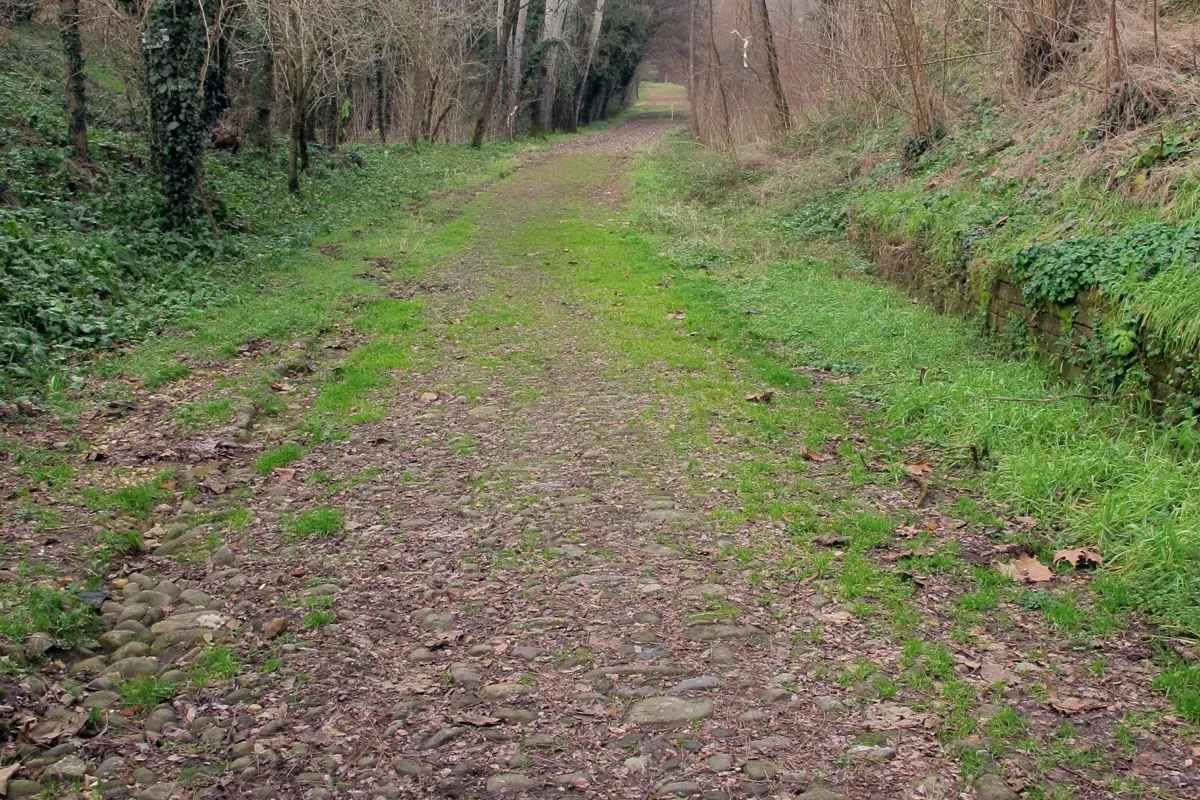
> The ancient stone paving of the Via Francigena through woodland at Galleno in Tuscany. Warning: Undefined variable $lightbox_attrs in /home/eternalr/public_html/wp-content/themes/bricks-child-two/templates/route-detail-v1.php on line 119
span>

Route facts · At a glance

The route at a glance.

The Via Francigena is best read as a historic corridor to Rome, walked today through a maintained, waymarked modern route.

Route type Historic pilgrim road Revived and waymarked for modern pilgrims
Classic start Canterbury Cathedral Southern England
Destination Rome St. Peter's Basilica and the apostolic city
Countries / regions England, France, Switzerland, Italy Kent, northern and eastern France, Vaud, Valais, Aosta, Tuscany, Lazio
Mountain crossing Great St. Bernard Pass Season and snow matter
Typical duration Many weeks end to end Often walked in stages
Difficulty Moderate to demanding Long distance, passes, heat, road sections
Waymarking Established but uneven by country Check official local updates
Lodging Mixed pilgrim infrastructure Stronger in parts of Italy; plan ahead elsewhere
Main season Spring to autumn Alpine crossing requires care

01 · Route overview

A long road to Rome.

Route overview, not a navigation map. Selected major waypoints only.

Select an approach or stop to trace it.

The road

Canterbury to Rome from Canterbury

Sacred stops on the way

  1. Canterbury
  2. Arras
  3. Reims
  4. Lausanne
  5. Great St. Bernard Pass
  6. Aosta
  7. Pavia
  8. Lucca
  9. Siena
  10. Viterbo
  11. Rome Destination

Regions crossed: Kent and the Channel · Northern France · Champagne and Burgundy · Swiss lake and Alpine pass · Aosta and the Po Valley · Tuscany and Lazio

02 · The walk in practice · Time, terrain, and difficulty

A long continental pilgrimage, usually walked in sections.

The full route asks for serious time, planning, and seasonal judgment. Many pilgrims choose a country section or the final Italian approach to Rome.

Overall difficulty Moderate to demanding Length and Alpine weather are the main factors
Daily range Often around 20 to 25 km Varies by stage, terrain, and lodging
Walked in sections Yes, commonly The route naturally lends itself to stages
Arrival focus Rome St. Peter's and the apostolic basilicas

Difficulty by route

Canterbury to Great St. Bernard Moderate to demanding
Long northern approach

A cross-country passage through England, France, and Switzerland before the Alps.

Great St. Bernard to Rome Moderate
The better-known Italian spine

Aosta, the Po Valley, Tuscany, and Lazio, with strong historic and practical route identity.

Tuscan and Lazio stages Easy to moderate
Often chosen in shorter blocks

Hill towns, abbeys, vineyards, and the long emotional pull toward Rome.

Terrain

Country lanes, towns, river valleys, vineyard and hill country, road sections, and the Alpine crossing at Great St. Bernard.

Elevation

The Great St. Bernard Pass is the decisive high crossing. Tuscany and Lazio add repeated hills rather than one single obstacle.

Waymarking

The route is waymarked, but support and signage vary by country and region. Official route notes should be checked before walking.

This page shows a representative historic corridor. It is not a navigation map and does not replace official stage notes.

Begin this route

Begin with the road to Rome in view.

Most pilgrims should decide first whether they are walking a final approach to Rome or a longer historic corridor.

Best first section

Tuscany and Lazio toward Rome, especially Siena, Viterbo, and the final approach.

Best one-week version

A focused Tuscan or Lazio section with Rome as the spiritual horizon.

Best final approach

Viterbo or another Lazio start toward Rome, depending on time and current stages.

Best for limited time

Walk an Italian section rather than trying to sample several countries at once.

When to plan carefully

Plan carefully around the Great St. Bernard Pass, summer heat, road sections, and lodging gaps outside stronger pilgrim corridors.

Verify before walking

Verify stages, accommodation, pass conditions, and local route changes with official Via Francigena sources.

Check official route source

Final approach

Tuscany and Lazio to Rome

The most natural first Eternal Roam section because the destination remains Rome and the apostolic tombs.

Distance
Varies by chosen start
Typical
Several days to two weeks+
Difficulty
Moderate
Sacred focus
Rome, St. Peter, and the apostolic city

Use official Italian stage notes before walking.

Longer pilgrimage

Great St. Bernard to Rome

A longer Italian spine after the Alpine threshold, still requiring real stage and lodging planning.

Distance
Long multi-week section
Typical
Several weeks
Difficulty
Moderate to demanding
Sacred focus
Alpine crossing and Rome

Verify season and pass conditions.

Historically curious traveler

Canterbury to the Channel

A short English opening that frames the road historically before the continental route begins.

Distance
Short opening section
Typical
A few days
Difficulty
Easy to moderate
Sacred focus
Canterbury and the road to Rome

Check current UK walking resources and ferry logistics.

03 · Historical context

A medieval road to the tombs of the apostles, remembered through Sigeric and walked again today.

The Via Francigena carries the old north-south pull of Europe toward Rome. Its best-known documentary anchor is the itinerary of Sigeric, Archbishop of Canterbury, who recorded the stages of his return journey from Rome in 990 after receiving the pallium.

The road was never only one fixed strip of earth. Medieval pilgrims, clergy, merchants, and messengers moved through corridors shaped by weather, politics, bridges, abbeys, and passes. The modern route follows that memory with a marked path for present-day pilgrims.

Its destination gives the road its Catholic gravity. Rome is not simply the end of a trek. It is the city of Peter and Paul, the apostolic tombs, the basilicas, and the long continuity of pilgrimage to the Holy See.

04 · Why this route matters

Why Via Francigena matters.

A road to Rome, where the pilgrim arrives not at a landscape but at the apostolic memory of the Church.

01

A Catholic road to Rome

The Via Francigena is ordered toward the Holy See and the tomb of St. Peter. Its end makes the long road intelligible.

02

The Alps as threshold

The Great St. Bernard Pass gives the route one of its great physical transitions: a hard crossing before the descent into Italy.

03

Abbeys, towns, and hospitality

The route is remembered through churches, hospice traditions, towns, and the practical mercy that made long pilgrimage possible.

04

A revived inheritance

Walking it today means receiving a recovered road honestly: medieval in memory, modern in signage, still capable of discipline and prayer.

05 · The ways within the route · Several established routes

Walked in major sections.

The classic arc runs from Canterbury to Rome. Most pilgrims today choose a section rather than treating the entire route as one continuous journey.

Canterbury to the Channel

Canterbury, Kent

Guide available

The English beginning keeps the route tied to Sigeric and to the old ecclesial road from Canterbury toward Rome.

Distance Short opening section
Typical Usually a few days
Difficulty Easy to moderate
Terrain Roads, lanes, villages

France and Switzerland

Calais region toward Lausanne and Valais

Guide available

A long northern passage through historic towns and river country before the mountains begin to gather.

Distance Many stages
Typical Several weeks
Difficulty Moderate
Terrain Towns, fields, roads, lakeside approach

Great St. Bernard to Rome

Alpine pass into Italy

Guide available

The route descends through Aosta, the Po Valley, Tuscany, and Lazio before the final approach to Rome.

Distance Long Italian spine
Typical Several weeks
Difficulty Moderate to demanding
Terrain Alpine pass, valleys, hills, city approaches

Southern extensions toward Apulia and the older roads onward to the Holy Land belong to a later guide, not this Canterbury-to-Rome page.

06 · Sacred stops along the way · Churches, shrines, and holy places

Selected sacred stops.

Selected major waypoints. The route includes many more churches, abbeys, and towns than are named here.

Cathedral

Canterbury Cathedral

Canterbury, England

The classic northern beginning, tied to Sigeric and to England's road toward Rome.

Historic start

Cathedral city

Reims

Champagne, France

A great French cathedral city on the wider northern corridor toward the Alps.

Cathedral city

Alpine hospice tradition

Great St. Bernard Hospice

Switzerland and Italy border

The pass gives the road one of its strongest pilgrim thresholds: height, weather, shelter, and descent.

Mountain crossing

Historic city

Pavia

Lombardy, Italy

A Lombard and medieval city on the Italian descent toward the Tuscan roads.

Po Valley passage

Cathedral city

Lucca

Tuscany, Italy

A major Tuscan stop, long associated with pilgrimage and the Holy Face devotion.

Tuscan sacred stop

Cathedral city

Siena

Tuscany, Italy

The road enters one of Tuscany's great sacred cities before turning south through hill country toward Lazio.

Cathedral city

Papal city

Viterbo

Lazio, Italy

A final historic city before Rome, with medieval papal memory and the last long approach to the apostolic city.

Approach to Rome
Destination shrine

Papal basilica · destination shrine

St. Peter's Basilica

Vatican City

The road comes to its Catholic focus at the basilica raised over the tomb traditionally venerated as that of St. Peter.

Apostolic tomb Open guide

07 · Associated saints · Saints connected to the route

Saints connected to the route.

Saints connected to the road by destination, beginning, and memory.

St. Peter the Apostle

Apostle · destination saint · Feast 29 June

The route is ordered toward Rome and the basilica raised over the tomb traditionally venerated as Peter's.

Destination saint Open saint

St. Paul the Apostle

Apostle of Rome · Feast 29 June

Paul shares Rome's apostolic memory with Peter; a fuller Roman pilgrimage naturally continues to his basilica outside the walls.

Apostolic Rome Open saint

St. Thomas Becket

Canterbury martyr · Feast 29 December

Canterbury gives the route its English threshold, though the Via Francigena is oriented toward Rome rather than Becket's shrine.

Beginning context

The saints named here are anchors rather than an exhaustive saint list. Many local churches on the route carry their own devotional geographies.

08 · How to walk it · Practical notes

How to walk it.

Choose a section honestly

Most pilgrims should begin with a country section or the Italian route into Rome rather than assuming the full road belongs in one attempt.

Check official stages

Use current route-body notes for waymarking, lodging, closures, and route changes.

Respect the pass

The Great St. Bernard crossing is seasonal. Snow, weather, and accommodation matter.

Plan lodging early

Infrastructure varies more than on the major Camino routes, especially outside the denser Italian pilgrim network.

Arrive in Rome slowly

Give the final approach time. The road should end in prayer, not only a photo in St. Peter's Square.

Official Via Francigena route bodies and local route authorities publish current stage and accommodation guidance.

Route reality

A historic corridor with modern route support.

Eternal Roam provides sacred context and planning orientation, not turn-by-turn trail navigation.

Historic basis

Historically anchored by Sigeric's tenth-century itinerary and the medieval road to Rome.

Modern waymarking

Revived and waymarked, with support that varies by country and region.

Infrastructure

Moderate overall. Italian sections are often stronger, while some stretches require more planning.

What ER provides

Major waypoints, selected sacred stops, and the pilgrimage direction toward Rome.

Before walking

Before walking, verify stages, lodging, closures, mountain conditions, and official guidance with route authorities.

Check official route source Last reviewed: 2026-07-05

09 · Approaching the route · Prayer and intention

Approaching the route.

A road to Rome asks for a different interior rhythm than a road to a single remote shrine.

Walk toward the apostles

Let Peter and Paul give the road its direction. The city at the end is not generic Rome; it is apostolic Rome.

Receive hospitality simply

The old road depended on shelter, monasteries, towns, and mercy. Accept the practical dependence of pilgrimage.

Mark the thresholds

The Channel, the Alps, the descent into Italy, and the last approach to Rome are spiritual thresholds as much as geographical ones.

Pray before planning more

A long route tempts the pilgrim to manage everything. Keep a daily pattern of prayer small enough to survive fatigue.

10 · Sources and route notes · History, revival, and practical details

Historical and practical notes.

Historic pilgrim road Revived waymarked route Official source available

Historically documented

The route is historically anchored by Sigeric's tenth-century itinerary and by the broader medieval pilgrimage road to Rome.

Revived and modern

The present walking route is a modern recovery and waymarked cultural route. Some sections follow historic corridors rather than a single immutable medieval track.

Details still being verified

Stage distances, lodging, closures, and mountain conditions should be checked against official local route sources before walking.

Official route source European Association of the Via Francigena
Recognition Cultural Route of the Council of Europe
Editorial notes Waypoints selected from the classic Canterbury-to-Rome corridor

My Journey

Save this route and its sacred stops.

Save Via Francigena to My Journey, then gather the churches, shrines, saints, and sacred stops connected to it. My Journey keeps those places together while you plan.

Open My Journey

Image credits