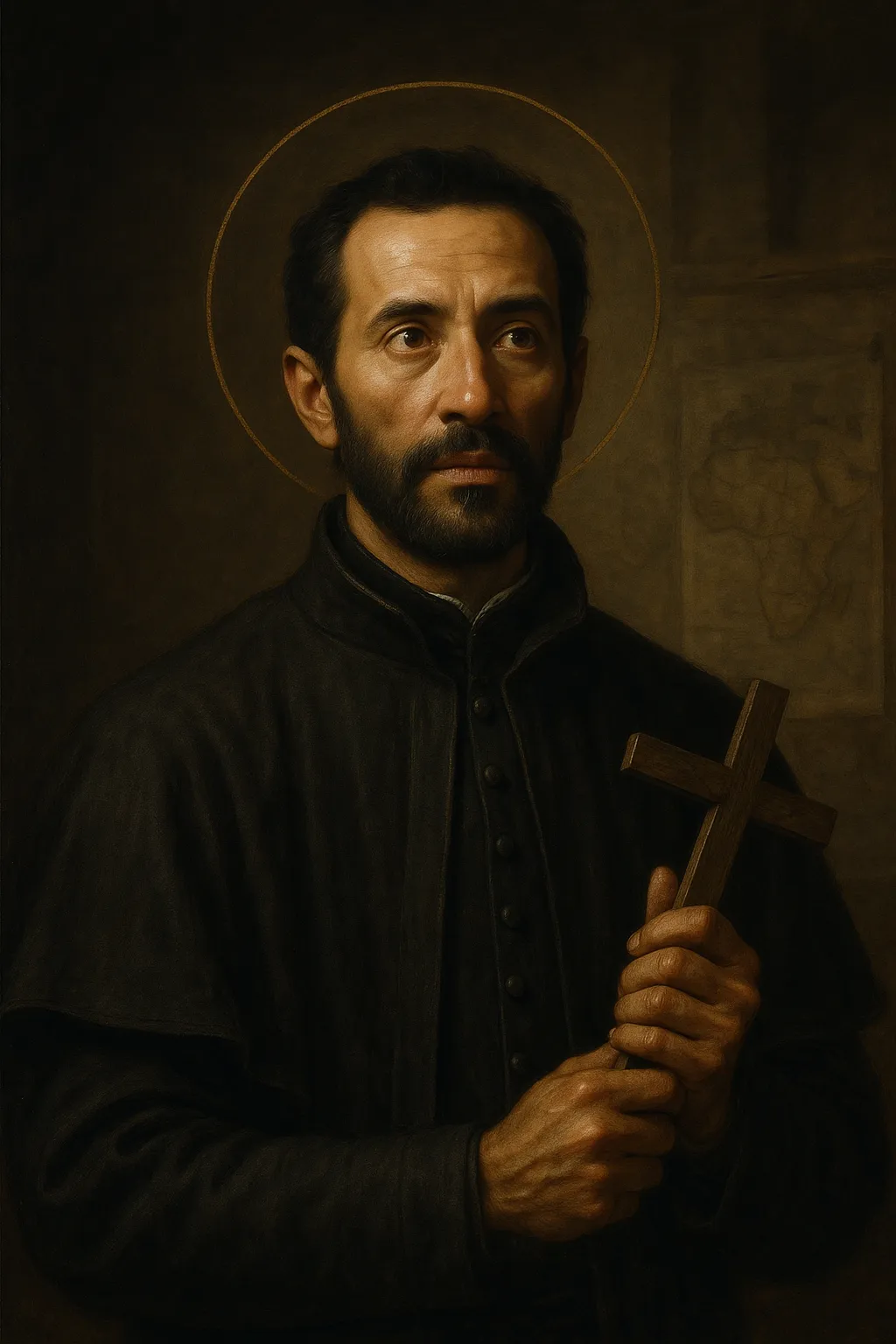
The body of Saint Francis Xavier
Saint's body
Archdiocese of Goa and Daman
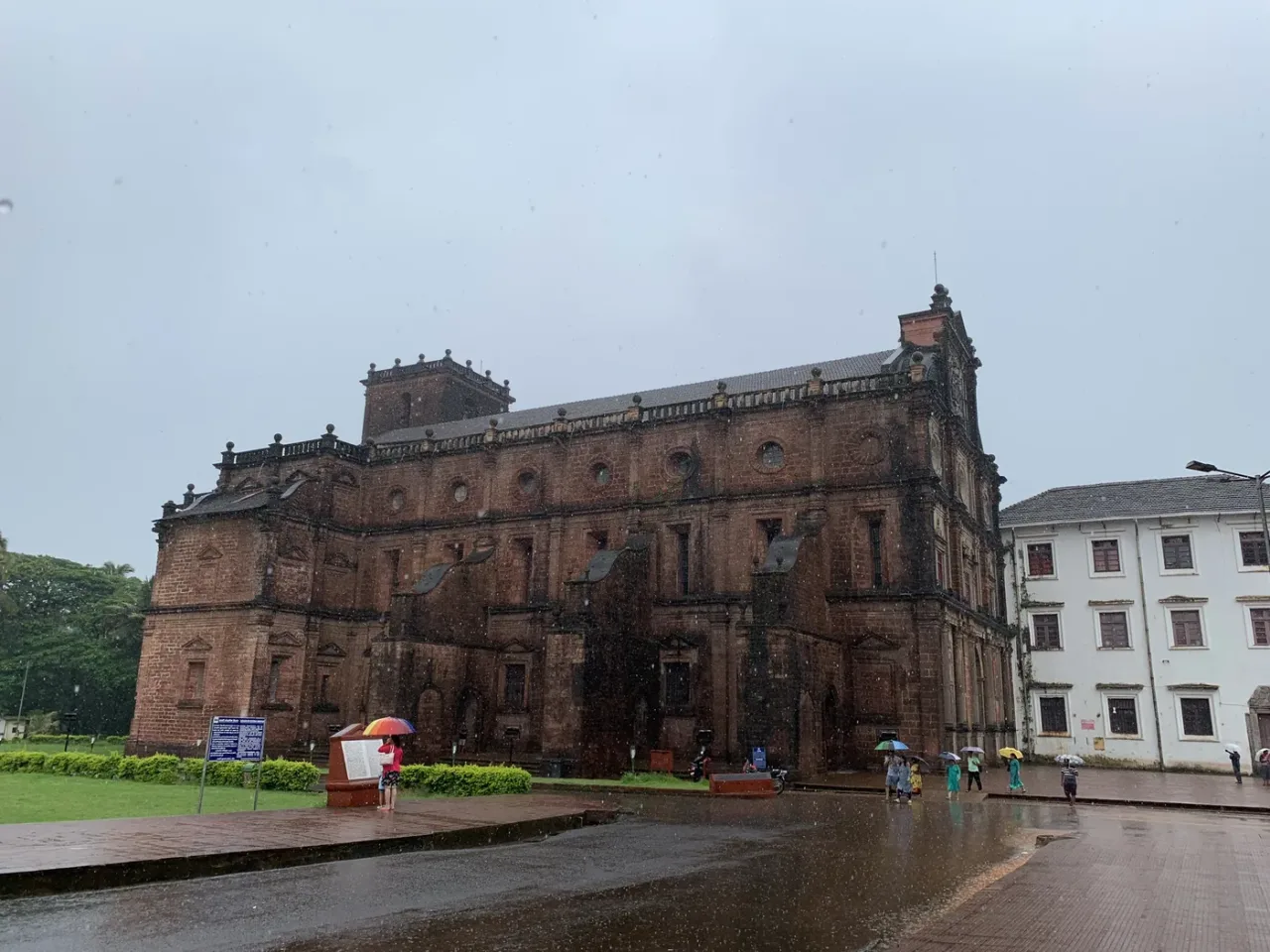
The church at Old Goa where the body of Francis Xavier lies in a silver casket, raised on a marble mausoleum in the chapel off the south transept. He died on Shangchuan Island in 1552 and never came back to Goa alive; his body was carried here and has stayed for four centuries.
Francis Xavier spent ten years leaving. He sailed from Lisbon in 1541, reached Goa in 1542, and from then on kept moving east: the fishery coast, Malacca, the Moluccas, Japan in 1549, and finally a small island off the Chinese coast where he waited for permission to enter the mainland and did not get it. He died there in December 1552, still short of where he was going. Everything he began in Asia has a place attached to it somewhere else. This is the one place that holds him. His body was brought back along the route he had traveled outward, and it is here, in the city he had used as a base, that the movement stops.
Xavier died on Shangchuan Island on December 3, 1552, and was buried there. In 1553 his body was taken up and carried to Malacca, where it lay for some months in the hilltop church of St. Paul. In 1554 it was brought on to Goa and received at the College of St. Paul, the Jesuit college in the city. It stayed at the college for seventy years. The Basilica of Bom Jesus was not yet standing when the body arrived; the church was begun in 1594 and consecrated in May 1605. Gregory XV canonized Xavier in 1622, and on February 19, 1624 the relics were carried in procession to the new Jesuit church, where they have remained. Two objects were added later and are often collapsed into one. The silver casket that contains the body was completed in 1637, made by Goan silversmiths at the initiative of the Jesuit Marcello Mastrilli, with panels showing scenes from Xavier's life. The marble and jasper mausoleum that carries the casket came from Florence: Cosimo III de' Medici, Grand Duke of Tuscany, gave it, Giovanni Battista Foggini carved it, and it was put in place in 1698, sixty-one years after the casket and seventy-four after the body arrived in the church.
The plan is a simple cross: one long nave, a transept, a main altar, two chapels, a sacristy, and a choir loft. The interior is about eighty feet long, and the scale registers as smaller than the reputation suggests. The main altar is dominated by a figure of the Infant Jesus beneath the symbol of the Trinity, with Saint Ignatius Loyola above; that dedication is where the name Bom Jesus comes from, and it is worth noticing that the church is not named for the saint buried in it. The facade is the part most often misread. It is carved Bassein basalt set against laterite, and the laterite was originally covered in lime plaster and whitewashed. A Portuguese restorer, Baltazar Castro, stripped the plaster in the 1950s to expose the bare stone. Conservators have argued since that the decision was ideological rather than architectural and that it left a porous stone exposed to monsoon rain. What a visitor sees today is a restoration choice from within living memory, not a sixteenth-century intention.
Four things explain most of what you are looking at.
It is dedicated to the Infant Jesus. Xavier was buried in it seventy years after his body reached Goa, and nineteen years after the church was finished. The tomb is in a chapel off the transept, not on the main axis.
The laterite was plastered and whitewashed for three and a half centuries. The plaster was removed in the 1950s. Conservators consider the exposure a cause of ongoing weathering.
Body into the church in 1624, silver casket in 1637, Florentine mausoleum under it in 1698. Nothing about the arrangement is original to the burial.
Old Goa was the capital of Portuguese India. The churches stand in what is otherwise open ground, which is why the site reads as a group of monuments rather than a parish quarter.
Four things about this church are true at once. It is a working Catholic church with Mass and a Jesuit rector. It is the tomb of the patron of Goa, called Goencho Saib in Konkani, and the devotion attached to him here is local and continuous rather than something staged for visitors. It is a protected monument whose fabric is the responsibility of a government agency rather than the Church. And it sits in a city that no longer exists as a city: Old Goa was the capital of Portuguese India, held around two hundred thousand people in the sixteenth century, and was progressively abandoned after cholera and malaria epidemics. The churches are what remain of it. The register of a visit shifts depending on which of the four you have come for, and the site does not resolve the tension for you.
Not at eye level, and not meant to be. Stand back in the chapel and look up. This is what a pilgrim sees on an ordinary day.
Foggini's scenes from Xavier's missions, carved in Florence by a sculptor who had never been to Asia.
The church's actual dedication, beneath the symbol of the Trinity, with Saint Ignatius above. Xavier's companion and superior stands over the altar; Xavier lies off to the side.
Reached by the corridor beside Xavier's chapel, through a carved wooden door into a vaulted room ending in an apse.
Carved dark basalt shipped from Bassein set against local laterite. Once you see the two materials you can read the whole front.
The length of the nave, the main altar, and the chapel where Xavier lies.
The basilica given enough time to read the tomb as an assembly of three centuries, with Mass if the timing allows.
Go into the nave first and walk its length before turning. The chapel that holds Xavier is off the south side of the transept, on your right as you face the main altar, and approaching it from the far end of the church gives the movement of the building rather than a detour to a tomb. In the chapel, look up. The casket sits at the top of the mausoleum, above eye level, and it is meant to be seen from the floor. A corridor beside the chapel leads to the sacristy. Give the church less time than you expect to need and Old Goa more; the basilica is small, and the churches around it are what make the place legible. If you want the visit to be a pilgrimage rather than a stop, come for Mass rather than between Masses.
Hours, photography rules, and conservation work change, and the basilica is a working church as well as a monument.
Source note Traditional attributions are presented as tradition, with documentation named where it exists.
One saint carries this church, and the reason to come is that his body is here.
The chronology given here separates four dates that secondary sources routinely merge: the body's arrival in Goa in 1554, its transfer into this church on February 19, 1624 after the 1622 canonization, the silver casket of 1637, and Foggini's mausoleum of 1698. Eternal Roam previously stated that the body had rested in the basilica since 1554; that has been corrected, since the church was not consecrated until 1605. Exposition history follows the published chronology of the eighteen expositions, which shows a regular ten-year interval only from 1974; the gap between the second exposition in 1782 and the third in 1859 was far longer. No future exposition is stated here, because none has been announced. The condition of the body is described as the archdiocese now describes it rather than in the language of older devotional accounts. Se Cathedral, across the square, has no Eternal Roam page yet and is named in prose rather than linked.
August 18, 2026
Use this for corrections, broken links, missing places, and planning ideas.