
If you have only one day
Do not compress both days; choose. Take the basilica at opening, San Rufino, and Santa Chiara, then either San Damiano on foot or the Porziuncola by bus, not both. The Assisi city page carries a full one day plan.
Pilgrimage Guide · Assisi
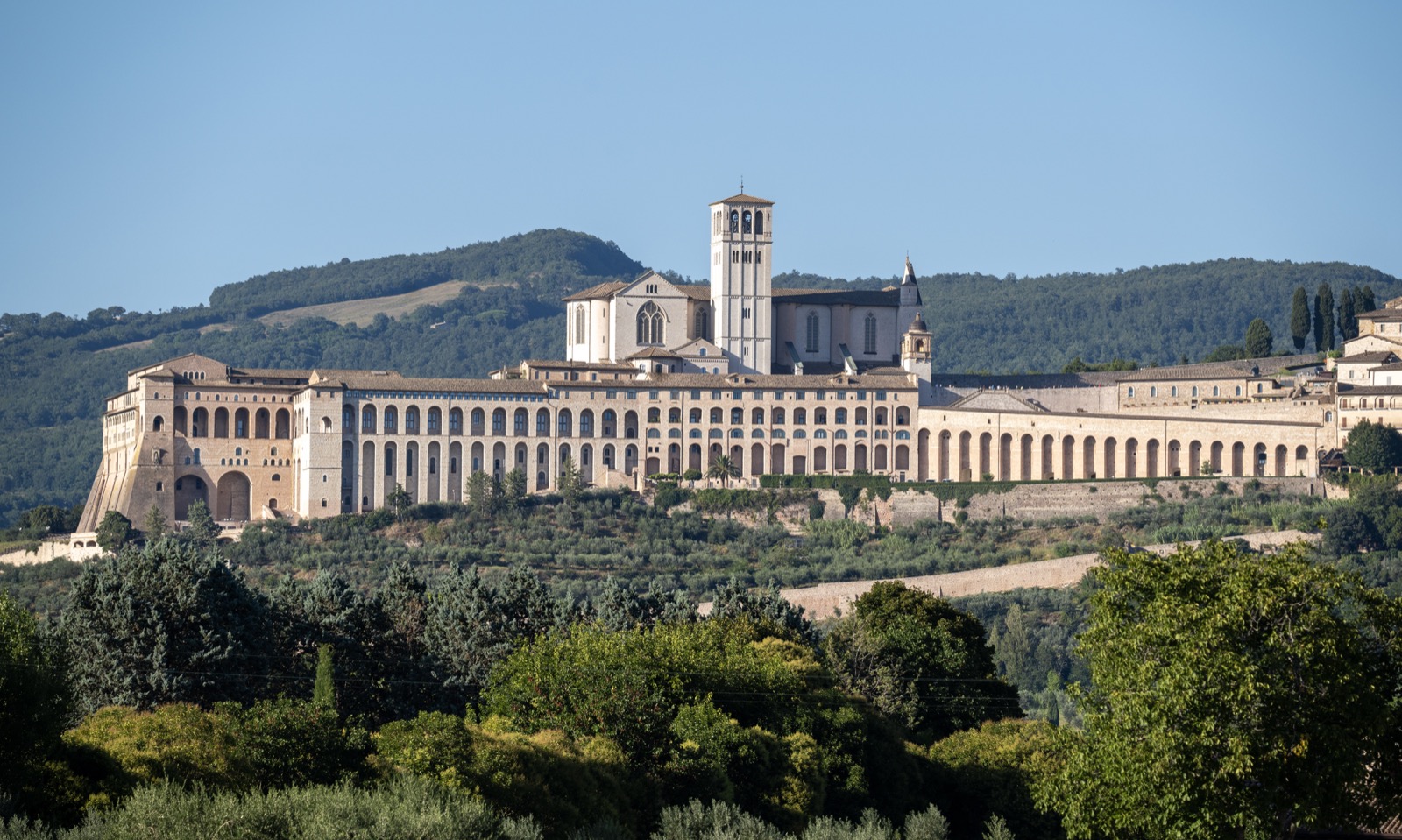
Assisi is a landscape before it is a monument. These two days follow its shape: the town and its two tombs first, then the valley and the mountain where the Franciscan life was actually lived.
Stifone / Wikimedia Commons (CC BY-SA 4.0)
The argument
Assisi rewards a plan that respects its terrain. The town sits on a spur of Monte Subasio; everything that matters lies either along its spine, down its southern slope, in the valley below, or up the mountain behind it. Trying to see all of it in one sweep flattens places that were never meant to be equal.
So the first day stays inside the walls. It belongs to the two tombs, Francis at the western end and Clare at the southern edge, and to the cathedral font where both of them were baptized. The day ends by walking out of the town entirely, down through the olive terraces to San Damiano, where the story that the churches commemorate actually began.
The second day goes where Francis went: down to the Porziuncola on the valley floor, the small chapel where the brotherhood formed and where he died, and then up the mountain to the Eremo delle Carceri, the hermitage in the oak woods where he prayed. The valley explains the movement's beginnings; the mountain explains its silence. Neither can be understood from the piazza.
Day 1
Inside the walls, Assisi keeps its endings: the tomb of Francis under the great basilica, the tomb of Clare beside the crucifix that started everything. This day walks between them slowly, and finishes where their story began, below the town at San Damiano.
First thing, when the doors open
Plan on about 1½ hours to 2 h 10 min
Begin at the end. The Basilica of Saint Francis holds his tomb in the rock of the lower crypt, and the first hour of the morning is the quietest this church gets. The building itself is the great Franciscan contradiction, a vast frescoed monument raised over a man who owned nothing; it reads best as the terminus of his life rather than its introduction, which is exactly how this itinerary uses it.
Give your time to the tomb in the crypt first, while it is still quiet, then the lower church; leave the upper church and its fresco cycle for the way out.
Silence is asked for and enforced inside. Mass times and open hours are on the basilica's site, linked from the place page.
If the day runs short: The crypt and lower church are the pilgrimage. The upper church can be returned to at evening, when the nave is often open late.
Walk up Via San Francesco into the town, about fifteen minutes, gently uphill the whole way.
Pause · Late morning
The town's Roman forum, still its living room. The temple front of Minerva, now a church, has watched this square for two thousand years. Coffee here is part of the itinerary, not a break from it.
Climb the stepped lanes from the piazza toward the cathedral, five steep minutes.
Midday
Plan on about 30 minutes to 45 minutes
The cathedral keeps the font where both Francis and Clare were baptized, a generation apart. Everything the morning showed you ended; this stone is where it started. The Romanesque facade above the piazza is among the finest in Umbria, and the church behind it is plainer than you expect, which is its own lesson.
Give your time to the baptismal font, right of the entrance, and the quiet of the crypt below.
Optional · A short detour
Plan on about 35 minutes to 45 minutes
The church where, the tradition records, Francis stripped himself of his clothes and his inheritance before the bishop. It now also holds the tomb of Saint Carlo Acutis, and the two devotions, eight centuries apart, share one room. A brief visit, and a moving one for many pilgrims.
Between San Rufino and Santa Chiara, a few minutes off the direct lane.
Optional · A short detour
Plan on about 30 minutes to 40 minutes
Built, by long-standing tradition, over the house of Francis's family. The cell where his father is said to have locked him is small enough to make the whole story suddenly domestic. Worth twenty minutes if the afternoon is unhurried.
Walk back along the town's southern terrace, ten minutes, the valley opening on your left.
Mid afternoon
Plan on about 40 minutes to 1 hour
Clare's basilica holds her tomb in the crypt and, in a side chapel, the San Damiano crucifix itself, the painted cross before which Francis prayed. Clare's answer to Francis was enclosure rather than the road, and her church, pink and white above the valley, keeps that stillness. The relics of her clothing and hair are kept near the tomb.
Give your time to the crucifix chapel first, then the crypt; the two together frame the walk that follows.
Leave by Porta Nuova and follow the lane down through the olives, fifteen minutes descending; the climb back is steeper than the way down.
Late afternoon
Plan on about 45 minutes to 1 h 5 min
The road down to San Damiano leaves the town quickly, through olive terraces, and the noise falls away behind you. This small, low complex is where the crucifix spoke to Francis, where he brought Clare and her sisters, and where she lived, wrote, and died. Arriving on foot, tired, at the end of the day, is the right way to arrive; the place is the argument of the whole itinerary in miniature.
Give your time to the little church itself, then the dormitory upstairs where Clare died.
If the day runs short: If the descent is too much at day's end, San Damiano can open Day 2 instead, before the valley.
Climb back to the town for the evening. Toward sunset the rose stone of the facades changes color, the day visitors are gone, and the lanes between the two basilicas belong to the people who stayed.
Day 2
Francis's Assisi was mostly not in Assisi. The order was founded on the valley floor at the Porziuncola, and its prayer was formed in the woods of Monte Subasio. This day descends before it climbs, and it ends in silence.
Take the bus or a taxi down from the town to Santa Maria degli Angeli, about fifteen minutes; the walk down takes closer to an hour.
Morning
Plan on about 50 minutes to 1 h 15 min
On the plain below the town, a great domed basilica encloses a stone chapel the size of a room. The Porziuncola is where Francis gathered the first brothers, where the order was given its charge, and where he died, in the Transito chapel a few steps away. The dissonance between the tiny church and its enormous shell is not a flaw; it is the clearest statement in Assisi of what happened here and how the Church received it.
Give your time to the Porziuncola itself, then the Transito chapel where Francis died; the rose garden and its tradition can follow.
Optional · A flat half hour by the fields
Plan on about 45 minutes to 1 hour
A short ride along the plain, the sanctuary at Rivotorto preserves, by long-standing tradition, the site of the first rough shelter of the brotherhood, a hovel kept now inside a nineteenth century church. It is plain, agricultural, and usually nearly empty, which is precisely its value.
Easiest by taxi or one stop on the local bus; confirm return times before you commit the hour.
Return toward the town, then up: by taxi from the valley, or on foot from Porta Cappuccini for the strong-legged.
Afternoon
Plan on about 1½ hours to 2 hours
The hermitage hangs in the oak woods high on Monte Subasio, above the town. The road up climbs hard for four kilometers; the air cools, the valley noise disappears, and what remains at the top is a small stone cleft where Francis and the brothers went to pray alone. Nothing in Assisi asks more effort to reach, and nothing repays it more exactly. Go up in the afternoon, when the morning groups have come down, and let it be slow.
Give your time to the grotto of Francis and the woods themselves; the point of the place is unbuilt.
On foot from Porta Cappuccini it is a steady uphill hour and a half. Carry water; there is little shade on the road's open stretches.
If the day runs short: If the climb is beyond the day, a taxi can take you most of the way up, or give the afternoon to the upper church frescoes and the Rocca instead; the mountain will still be here on another pilgrimage.
Come down with the light. From the road below the hermitage the whole plain of Umbria opens westward, and the town you began in yesterday looks, from above, exactly as small as Francis insisted it was.
Geography
Numbered markers follow the day's order. Optional stops appear hollow.
When plans bend
Do not compress both days; choose. Take the basilica at opening, San Rufino, and Santa Chiara, then either San Damiano on foot or the Porziuncola by bus, not both. The Assisi city page carries a full one day plan.
The two basilicas and the cathedral absorb a wet day well. The lane down to San Damiano and the hermitage road both turn slick; swap them for the Spogliazione, Chiesa Nuova, and a longer hour with the frescoes.
Shorten the blocks and keep the climbs honest. The valley basilica, the Rivotorto fields, and the piazza carry children well; the hermitage is better reached by taxi, and the crypts ask for short, prepared visits.
The old town is steep, uneven stone throughout. The Basilica of Saint Francis and the valley basilica are the most accessible anchors; each place page carries its own access notes. A taxi makes San Damiano and the hermitage reachable without the slopes.
My Journey
Save these days into My Journey and shape them to your own pace: reorder the stops, drop what does not fit, and add the quieter places you find between them.
You choose the journey it joins before anything is saved.
Editorial responsibility
Researched from official and reliable sources, including the sanctuaries' own published information. This itinerary has not yet been field verified by an Eternal Roam contributor.
Built from the sanctuaries' own published information, the sources below, and Eternal Roam's canonical Assisi place records, with distances and terrain checked against maps rather than memory.
Opening hours, Mass times and access change; each place page above carries its current sources. How Eternal Roam researches and reviews its guides is described in our editorial standards.
Use this for corrections, broken links, missing places, and planning ideas.