
If you have only two days
Keep Days 1 and 3 whole: Peter and the tomb in the morning, Cecilia in the afternoon; the Lateran and Mary Major on the second day. The catacombs and Saint Paul ask for a third day; do not squeeze them into halves.
Pilgrimage Guide · Rome
Rome cannot be seen in four days; it must be chosen. This itinerary reads the city from the apostles outward: the tomb of Peter, the buried church of the martyrs, the pilgrim basilicas, and the saints who lie beneath the streets of the walking city.
David Iliff / Wikimedia Commons (CC BY-SA 3.0)
The argument
Every failed Rome itinerary fails the same way: it treats the city as a list, and the list always wins. Christian Rome is not a list. It is a small number of graves and the buildings that grew over them, and when you visit the graves in order, the city explains itself.
So these four days make one argument. Day one begins at the tomb of Peter and stays with the scale of what rose above it, then crosses the river to a Roman house church small enough to undo that scale. Day two goes underground and outside the walls, to the catacombs where the young church buried its dead and to the tomb of Paul, because the martyrs are the foundation everything else stands on. Day three walks the pilgrim's own circuit, the Lateran and Saint Mary Major, the two basilicas every Holy Year has turned toward. Day four stays inside the walking city, where the tombs of Catherine of Siena and Ignatius of Loyola sit a street apart from the coffee bars, which is the most Roman fact of all.
What this guide refuses to do is include everything. The omissions below are deliberate, and each stop that remains carries a reason for being where it is.
Day 1
The pilgrimage starts where Roman Christianity starts, at the tomb of the fisherman, and spends the morning inside the largest church in the world. The afternoon crosses the river to a house church, because the two buildings together say what one alone cannot.
Early morning, ahead of the security line
Plan on about 1 h 45 min to 2½ hours
Go in when it opens if you can. The nave takes time to disclose its actual size; walk it slowly before anything else. Then go down: the Confessio and the grottoes below the high altar hold the tomb the whole basilica exists to mark, the grave Catholics have venerated as Peter's since the second century. The Pieta and the Baldachin will find you on the way back up.
Give your time to the Confessio and the tomb below; the basilica above it is the commentary, not the text.
Security screening makes arrival time uncertain; papal audiences can close the square on Wednesday mornings. The dome climb and the excavations under the basilica each need their own booking and their own hours.
If the day runs short: If the line has consumed the morning, keep the tomb and surrender the rest; the church rewards a second visit at evening on Day 4.
Pause · Before leaving the Vatican
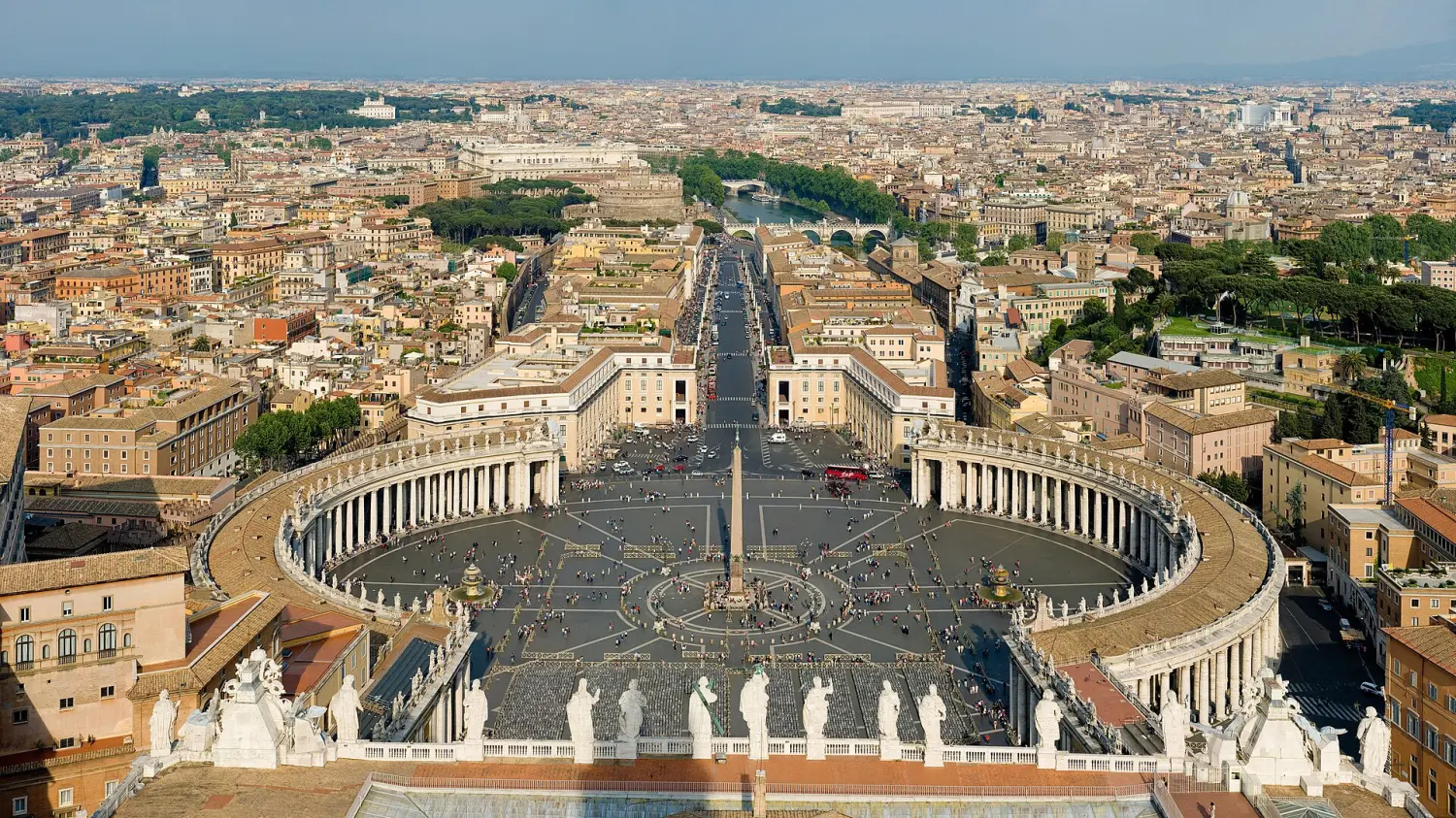
Bernini's colonnade was built to hold crowds and it still knows how. Stand inside its arms long enough to feel the square close around you, then eat properly in the Borgo before the river; the afternoon needs it.
Cross the river and follow it south, about forty minutes on foot along the Tiber, or take a bus down the Lungotevere. There is no better city walk for digesting the morning.
Late afternoon, when the church reopens
Plan on about 45 minutes to 1 h 5 min
Across the river, down in Trastevere's quietest corner, the basilica of Cecilia stands over the house where the tradition places her martyrdom. After the morning's immensity this church is the correction: a courtyard, a garden, a Roman room underneath. Maderno's marble of the saint lies below the altar, carved, his inscription testifies, as her body was found when the tomb was opened in 1599.
Give your time to the statue and the altar, then the excavated rooms below when open.
Trastevere's churches keep real midday closures; check the place page's hours before you shape the afternoon around them.
Stay in Trastevere as the lamps come on. Santa Maria in Trastevere's mosaics glow at evening, and vespers, where you find them, end the day better than any restaurant; though the restaurants here will argue.
Day 2
Rome's martyrs are not a mood; they are an address. This day goes south along the old Appian Way into the tunnels where the young church buried its popes, and ends at the tomb of the other apostle, in the basilica that bears his name outside the walls.
Take a taxi or the Appia Antica buses south past the old gate; allow half an hour from the center. The little chapel of Domine Quo Vadis, where the tradition places Peter's turning back, stands by the roadside on the way.
Morning, on a booked or early guided visit
Plan on about 2 hours to 2 h 45 min
Under the farmland along the Appian Way lie the galleries where third century Christians buried their dead by the thousands. The Crypt of the Popes here held nine of Peter's early successors, and the empty tomb of Cecilia, whose body you stood beside yesterday, still opens off the same corridor. The tunnels put the entire pilgrimage in order: this is the church the basilicas were built to remember.
Give your time to the Crypt of the Popes and the crypt of Cecilia; let the guide set the pace in between.
Entry is by guided visit only, and the calendar closes some days entirely; check the official site before committing the morning. The tunnels involve stairs, low passages, and a constant cool that asks for a layer.
Optional · A half hour further down the Way
Plan on about 1 hour to 1½ hours
A few minutes' walk down the Appian Way, the basilica of Sebastian stands over the catacombs where, according to long-standing tradition, the relics of Peter and Paul were hidden during persecution. Quieter than its neighbor, and the walk between them is the best surviving stretch of the old road.
From the Appian Way it is a short taxi ride west across Ostiense, or bus and metro with one change; allow half an hour either way.
Afternoon
Plan on about 1 h 15 min to 1 h 45 min
Paul's basilica is the day's resolution: a cool, vast, level church over the apostle's tomb, rebuilt after fire but keeping its shape from the fourth century. The sarcophagus sits below the high altar with the chains traditionally venerated as his displayed nearby, and the portrait medallions of every pope run round the nave like a ledger of the succession the morning's crypt began.
Give your time to the tomb and the chains, then the cloister, which is the most serene in Rome.
If the day runs short: This church absorbs tired pilgrims gently; even an hour here completes the day's argument.
An early evening. This is the day to be back before dark, eat near where you sleep, and let the tunnels settle. The two loudest days of the pilgrimage are done.
Day 3
Before Saint Peter's, pilgrims came to the Lateran, the cathedral of Rome, and to Mary Major on its hill. This day walks the old circuit between them, the straight Roman street that Holy Years have walked for centuries, with the relics of the Passion and the quietest mosaics in the city a few steps off its line.
Morning
Plan on about 1 h 15 min to 1 h 45 min
The Lateran, not Saint Peter's, is the cathedral of Rome, mother and head of all churches, as the facade inscription insists. The colossal apostles lining the nave, the papal cathedra in the apse, and the reliquaries above the papal altar, traditionally venerated as holding the heads of Peter and Paul, make this the juridical heart of everything the first two days showed you.
Give your time to the nave's apostles and the apse; then the cloister if the morning is unhurried.
The baptistery, older than the basilica beside it, keeps its own hours across the piazza.
Optional · Beside the Lateran
Plan on about 30 minutes to 45 minutes
Across the piazza, the Holy Stairs are traditionally venerated as the steps of Pilate's praetorium, brought to Rome, the tradition holds, by Saint Helena. Pilgrims still climb them on their knees. Whether you climb or stand and watch, it is the rawest devotion you will see in Rome.
Optional · A ten minute walk east
Plan on about 45 minutes to 1 hour
Helena's own basilica, built in her palace hall, preserves the relics of the Passion that the tradition records she brought from Jerusalem. The chapel that holds them is reached at the end of a corridor that gives the visit the character of an approach rather than a viewing.
Walk Via Merulana straight from the Lateran, about twenty five minutes, flat; the dome of Mary Major closes the view the whole way.
Afternoon
Plan on about 1 hour to 1½ hours
The greatest Marian church in the West has stood on this hill since the fifth century, and its nave mosaics have watched every pilgrim since. Beneath the high altar rests the reliquary of the Holy Crib; in the Pauline chapel hangs the Salus Populi Romani, the icon of Mary the city turns to in its worst hours; and since 2025 the basilica also keeps the tomb of Pope Francis, who prayed before that icon at the start and end of every journey.
Give your time to the fifth century mosaics along the nave, the icon, and the crib reliquary below the altar.
Optional · Two minutes from Mary Major
Plan on about 35 minutes to 50 minutes
Around the corner, behind an easy-to-miss door, the small church of Praxedes holds the Chapel of Saint Zeno, the most complete ninth century mosaic room in Rome, gold from floor to vault, and a column traditionally venerated as the pillar of the scourging. Ten minutes here outweigh an hour in larger rooms.
The Monti quarter below Mary Major fills gently at evening and makes no demands. If energy remains, this is the night to restore San Clemente from the omissions list; its layered basilica sits between Monti and the Lateran.
Day 4
The last day makes the quietest point. In the dense center, between the coffee bars and the tram stops, lie Catherine of Siena and Ignatius of Loyola, saints buried not outside the city but inside its daily noise. This day is short, level, and mostly on foot, because departure days deserve mercy.
Morning
Plan on about 40 minutes to 1 hour
Rome's one Gothic church stands over a Roman temple precinct a street behind the Pantheon. Beneath its high altar lies Catherine of Siena, the tertiary who argued a pope back from Avignon; Fra Angelico, painter and friar, is buried a few steps away. The blue vault above the nave was restored in the nineteenth century, but the tombs are the reason you are here.
Give your time to Catherine's tomb beneath the altar, then Michelangelo's Risen Christ beside it.
Pause · Midday
The temple of all gods has been the church of Saint Mary and the Martyrs for fourteen centuries, which is the neatest summary of this city on offer. Step in if the line is short; the oculus does its work in one look. Otherwise the porch and the square are enough.
Optional · Five minutes north
Plan on about 30 minutes to 45 minutes
In the French national church, the Contarelli chapel holds Caravaggio's three canvases of Saint Matthew, the call, the inspiration, the martyrdom, lit by coins and patience. It is the single greatest free room of painting in the city, and it belongs in a pilgrimage because the Calling is a vocation story told in tavern light.
Optional · Ten minutes south
Plan on about 35 minutes to 50 minutes
The mother church of the Jesuits holds the tomb of Ignatius of Loyola under lapis and gold, with the right arm of Francis Xavier, traditionally venerated, in the facing chapel. The evening light show over the altar, when it runs, is Baroque theater doing exactly what it was built to do.
End where you began. Walk back toward the river at dusk and let the dome of Saint Peter's close the pilgrimage from the bridge, the way it closed the horizon for every pilgrim who ever arrived on foot. The square at night, after the crowds, returns the first morning to you in silence.
Geography
Numbered markers follow the day's order. Optional stops appear hollow.
When plans bend
Keep Days 1 and 3 whole: Peter and the tomb in the morning, Cecilia in the afternoon; the Lateran and Mary Major on the second day. The catacombs and Saint Paul ask for a third day; do not squeeze them into halves.
Papal audiences fill the square on Wednesday mornings and the Angelus draws crowds at Sunday noon; move Day 1 accordingly or arrive very early. Sunday Masses also reshape every basilica's visiting hours, in the church's favor.
The catacombs fascinate children in exactly one hour and not two, and Day 3's optional stops cut cleanly. Day 4 is already a family day: short distances, an oculus, and the best gelato geography in Rome.
The catacomb tunnels are the one genuinely hard passage of these days; Saint Paul Outside the Walls is level and calm and can anchor Day 2 alone. The basilicas all manage step-free entry; each place page carries current access notes.
My Journey
Save these days into My Journey and make them yours: reorder the stops, drop what does not fit, and add the churches that find you on the way.
You choose the journey it joins before anything is saved.
Editorial responsibility
Researched from official and reliable sources, including the sanctuaries' own published information. This itinerary has not yet been field verified by an Eternal Roam contributor.
Built from the basilicas' and sanctuaries' own published information, the sources below, and Eternal Roam's canonical Rome place and planning records, with distances and transit assumptions checked against maps rather than memory.
Opening hours, Mass times and access change; each place page above carries its current sources. How Eternal Roam researches and reviews its guides is described in our editorial standards.
Use this for corrections, broken links, missing places, and planning ideas.