Why Go
A church built around cargo
Bari did not inherit Saint Nicholas. It went and got him.
In the spring of 1087 a party of roughly sixty-two sailors and merchants from Bari sailed for Antioch with grain, and diverted to Myra on the coast of Lycia, in what is now Turkey. Nicholas had been bishop there in the fourth century and his tomb had drawn pilgrims for seven hundred years. The region was unstable, the Byzantine hold on it broken, and the shrine was watched by a handful of monks. The Bari party took the relics and sailed home. They reached the city on Sunday, May 9, 1087, and two months later the ground was cleared for a church to hold what they had brought.
Everything else here follows from that. The basilica is not a shrine that grew around a grave; it is a purpose-built reliquary the size of a cathedral, put up fast, in the fortified idiom of Norman Puglia, by a city that had just acquired the most valuable object in the western Mediterranean and intended to keep it.
And it worked. Nine hundred and forty years later the crypt is still the busiest room in Bari, and on any ordinary morning the people praying in it are Italian, Greek, Russian, Romanian, Serbian and Ukrainian. Nicholas is venerated across the whole Christian world, and Bari is where that fact becomes a place rather than an idea.
What happened at Myra in 1087, and what was left behind
The basilica publishes its own account of the translation, and it does not soften it. That is worth knowing before reading anyone else's version.
By the shrine's telling, three ships left Bari early in 1087 loaded with grain and bound for Antioch, whose fall to the Seljuks in 1085 had wrecked the city's main trade. They put in at Andriake, the port of Myra. Forty-seven of the men went inland to the church, where four custodians, three of them monks, were on duty. The Baresi asked to be shown where the manna was drawn from the tomb. When the monks would not say, the basilica's account states plainly that they were forced to speak with a sword at the throat. A young man named Matthew broke open the tomb with an iron bar and the relics were lifted out, the skull among them. The ships sailed. They reached Bari on Sunday, May 9, and the welcome turned into a fight over who would keep the relics, in which the archbishop, Ursone, tried to take them by force and men were killed before a settlement was reached. The relics went to the abbot Elias, who began building this church.
Eternal Roam states it this way. This was a relic translation carried out by force, in a period when such removals were common enough to have their own name in modern scholarship, and it is described as a theft by historians and as a translation by Bari. Both descriptions are answering different questions. The medieval sources, including the Bari accounts written within living memory, do not deny the coercion. What they claim is that the saint consented and that Myra could no longer protect him. A pilgrim does not have to settle that to pray here, but should not be told a gentler story than the shrine tells about itself.
Myra was not stripped bare. In 1099 Venetian ships on their way to the First Crusade stopped at the same church, found it largely abandoned, broke through the floor and took what remained, reaching Venice in 1101. For nine centuries the two cities disputed which held the real relics. The question was settled anatomically. Luigi Martino, professor of anatomy at the University of Bari, examined the Bari bones in 1953 and again in 1957, recording measurements, photographs and radiographs. In 1992 he was asked to examine the Venetian relics and found roughly five hundred small fragments that were complementary to the Bari skeleton: the same man, with Venice holding the pieces a hurried party in 1087 would have left in the bottom of a tomb. Bari has the body. Venice has what fell off it. Both are genuine, and the long argument is over.
As for Myra itself, the church of Saint Nicholas still stands at Demre and can be visited, with the empty sarcophagus in it. Eternal Roam does not route it, and the relics are not there.
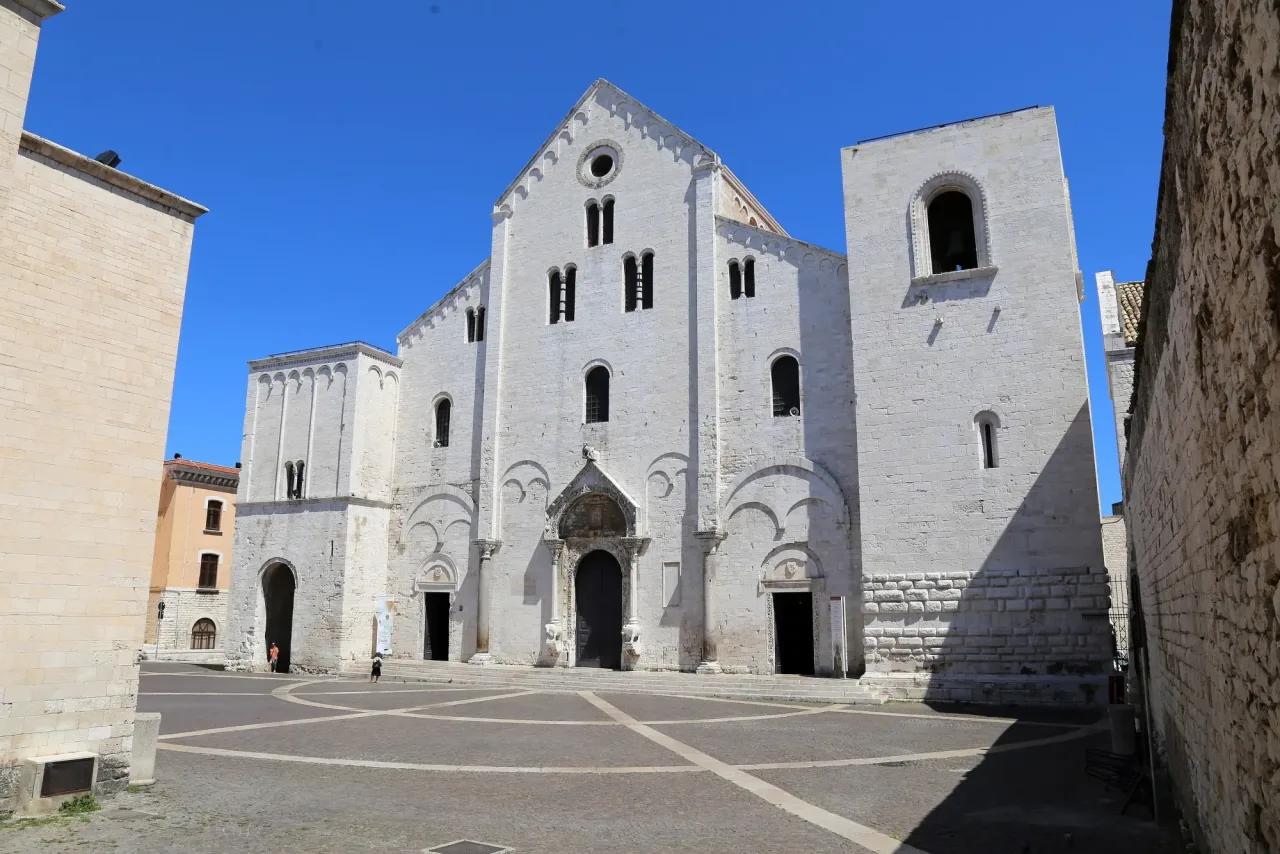
The basilica is best read as a fortress with a liturgical program, because that is more or less what it is.
Abbot Elias began work on July 8, 1087, on the site of the Byzantine catepano's palace, the seat of the imperial governor Bari had recently stopped answering to. Material from that palace went into the new church, and the crypt columns are visibly reused Byzantine work: twenty-six of them, in Greek and Numidian marble, coral breccia and Carystian marble, no two capitals quite agreeing. Building on the governor's palace was not an accident of real estate. It was a statement about who now ran the city.
The west front is broad, pale and severe, with two flanking towers of unequal height and a plain gabled center. Very little of it is decorated, and what decoration there is has been concentrated where a visitor will walk: the central portal, and on the north flank the Portale dei Leoni with its carved riders. The overall effect is defensive, and that is period-correct for Puglia in the decades after the Norman conquest.
Inside, the nave is high, columned, and interrupted by three great transverse arches thrown across it in later centuries to hold the building together after earthquake damage. They are an obvious intrusion and they are the reason the church is still standing. Above them the ceiling is a gilded and painted baroque coffering of the seventeenth century, which sits over Romanesque stonework without pretending otherwise. Beyond the nave stand two objects worth crossing the church for: the ciborium over the high altar, attributed to Eustazio and dated around 1115, the oldest of its kind in Puglia; and the silver altar, worked between 1319 and 1684, in front of it.
The throne of Abbot Elias, in the presbytery, is the single finest carving in the building. It was made in 1098 for the Council of Bari, the assembly Pope Urban II convened in this city that October, at which Anselm of Canterbury argued the Latin case on the procession of the Holy Spirit. The throne rests on three straining figures, their faces carved in real pain, and it is one of the earliest pieces of European sculpture in which physical effort is rendered as feeling rather than as convention.
The crypt runs beneath the whole presbytery and transept, about thirty meters by fifteen, low and heavily vaulted on those reused columns. It is the oldest finished part of the church and the part that matters.