Basilica di Sant'Ambrogio, Milan

Ambrose's own basilica, rebuilt in brick five hundred years after him, with the bishop and the two martyrs he brought here still together in the crypt.

ITALY · MILAN 45.4624° N · 9.1755° E
Location
Milan, Italy 45.4624° N · 9.1755° E
Type
Minor basilica and parish church of the Archdiocese of Milan, in the Ambrosian Rite
Dedication
Founded as the Basilica Martyrum for Gervasius and Protasius, and known by Ambrose's name from soon after his burial here.
Why Go

A bishop who chose his neighbors

Most great tombs are the result of a cult that grew after a saint died. This one was arranged by the man in it.

Ambrose began building here in 379, outside the walls, on a Roman burial ground where Milan's Christians had been laid since the persecutions. In the spring of 386 he found the bodies of two martyrs, Gervasius and Protasius, near the old basilica of Naborre and Felice, and had them carried into his new church. It took the name Basilica Martyrum. Eleven years later he was buried beside them, in the tomb he had prepared for himself. That sequence is the whole point of the building, and it is still legible in the crypt.

What you walk into is not his church. The brick basilica standing today is Lombard Romanesque, raised across the eleventh and twelfth centuries on the footprint of the fourth-century one, and its atrium, towers and vaults all belong to the rebuilding rather than to Ambrose. The continuity here is not fabric. It is a place, an intention, and three bodies that have not moved far from where he put them.

Ambrose, two martyrs, and one sarcophagus

The discovery of Gervasius and Protasius in June 386 is one of the better-documented episodes in fourth-century Milan, because Ambrose wrote about it himself, in a letter to his sister Marcellina. He was under pressure at the time: the imperial court, backing the Arian party, was pressing him to hand over a basilica. He records that he had the ground opened at the church of Naborre and Felice, that two bodies of unusual size were found, and that they were carried into the new basilica and laid under the altar he had meant for himself. The politics and the piety are in the same letter, and the Church has never needed to separate them.

When Ambrose died in the night between April 3 and 4 in 397, he was buried in that church, to the left of the martyrs. In the ninth century, during the rebuilding under Archbishop Angilbert II, the relics were found in two separate burials: the martyrs in one, Ambrose in the other. Angilbert had all three placed in a single porphyry sarcophagus, set across the older graves, and commissioned the Golden Altar to stand over it. That is the moment three bodies became one tomb, and it is why the goldsmith's masterpiece upstairs and the urn downstairs are the same story told twice.

Then the tomb was lost. For centuries no one could say with certainty where under the church it lay. A first inspection beneath the altar was made in January 1864. The basilica's own account puts the resolution between 1871 and 1874: the porphyry sarcophagus was found and the relics of Ambrose, Gervasius and Protasius were officially recognized. In 1897 a new crypt was opened, paid for by leading Milanese families, with a silver and glass urn by Giovanni Lomazzi to a design by Ippolito Marchetti. The three have lain in it since.

In 2018 they were examined again. A team coordinated by Cristina Cattaneo, professor of forensic medicine at the University of Milan, studied the remains before the reliquary was canonically closed by Archbishop Mario Delpini. The findings are worth stating plainly because they are unusually specific. Ambrose: a man of about sixty, roughly 1.70 meters, with a fractured right clavicle and a facial asymmetry consistent with old injury, and with the shoulder trouble he mentions in his own letters. The martyrs: two young men between about 23 and 27, both over 1.80 meters, sharing a congenital vertebral defect of the kind found in brothers, one showing decapitation and the other defensive injuries and broken ribs. Eternal Roam states it this way. The science does not prove sanctity, and it was never asked to. What it does is agree, in detail, with what Ambrose said he found.

Read the building as three campaigns stacked on one site, and it stops being confusing.

The fourth-century basilica is almost entirely gone above ground. What survives from Ambrose's Milan is the ground itself, the burial-church purpose, and one room: the Sacello di San Vittore in Ciel d'Oro, a small square chapel that stood as an independent structure before the basilica swallowed it. It opens off the end of the right aisle, and its vault is a solid field of gold mosaic with Victor in a wreath at the center. Among the saints on its walls is a bust of Ambrose in civil dress, without a halo, which is one of the earliest surviving likenesses of him and was made by people who could have known his face. The 2018 study found the mosaic portrait anatomically consistent with the skull in the crypt.

The Carolingian layer is the ninth century, and it is concentrated in one object. The Golden Altar was commissioned by Archbishop Angilbert II, who held the see from 824 to 859, and signed by the goldsmith Vuolvino, magister phaber. It is gold on the front, silver and gilt behind, worked in relief and set with stones and enamels, and it was built to enclose the porphyry sarcophagus. The back, which faces the clergy rather than the nave, carries scenes from Ambrose's life. It is the finest piece of Carolingian goldsmithing to survive anywhere, and it is still on the altar it was made for.

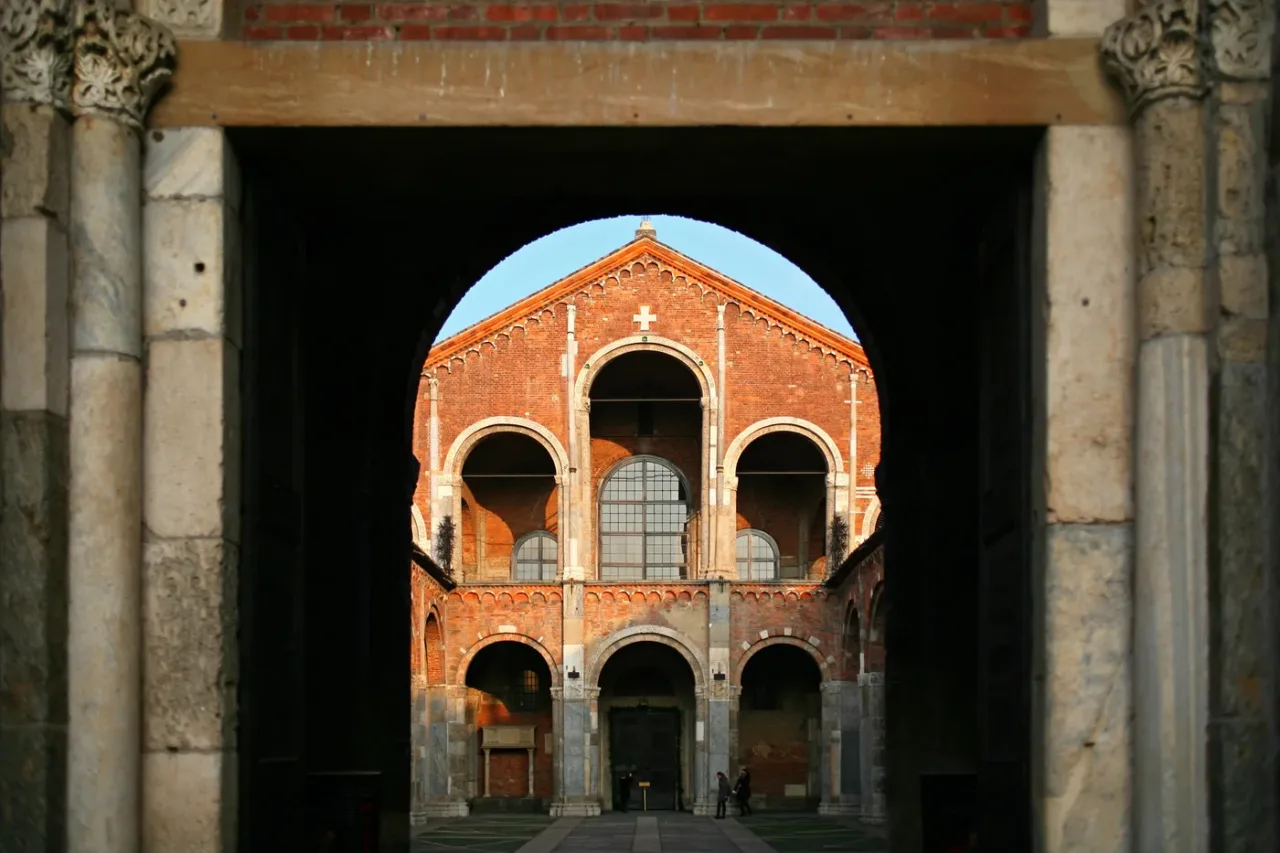
The Romanesque church is the eleventh and twelfth centuries and is what a visitor actually sees. Red brick throughout, a gabled front of two orders of arcades, a nave and two aisles under ribbed cross vaults, deep bundle piers, and a wide gallery running above the aisles. Two bell towers stand apart from each other and from different centuries: the shorter one on the right belongs to the monks and is ninth or tenth century, the taller one on the left to the canons and was finished in the twelfth. In front of it all lies the quadriportico, the Atrium of Anspertus, a colonnaded court that reached its present form in the late eleventh century. Over the crossing sits the tiburio, the lantern tower, and beneath it the ciborium, a canopy on four porphyry columns with carved gables, standing directly over the Golden Altar.

The apse behind them holds a mosaic of Christ in majesty between Gervasius and Protasius, eleventh-century in its present state and much restored after bombing in 1943. The crypt below was rebuilt in 1897 and is deliberately quiet by comparison: marble columns, low vaults, benches around the walls, and the urn.

Read the Place

Four centuries, four layers.

Almost nothing you can see is Ambrose's, and the tomb is. Sorting the fabric by date is the fastest way to understand what you are standing in.

Fourth century: the ground and the Sacello

A Roman cemetery outside the walls, a basilica begun in 379 for the martyrs, and one surviving room: the Sacello di San Vittore in Ciel d'Oro, absorbed into the later church. Its mosaics hold one of the earliest likenesses of Ambrose.

Ninth century: Angilbert's sarcophagus and altar

Archbishop Angilbert II found the martyrs and Ambrose in two separate graves, united them in one porphyry sarcophagus, and had Vuolvino build the Golden Altar over it. Three burials became one tomb.

Eleventh and twelfth centuries: the brick church

The Romanesque basilica, the quadriportico, the ribbed vaults, the galleries, the tiburio and the ciborium. The taller bell tower was finished in the twelfth century; the shorter one is two hundred years older.

1897: the crypt you enter

After the tomb was recovered in the 1870s, a new crypt was opened with a silver and glass urn. The room is late nineteenth century. What is in it is not.

The ciborium stands on four porphyry columns over the Golden Altar, with the apse mosaic behind. Beneath all of it is the sarcophagus the altar was built to enclose, and beneath that, the crypt.
Spiritual Significance

The devotional grammar here is a bishop's, not a mystic's, and the church has kept it that way for sixteen centuries.

Ambrose is venerated as a Doctor of the Church, but what Milan remembers is a pastor who governed. He was a Roman official acclaimed bishop by a city that would not take no for an answer, baptized and consecrated within days, and he spent twenty-three years teaching, arguing, negotiating and singing. He gave the West hymns it still uses. He told an emperor that he stood inside the Church rather than above it. He instructed a restless African rhetorician named Augustine and baptized him at the Easter Vigil of 387. Pilgrims who come here for Augustine's sake are welcome, and they should know that Augustine's baptism happened at the cathedral baptistery on the other side of the center, not in this building.

What is asked for at this tomb tends to follow from that life: clarity in teaching, steadiness in public responsibility, courage that does not curdle into anger. December 7 is his feast, and in Milan it is a city holiday as much as a liturgical one, opening the Oh bej! Oh bej! market in the streets around the basilica and the opera season at La Scala on the same day.

The basilica also keeps the Ambrosian Rite, the Milanese liturgical tradition that carries his name and predates the Roman uses that surround it. Its calendar and its chant differ from the Roman Rite in ways a visiting Catholic will notice: a different Lent, a different order at Mass, a different repertory of song. Ambrose did not invent it, and the scholarship is careful about how much of it goes back to him personally. But it is the living form of the thing he is most remembered for, which is a bishop teaching a city to pray out loud together, and it is celebrated here every day.

The crypt was rebuilt in 1897 and is plain after the presbytery above it. The urn of the three saints stands out of this frame, below the high altar.
Do Not Miss · 5 stops

Five things, in the order the building gives them.

  1. The quadriportico

    Enter through it. The colonnaded court took its present form in the late eleventh century and its walls hold reused Roman and early medieval fragments. It is also the best place to see the front whole.

  2. The two bell towers

    They do not match, and they were never meant to. The lower one on the right is the monks' tower, ninth or tenth century. The taller one on the left belongs to the canons and was finished in the twelfth, after a long argument between the two communities.

  3. The Golden Altar of Vuolvino

    Ninth century, commissioned by Archbishop Angilbert II and signed by its goldsmith, built to enclose the sarcophagus of the three saints. Gold on the nave side, silver and gilt behind with scenes of Ambrose's life. It is visible from the nave, under the ciborium, without a ticket.

  4. The crypt urn

    Ambrose and the martyrs Gervasius and Protasius, vested, in the silver and glass urn made for the crypt of 1897. This is the object the whole basilica exists around.

  5. The Sacello di San Vittore in Ciel d'Oro

    Off the end of the right aisle, and the oldest room in the complex. A gold vault with Victor at its center, and on the walls a bust of Ambrose in civil dress, one of the earliest surviving images of him.

The vault of the Sacello di San Vittore in Ciel d'Oro, a solid field of gold with Victor at its center. The saints named in mosaic letters on the walls below include Gervasius and Protasius, and Ambrose himself.
What to notice
  • The nave is two stories: arcade below, open gallery above. That elevation is Romanesque rather than late antique, and it is why the church reads as heavier and older than its brickwork.
  • The apse mosaic was badly damaged by bombing in 1943 and what you see has been substantially restored. Its subject, Christ between Gervasius and Protasius, is the old one.
  • Visits pause during Mass and confession. In a working parish that means mid-morning and early evening are the busiest liturgical hours and the least useful for looking.
Visit Plans · 2 plans · add to a journey

How much time, and what to do with it.

  • Duration About an hour Best for A first visit, or an hour taken out of a Milan day

    The nave, the altar, the crypt

    5 ordered stops

    Enter through the court, walk the nave, stand at the ciborium, then go down.

    1. The quadriportico and the front
    2. The nave and the galleries above the aisles
    3. The ciborium and the Golden Altar
    4. The apse mosaic
    5. The crypt and the urn of the three saints
  • Duration Ninety minutes to two hours Best for Pilgrims and anyone who came for Ambrose rather than past him

    Add the oldest room and the treasury

    5 ordered stops

    The Sacello is the one part of the complex Ambrose would recognize. Do not leave without it.

    1. Mass or a quiet weekday hour in the nave
    2. The Sacello di San Vittore in Ciel d'Oro
    3. The Golden Altar seen closely on the museum route
    4. The treasury: silver, reliquaries and vestments
    5. The streets around the basilica, and the Duomo baptistery afterward if Augustine is your thread

Weekday mornings are the calmest, and the last hour before the evening Mass is the quietest time in the crypt. Avoid the days around December 7 unless the feast is why you came.

How to Visit

How to visit well.

Come in through the quadriportico rather than around it. The court is the building's own introduction: it slows the approach, frames the front, and holds fragments and inscriptions in its walls that are worth two minutes.

Inside, resist the pull toward the crypt. Walk the nave first and look up at the gallery, because the two-story elevation is what makes this church feel older and heavier than its date. Then go to the presbytery. The ciborium and the Golden Altar under it are the reason to stand still here, and the apse mosaic is behind them.

The crypt is reached from the presbytery. It is a small, plain room after everything above it, and that is the right sequence. The three lie together in the urn, vested. Give it the time you would give a grave.

On the way out, take the right aisle to its end and find the Sacello di San Vittore in Ciel d'Oro. It is easy to walk past, and it is the oldest thing here.

The basilica itself is free. The museum route, called Ambrosius, is ticketed and takes in the treasury alongside the presbytery and the crypt. Visiting stops during services, which in a working parish means the middle of the morning and the early evening are the least useful times to arrive with a camera.

Current Practical Info · reviewed August 19, 2026

A free working parish with a ticketed museum route, closed to visitors during services.

Entry to the basilica is free and needs no booking. The Ambrosius museum route, which covers the treasury alongside the presbytery and crypt, is ticketed and keeps shorter hours than the church, with a narrow Sunday afternoon window. Visiting stops while Mass or confession is going on. Times shift with the season and the Ambrosian calendar, so take them from the basilica on the week you travel rather than from here.

Address
Piazza Sant'Ambrogio 15, 20123 Milan, Italy
Admission
Free to the basilica and the crypt. The Ambrosius museum route is ticketed, around 5 euro full price at the last check, with reductions for under 18s, schools and groups.
Getting there
Metro line 2 to Sant'Ambrogio, which comes up at the basilica. About fifteen minutes on foot from the Duomo.
Accessibility
Step-free access to the basilica by ramps on the right of the main entrance. Multisensory panels are provided for visitors with sight or hearing impairments.
Groups
Group and school visits must be booked, and enter at fixed times with a whisper system.
Additional schedule notes

Basilica hours

  • Eternal Roam does not publish the timetable. It changes with the season and again for the Ambrosian feasts.
  • Weekday mornings open early for the parish, well before the visiting hours begin.
  • Sunday hours run later into the evening than weekday hours.

Visiting hours

  • These are narrower than the hours the church is open, because the building is a parish before it is a monument.
  • Visits are suspended entirely during services.

Mass

  • The Ambrosian Rite differs from the Roman Rite in calendar, order and chant. A visiting Catholic will notice, and it is worth staying for.
  • December 7, the feast of Saint Ambrose, is the basilica's own day and a public holiday in Milan.

Confession

  • Ask at the sacristy about languages other than Italian.
  • Both sittings are short compared with a pilgrimage shrine; this is a parish schedule.

The museum route

  • Tickets can be bought online in advance, which is worth doing around December 7 and on summer weekends.
  • Guided visits and family workshops are offered on top of admission and last about ninety minutes.
  • The route keeps shorter hours than the church, and the Sunday window is a couple of hours in the afternoon only.

Photography

  • Do not photograph during Mass or confession, and treat the crypt as a grave rather than an exhibit.
  • The museum's downloadable regulations govern the ticketed route; read them before bringing equipment.

Feast days and crowds

  • The feast of Saint Ambrose is a Milan city holiday. The Oh bej! Oh bej! market runs in the surrounding streets and La Scala opens its season the same evening.
  • For a quiet visit, come on a weekday morning outside the visiting rush, or in the last hour before the evening Mass.

What to wear

  • Shoulders and knees covered, as at any Italian basilica.
  • The quadriportico and the streets around it are paved in stone and uneven in places.
Relics, Tombs, Sacred Objects

What is venerated here, and on what evidence.

The bodies of Saint Ambrose, Saint Gervasius and Saint Protasius

Bodily relics, in a silver and glass urn of 1897

The devotional center of the basilica and the reason it stands where it does. Ambrose brought the martyrs Gervasius and Protasius into the church in 386 and was buried beside them in 397. In the ninth century Archbishop Angilbert II placed all three in one porphyry sarcophagus. The sarcophagus was recovered and the relics officially recognized between 1871 and 1874, and since 1897 the three have rested together, vested, in a silver and glass urn in the crypt below the high altar.

Basilica di Sant'Ambrogio (basilicasantambrogio.it); Ambrose, Letter to Marcellina on the finding of Gervasius and Protasius; Archdiocese of Milan
Documented

Documented from the fourth century forward and tested in the twentieth. Ambrose describes the finding of the martyrs in his own letter; his burial here in 397 is recorded; the tomb's recovery and canonical recognition took place between 1871 and 1874. In 2018 a team coordinated by Cristina Cattaneo of the University of Milan examined the remains before the reliquary was canonically closed: one man of about sixty with a fractured clavicle, and two young men in their twenties sharing a congenital vertebral trait, one decapitated and one with defensive injuries. The findings match the tradition rather than establishing it.

The Golden Altar of Vuolvino

Gold, silver, enamel and gemstone altar, ninth century

Built as the container of the saints' tomb rather than as decoration for it. Commissioned by Archbishop Angilbert II, who held the see from 824 to 859, and signed by the goldsmith Vuolvino. The nave face is gold and shows the life of Christ; the face toward the clergy is silver and gilt and shows the life of Ambrose, so the bishop's story is told to the men who succeeded him.

Basilica di Sant'Ambrogio; Ambrosius, il Tesoro della Basilica
Documented

Dated and attributed by the object itself. The dedicatory panel names Angilbert as patron, and the goldsmith Vuolvino is named in the work, which places it within his episcopate of 824 to 859.

The mosaic portrait of Ambrose in the Sacello di San Vittore

Wall mosaic, late antique

A bust of Ambrose among the saints on the walls of the Sacello, shown in civil dress and without a halo, and traditionally regarded as the closest thing to a portrait of him. Pilgrims and art historians come for the same image for different reasons.

Basilica di Sant'Ambrogio; published studies of the Sacello mosaics
Documented

The chapel is fourth century and the mosaics are usually dated to the second half of the fifth, which puts them within living memory of people who had seen Ambrose but not within his lifetime. That it is a likeness rather than a type is a long-standing judgment supported by the 2018 examination, which found the mosaic head anatomically consistent with the skull in the crypt. Eternal Roam reports it as an early portrait tradition with unusual physical support, not as a life study.

Source note Traditional attributions are presented as tradition, with documentation named where it exists.

Map · Milan, Italy

Plan your visit.

Editorial sources

Built from the basilica's own published history and visiting information, read directly, with the Archdiocese of Milan and Ambrose's letter to Marcellina for the finding of the martyrs. Three inherited claims were checked rather than carried: the recovery of the porphyry sarcophagus is dated between 1871 and 1874 as the basilica itself dates it, not to 1864, which was a preliminary inspection beneath the altar; the arrangement of the three bodies inside the 1897 urn is described as together rather than in a stated order, because no source consulted specifies the order; and the quadriportico is credited to the ninth-century and eleventh-century rebuildings rather than to Ambrose's own church. The 2018 examination is reported as agreeing with the tradition rather than as proving it. Hours, Mass times and ticket prices are described as patterns and linked to the basilica rather than transcribed.

Last reviewed

August 19, 2026

Photo credits
  1. Hero. Paolobon140 / Wikimedia Commons. Source. CC BY-SA 4.0.
  2. Detail. RedepaoliniPoelman / Wikimedia Commons (CC BY-SA 4.0). Source. CC BY-SA 4.0.
  3. Detail. Emmanuel Brunner / Wikimedia Commons (CC BY-SA 4.0). Source. CC BY-SA 4.0.
  4. Detail. Melancholia~itwiki / Wikimedia Commons (CC BY-SA 4.0). Source. CC BY-SA 4.0.