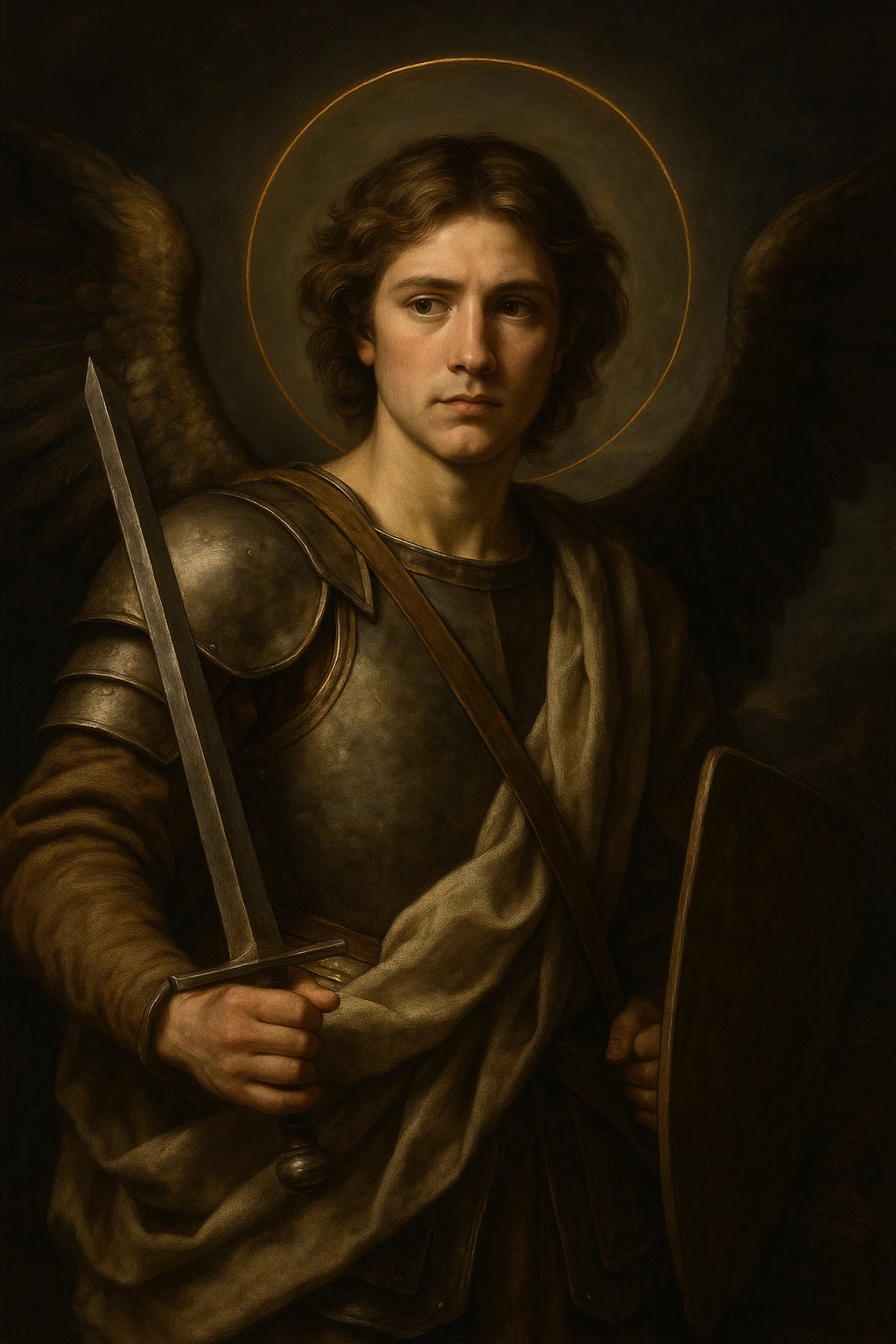
Sanctuary of Saint Michael the Archangel, Monte Sant'Angelo

A cave on the Gargano where Michael has been venerated since late antiquity, entered by descending a long stairway from the town above.

ITALY · MONTE SANT'ANGELO 41.7078° N · 15.9550° E
Location
Monte Sant'Angelo, Italy 41.7078° N · 15.9550° E
Type
Basilica and international sanctuary, served by the Michaelite Fathers
Dedication
Saint Michael the Archangel. The sanctuary holds that the cave was never dedicated by a bishop because the Archangel had already consecrated it himself.
Why Go

A church you reach by going down

Almost every great pilgrimage church in Europe asks you to climb. This one asks you to descend. From the street the sanctuary shows a pale stone front of two pointed arches and an octagonal tower, and it looks like a modest town church. Then the floor drops away. A stairway of five flights runs down through the rock, past sarcophagi set into the walls, and ends at a pair of bronze doors that were cast in Constantinople in 1076. Behind them there is no nave in the ordinary sense. There is a cave.

The grotto is the church. Its ceiling is uneven rock, water still works through the stone, and the altar stands under a natural vault rather than a built one. Catholics have prayed in this cave since late antiquity, and it is the oldest sanctuary in western Europe dedicated to Saint Michael. Everything above ground was raised over the centuries to get pilgrims safely down to it.

That is what makes the visit unusual. The sanctuary is not a building containing a relic. It is a hole in a mountain that the Church has spent fifteen hundred years making it possible to enter.

The apparitions, and what the earliest source actually is

The sanctuary distinguishes four apparitions, and it is worth knowing which of them the historical record can speak to.

The first three belong together and are traditionally dated to the years around 490 to 493. In the account the sanctuary tells, a wealthy man named Gargano lost a bull, found it standing in the mouth of a cave on the mountain, and shot an arrow at it that turned back and struck him instead. The bishop of Siponto, whom the tradition names Lorenzo Maiorano, ordered three days of prayer, and on the third day the Archangel appeared and asked that the cave be given over to Christian worship. In the second episode Michael promises victory before a battle, and in the third the bishop comes up with seven other bishops of Puglia to consecrate the cave and is told that the consecration has already been done. The fourth apparition is much later and much better documented: in September 1656, during the plague, Archbishop Alfonso Puccinelli blessed stones from the grotto, and the city credited its deliverance to that intervention.

The first three episodes come to us through one text, the Liber de apparitione Sancti Michaelis in Monte Gargano. It is the earliest narrative account of the sanctuary's foundation, and it is not a fifth-century document. It is a composite Latin work whose earliest surviving manuscripts are late eighth or early ninth century, and Nicholas Everett places its composition between roughly 663 and 750, reading it as a text shaped by the rivalry between the churches of Siponto and Benevento over control of the shrine. Its oldest layer may go back further, but no contemporary fifth-century record of these events survives.

This is not a reason to hold the tradition lightly. It is a reason to describe it accurately. What the evidence independently supports is that the cave was a Christian sanctuary very early: inscriptions cut into the rock carry the names of the Lombard dukes Grimoald I and Romuald I in the seventh century, and Giorgio Otranto has connected the second apparition's battle to the victory of May 8, 663 that Paul the Deacon records in his history of the Lombards. Eternal Roam states it this way. The foundation of Monte Sant'Angelo is carried by an early medieval apparition tradition rooted in late-antique Gargano and preserved in the Liber de apparitione. The cult itself is documented from the sixth and seventh centuries by the stones of the sanctuary.

The sequence matters more here than any single object, because the building is essentially a machine for getting people underground.

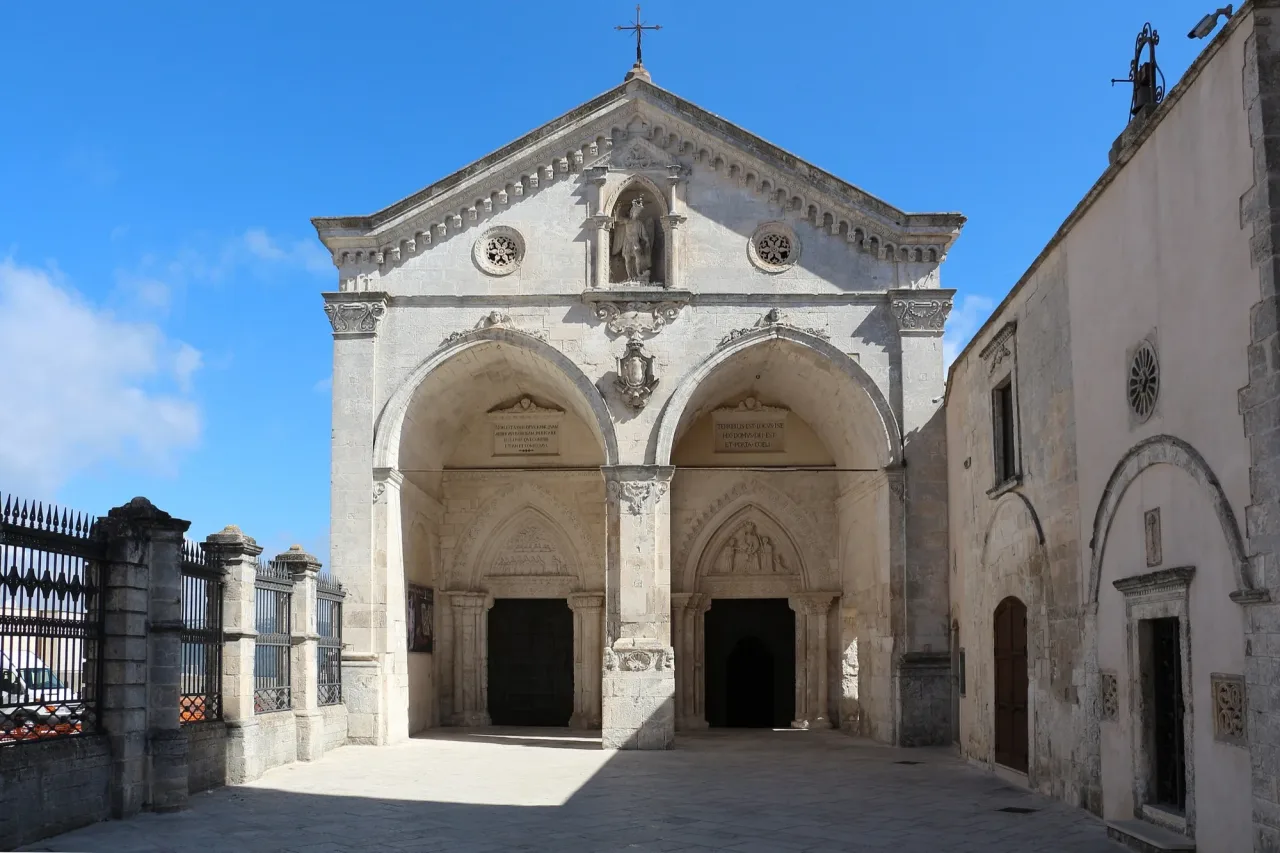
You enter through the front of 1395, two blind arches under a triangular gable with Saint Michael standing in a niche above. Both arches carry inscriptions. The right one is Genesis: Terribilis est locus iste, hic domus Dei est et porta coeli. This place is awesome; this is the house of God and the gate of heaven. The left one carries the sanctuary's own claim, in the Archangel's voice, that there was no need to dedicate the basilica he had built because he had already consecrated it himself. The octagonal bell tower beside it is Angevin work, begun in 1274 for Charles I of Anjou by the brothers Giordano and Maraldo of Monte Sant'Angelo, and built on the pattern of the towers at Castel del Monte.

Past the doors an upper vestibule opens onto the stairway, and this is the part of the visit people remember. Five flights descend about forty meters through vaulted galleries, and the walls on the way down hold medieval sarcophagi in arcaded recesses. At the bottom the stair reaches a lower atrium and the Porta del Toro of 1652, and then the bronze doors.

Those doors are the sanctuary's finest object and the clearest proof of how far its reputation reached. They were cast in Constantinople in 1076, given by Pantaleone of Amalfi at the request of Gerardo, archbishop of Siponto, and they carry twenty-four panels of angels and archangels drawn from the Old and New Testaments together with scenes of the sanctuary's own foundation. A merchant family trading out of Amalfi paid for Byzantine bronze to be shipped to a cave in Puglia. That is the eleventh-century Mediterranean in a single object, and it is still in place at the entrance to the grotto.

Inside, the grotto is irregular, low in places, and unmistakably a cave. A single nave of three bays was built alongside it under Charles I of Anjou to hold more pilgrims, so part of what you stand in is constructed and part is not. The line between them is visible, and it is worth looking for. Beneath the present floor lie Lombard-era crypts, excavated in the twentieth century, which revealed a pre-Romanesque lower church with a gallery and two stairs: an earlier version of the same problem, solved the same way.

Read the Place

How to read the sanctuary.

Four layers, from the street downward. Read them in that order and the building stops looking like a church with a crypt.

The front and the tower

The two-arched entrance front was finished in 1395; the octagonal bell tower beside it is Angevin, begun in 1274 for Charles I of Anjou. Both are late additions. They mark the way in, not the sanctuary itself.

The stairway

Five flights and roughly forty meters of descent, vaulted, with medieval sarcophagi set into the wall arcades. This is engineering for crowds, built and rebuilt because the cave could not take the traffic that came to it.

The bronze doors

Cast in Constantinople in 1076 and given by Pantaleone of Amalfi at the request of the archbishop of Siponto. Twenty-four panels of angels and of the sanctuary's own foundation. The threshold, and the evidence of how widely the shrine was known.

The grotto

Natural rock, irregular and low, with an altar beneath it and a built nave added alongside under the Angevins. Everything above was raised to make this room reachable.

The town falls away toward the sea. The sanctuary sits high on the Gargano, and the water a pilgrim sees from the street is the Adriatic that medieval pilgrims crossed on the way to the Holy Land.
Spiritual Significance

Michael is the one figure in the Church's calendar who has no grave. He left no body, no writings, and no relics, and this is the difficulty and the interest of every Michael shrine. What can be venerated is not remains but a place where the Church has long asked for protection.

That is what the Gargano offers, and it is why the sanctuary's language is about consecration rather than about relics. The third apparition, as the shrine tells it, has Michael saying that the cave needs no dedication because he has consecrated it. Out of that grew the sanctuary's traditional description of itself as the Celeste Basilica, the heavenly basilica, and as a church not consecrated by human hands. That phrase is the sanctuary's own devotional language, carved into its entrance arch, and it should be read as devotion rather than as a canonical statement about liturgical rites.

The theology stays close to the ground here. Michael is the defender who appears in Daniel, in Jude, and in Revelation 12, and pilgrims come to ask for protection: for themselves, for their households, for people who work in danger. The Gargano adds one particular note. Because the sanctuary is a cave, the prayer is made by going down into the earth rather than up a hill, and the sanctuary has always understood that as part of what it teaches.

Monte Sant'Angelo is also the head of a network, and it is worth separating the real one from the popular one. This is the oldest Michael sanctuary in the West, and the shrines that followed took it as their model. Mont-Saint-Michel is the clearest case. Its own foundation tradition holds that when Aubert, bishop of Avranches, raised an oratory on Mont Tombe in 708, he sent envoys to the Gargano, and that they returned with relics from this cave, a fragment of the red altar cloth and a piece of the rock. Later Michael foundations across northern Europe repeat the same pattern of borrowing from here. That is a line of influence carried by people, by relics, and by imitation. The great Michael sanctuaries are also grouped today in a popular devotional geography, sometimes called the Line of Saint Michael, which arranges them on a single axis across Europe. That is modern devotional imagination rather than medieval geography, and no medieval source understood these shrines as points on a line. The connection between them is real and it is older than the idea, but it runs through pilgrims and founders rather than through coordinates. Two feasts carry the devotion. September 29 is the feast of the Archangels, kept everywhere. May 8 is the older local feast of the apparition, tied to the victory of 663, and it remains the sanctuary's own day, with pilgrimages arriving on foot from across the Gargano.

The old town on the way to the sanctuary. The streets are narrow, paved, and stepped, which is worth knowing before the descent inside the church begins.
Do Not Miss · 5 stops

Five things to notice, in the order you meet them.

  1. Both inscriptions on the entrance arches

    The right arch quotes Genesis: Terribilis est locus iste. The left one carries the sanctuary's claim that the Archangel consecrated the church himself. Read them together before going in.

  2. The sarcophagi on the way down

    Medieval tombs sit in arcaded recesses along the stairway. People wanted to be buried on the route pilgrims walked, which tells you how heavily this stair was used.

  3. The bronze doors of 1076

    Byzantine casting, paid for by an Amalfitan merchant, still hanging at the entrance to the cave. Twenty-four panels of angels and of the shrine's own founding story.

  4. The line where the cave stops and the building starts

    A three-bay nave was added alongside the grotto under Charles I of Anjou. Find the join. It is the clearest way to understand what is natural here and what is not.

  5. The episcopal throne

    Twelfth-century marble, brought from Siponto, resting on two crouching lions and carved with Saint Michael. It is the seat of the bishop whose see the apparition tradition is built around.

What to notice
  • The grotto is cold and damp in every season, and noticeably colder than the street you left. Bring a layer even in August.
  • Photography and filming are not permitted in the grotto. People pray in there at close quarters, and the room is quiet in a way that photographed churches are not.
  • The rock is wet. Water still moves through the stone, and the sanctuary has always regarded the water of the cave as part of the place.
Visit Plans · 2 plans · add to a journey

How much time, and what to do with it.

  • Duration 60 to 90 minutes Best for A first visit, or a stop on a Gargano day

    The descent and the grotto

    5 ordered stops

    Read the arches, walk down slowly, and stop moving once you are in the cave.

    1. The entrance front and the two inscriptions
    2. The stairway and the sarcophagi in the wall arcades
    3. The bronze doors of 1076
    4. The grotto, the altar, and the marble Saint Michael
    5. The episcopal throne
  • Duration Half a day Best for Pilgrims who came for the sanctuary rather than past it

    Mass in the cave, then the older layers

    5 ordered stops

    The difference between seeing the cave and making the pilgrimage is whether you receive the sacraments in it.

    1. Mass in the grotto
    2. Confession
    3. The Lombard crypts and the excavated lower church
    4. The sanctuary museums
    5. The old town, on foot, with the sea below

Come early or late in the day. The sanctuary shuts for a long midday break outside high summer, and the grotto is quietest before the coaches reach the town.

How to Visit

How to visit well.

Come down the stairs slowly. Most people arrive from a coach park or a steep street, walk into the vestibule and start descending immediately, and the sanctuary rewards the opposite. Stop at the entrance arches long enough to read both inscriptions, because between them they tell you what the building thinks it is.

On the stairway, look at the walls rather than the steps. The sarcophagi in the recesses are medieval, and the whole descent was built and rebuilt over centuries to carry pilgrim traffic that the original cave mouth could not handle.

At the bottom, give the bronze doors a few minutes before going through them. Then go in and stop moving. The grotto is not a place to walk a circuit. Photography and filming are not permitted inside it, which most visitors find is the best thing about the room. People pray, and they stay until they have finished praying.

If you can, be there for a Mass in the grotto. The sanctuary celebrates several each day, confession is heard through the morning and again in the afternoon, and for a pilgrim that is the difference between visiting the cave and praying in it.

Current Practical Info · reviewed August 19, 2026

A free, working sanctuary reached by a long descent, with a midday closure for most of the year.

Entry to the sanctuary and the grotto is free. The sanctuary opens early and closes in the evening, but outside high summer it shuts for a long midday break, which catches out day visitors more than anything else here. Mass is celebrated several times a day in the grotto and confession is heard in two sittings. Exact times move with the season and the calendar, so take them from the sanctuary rather than from here.

Address
Via Reale Basilica, 71037 Monte Sant'Angelo FG, Italy
Admission
Free to the sanctuary and the grotto. The museums are ticketed separately and can be booked through the sanctuary.
Photography
Not permitted inside the grotto. Treat the cave as a place of prayer and keep the camera down.
The descent
Five flights of stairs, about forty meters down, and the same back up. There is no step-free route to the grotto.
Getting there
About eight hundred meters above sea level on the Gargano. Foggia is the nearest mainline rail station; the last stretch is by bus or car.
Additional schedule notes

Sanctuary hours

  • Eternal Roam does not publish the timetable, because it shifts three times a year and again for feasts.
  • The midday closure is the thing that catches out day visitors. From roughly October to June the sanctuary shuts for about two hours in the middle of the day.
  • Sunday and feast-day hours run longer than weekday hours.

Mass

  • Mass is said in the cave rather than in a separate chapel, so the grotto is closed to visiting during it.
  • For a pilgrim this is the visit. Plan the day around a Mass rather than fitting one in.

Confession

  • Both sittings are long, and the afternoon one ends earlier in winter than in summer.
  • Ask at the sacristy about languages other than Italian.

Museums

  • The museums are optional rather than essential; the grotto is the visit.
  • Booking is handled through the sanctuary's own site.

Stairs and accessibility

  • The descent is about forty meters through five vaulted flights, and the return is the same climb.
  • The old town above is steep and largely stepped, so the difficulty starts before the sanctuary door.
  • Contact the sanctuary directly if a member of your group has limited mobility, rather than assuming a lift exists.

Photography in the grotto

  • The rule exists because pilgrims are praying at close quarters in a small, dark room.
  • Images of the grotto interior circulate widely online. Their existence is not permission.

Feast days

  • On May 8 pilgrims still arrive on foot from across the Gargano, and the sanctuary is at its fullest.
  • Outside those days the shrine is quiet enough for an unhurried visit, particularly early.

What to wear

  • The grotto is cold and damp year round, and considerably colder than the street.
  • The floors underground are uneven and can be wet.
Relics, Tombs, Sacred Objects

What is venerated here, and on what basis.

The grotto of Saint Michael

Natural cave, the sanctuary church itself

The devotional center of the shrine and the reason everything else was built. A Christian sanctuary in this cave is attested from late antiquity by inscriptions cut into its rock. Catholic tradition holds that Michael appeared here and asked that the cave be given to Christian worship, and that at the third apparition he told the bishop of Siponto that no dedication was needed because he had consecrated it himself. From that comes the sanctuary's own name for the cave, the Celeste Basilica, and its traditional description of itself as a church not consecrated by human hands.

Basilica Santuario San Michele Arcangelo; Liber de apparitione Sancti Michaelis in Monte Gargano; inscriptions in the sanctuary published by Carlo Carletti and Giorgio Otranto
Documented

Two claims, held apart. That the cave was a Christian sanctuary very early is documented: inscriptions cut into its rock name the Lombard dukes Grimoald I and Romuald I in the seventh century. The apparition narrative that explains its founding survives only in the Liber de apparitione, whose earliest manuscripts are late eighth or early ninth century and whose composition is placed between about 663 and 750. It is tradition, carried early and carried continuously, rather than contemporary record.

The bronze doors

Byzantine cast metal doors, 1076

Twenty-four panels showing angels and archangels from the Old and New Testaments together with episodes from the sanctuary's own foundation. They stand at the entrance to the grotto, and pilgrims pass through them to reach the altar.

Basilica Santuario San Michele Arcangelo; dedicatory inscription on the doors
Documented

Documented and dated by the doors themselves. Cast in Constantinople in 1076, given by Pantaleone of Amalfi at the request of Gerardo, archbishop of Siponto, and still in place.

The episcopal throne

Carved marble bishop's throne, twelfth century

Set near the altar in the grotto, resting on two crouching lions, with Saint Michael carved in relief. Reported by the sanctuary to have come from Siponto, the see whose bishop the apparition tradition names.

Basilica Santuario San Michele Arcangelo
Documented

The throne is twelfth-century work and its Sipontine provenance is the sanctuary's own account. The date rests on the carving rather than on a dated inscription.

The marble Saint Michael at the altar

Carved marble statue, early sixteenth century

The image pilgrims see at the grotto altar, showing the Archangel standing over the devil. It is the visual focus of prayer in the cave.

Basilica Santuario San Michele Arcangelo
Traditional

The statue is early sixteenth-century work, usually dated 1507. Its authorship is not settled: it is attributed to Andrea Sansovino in most accounts and to Andrea Ferrucci in others. Eternal Roam reports both rather than choosing.

Source note Traditional attributions are presented as tradition, with documentation named where it exists.

Map · Monte Sant'Angelo, Italy

Plan your visit.

Editorial sources

Built from the sanctuary's own published account of the four apparitions and its hours, read directly, with the UNESCO entry for Longobards in Italy: Places of the Power for the heritage framing. The dating of the Liber de apparitione follows the published scholarship rather than devotional summaries, and the gap between the traditional fifth-century dates and the surviving text is stated rather than smoothed over. The sanctuary's description of itself as a church not consecrated by human hands is attributed to the sanctuary and to the inscription on its own entrance arch. The attribution of the altar statue is left open because the sources disagree. Hours, Mass times, and confession windows are described as patterns and linked to the sanctuary rather than transcribed.

Last reviewed

August 19, 2026

Photo credits
  1. Hero. Bernard Gagnon / Wikimedia Commons. Source. CC0.
  2. Detail. Nikater / Wikimedia Commons (CC BY-SA 3.0). Source. CC BY-SA 3.0.
  3. Detail. Bernard Gagnon / Wikimedia Commons (CC0). Source. CC0.