
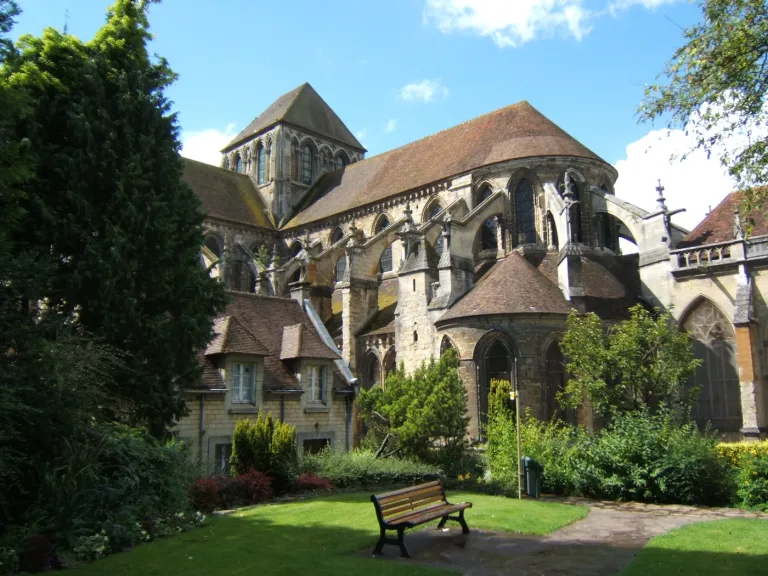
The place of the Martin family at Sunday Mass
Marked site associated with a saintA place of prayer for pilgrims
Sanctuary of LisieuxThe medieval cathedral of Lisieux, begun about 1149, and the parish church of the Martin family. Thérèse heard Sunday Mass here for eleven years, made her first confession here, and prayed here for the conversion of a condemned man.
Come here for the ordinary. The basilica on the hill was built because Thérèse became famous; this church is where she was simply a girl at Mass with her father and her sisters. A plaque in the ambulatory marks where they stood. It is a smaller thing than a basilica and it does more work.
The cathedral of Saint-Pierre was begun about 1149 and is among the earliest Gothic buildings in Normandy. It served as the cathedral of the diocese of Lisieux until that diocese was joined to Bayeux. When Louis Martin brought his daughters to Lisieux in November 1877 this became their parish church, and it stayed so until Thérèse entered the Carmel in April 1888. She made her first confession here to Father Ducellier. The family came to weekday Mass in the chapel at the east end and to high Mass on Sundays in the south ambulatory, where a marble plaque now marks the place. In 1887, at fourteen, she prayed in the Lady chapel for Henri Pranzini, a murderer condemned to death and refusing the sacraments, asking God for a sign that her prayer had been heard; she read afterwards that he had kissed a crucifix at the scaffold, and called him her first child. On Christmas night of 1886 she came home from midnight Mass in this church to the grace at Les Buissonnets that she called her complete conversion. Lisieux was heavily bombed in June 1944 and the cathedral came through it.
Early Gothic, with the sober strength that Norman building keeps even when it goes Gothic. The chevet and its ring of chapels are the best thing about the outside, and the gardens behind give the only clear view of them.
It is a working church rather than a shrine, and it is usually quiet. Pilgrims come with a list of four places to find, and the building rewards putting the list down for a while first.
It marks where Thérèse stood or sat for Sunday high Mass through the years at Les Buissonnets. It is a small thing and it is the most direct contact with her ordinary Sundays anywhere in Lisieux.
In 1887, at fourteen, Thérèse prayed here for Henri Pranzini, a murderer condemned to death and refusing the sacraments. She asked for a sign. He kissed a crucifix at the scaffold, and she called him her first child.
In the north ambulatory. Her first confession was heard here by Father Ducellier.
Thérèse's father paid for an altar in this church. It is a plain reminder that the Martins were parishioners here before they were anything else.
Begun about 1149 and among the earliest Gothic churches in Normandy. It came through the Revolution and through the bombardment of Lisieux in 1944, when much of the town around it did not.
The short visit that follows the family rather than the architecture.
Come between Les Buissonnets and the Carmel; it sits between them on the ground as well as in the story. Give it half an hour and do not skip the Lady chapel.
A place of prayer for pilgrims
Sanctuary of LisieuxShown to pilgrims
Sanctuary of Lisieux; Story of a SoulIn liturgical use
Sanctuary of LisieuxSource note Traditional attributions are presented as tradition, with documentation named where it exists.
Written from the Sanctuary of Lisieux page for the cathedral, the Diocese of Bayeux and Lisieux, and Thérèse's own account in Story of a Soul, with the Wikimedia image provenance given in the credits. The Martin family's places in the building are described as the sanctuary marks them.
August 5, 2026
Use this for corrections, broken links, missing places, and planning ideas.