
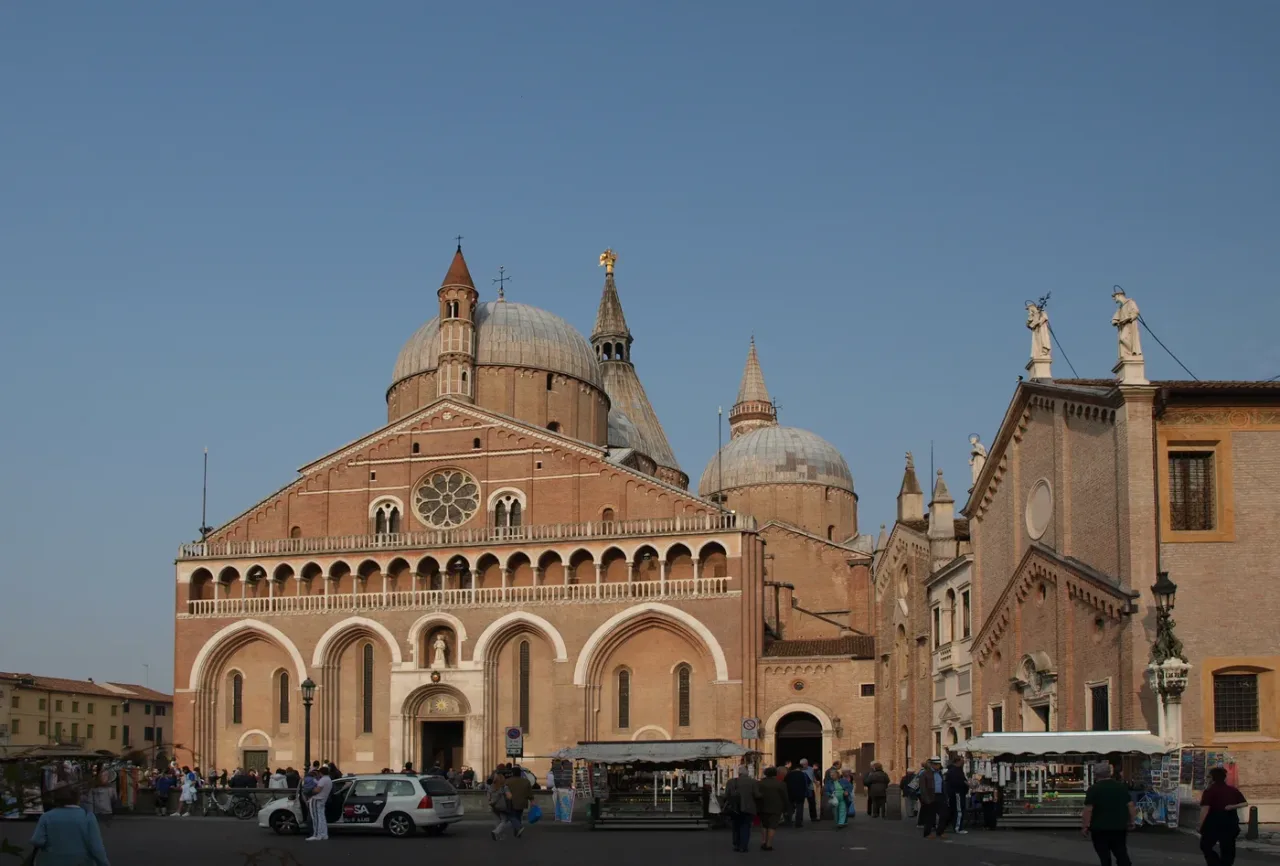
Basilica of St. Anthony of Padua
The basilica the Franciscans built over the tomb of Saint Anthony, where the tomb and the relic chapel are still the reason people come.
- Location
- Padua, Italy 45.4014° N · 11.8807° E
- Type
- Pontifical basilica and Franciscan friary A thirteenth-century church of domes and brick, holding Romanesque, Gothic and Byzantine habits in one building
- Dedication
- Saint Anthony of Padua The tomb of Saint Anthony and the relics in the Chapel of the Treasury
- Time Needed
- 1 hour to half a day
Padua Is Where Anthony Is Buried
Anthony was Portuguese by birth and preached across northern Italy and southern France, so no single city can claim his whole life. Padua can claim his death and his burial. He died just outside the city in 1231, and within a year of his canonisation the Franciscans had begun raising a church over his grave. Pilgrims still arrive to stand at the tomb and ask him for something.
A Church That Grew Around a Grave
Anthony died at Arcella, on the edge of Padua, in June 1231. He was canonised the following year, and the city began building. The result is a church that never settled into one style, because people kept adding to it for centuries: Byzantine domes, a Romanesque brick front, a Gothic interior.
The tomb reached its present setting slowly. The marble Chapel of Saint Anthony was begun in 1500 and finished near the end of that century; the Chapel of the Treasury came at the end of the seventeenth. Both were built to hold something already there. The friars who received the small church of Saint Mary Mater Domini in 1229, in Anthony's own lifetime, are the same order that keeps the basilica now.
The basilica reads as a series of additions rather than a design, with Renaissance and Baroque chapels set into a Gothic frame. The two spaces that matter most to pilgrims are both later insertions: the marble chapel around the tomb, and Parodi's Chapel of the Treasury behind the high altar.
The Chapel of Saint Anthony, begun in 1500 and finished only towards the end of that century, built to hold the tomb
The Chapel of the Treasury, raised at the end of the seventeenth century by Filippo Parodi
The Chapel of Blessed Luke, behind the north wall of the Black Madonna chapel
The Oratory of Saint George, in the square outside
This is a working friary church before it is anything else. The friars keep the hours, hear confession through most of the day in several languages, and give the blessing with the relic in the Chapel of the Treasury. Photography is not allowed anywhere inside, which does more for the atmosphere than any sign asking for silence. The queue at the tomb moves constantly and quietly.
What to notice.
-
The tomb of Saint Anthony
In the Chapel of Saint Anthony on the north side. Walk behind it slowly with the others, hand on the stone. The petitions and photographs left along the wall are the clearest record of what this place is for.
-
The Chapel of the Treasury
Behind the high altar, built by Filippo Parodi at the end of the seventeenth century. The relics of Saint Anthony are kept here, and the friars give the blessing with the relic at published hours through the day.
-
The Chapel of the Black Madonna
The remains of the small church of Saint Mary Mater Domini, given to Anthony in 1229. The oldest thing in the basilica, and the only part he would have known himself.
-
The Chapel of Blessed Luke
Behind the north wall of the Black Madonna chapel. Luke Belludi was Anthony's companion and disciple, and is buried here. A quiet corner that explains something about how devotion to a saint keeps his friends in view.
-
The bronzes of the presbytery
The communion rail carries four bronze statues by Tiziano Aspetti, in place since 1594. Worth a pause on the way between the tomb and the Chapel of the Treasury rather than a detour of its own.
- The basilica was begun almost immediately after Anthony's canonisation in 1232. The speed matters: this was not a shrine built later to explain a devotion, it was built by people who had heard him preach.
- The Friars Minor Conventual have kept this church since the beginning. The friars you see are not custodians brought in to manage a monument; the basilica is their house.
- Photography is prohibited throughout the interior. The result is a church full of people who are present rather than recording, which is unusual for a site of this size.
- The relic of the tongue is venerated by name in the basilica's own devotions. Eternal Roam reports this as the basilica reports it, without pressing the anatomical claim further than the custodian does.
- Confession is heard here for most of the day in several languages. For a great many pilgrims this, and not the art, is the reason for the journey to Padua.
How much time, and what to do with it.
-
The tomb in the Chapel of Saint Anthony, then the Chapel of the Treasury behind the high altar. That is the whole devotional core and it is enough for a real visit.
-
Add the Black Madonna chapel, the chapel of Blessed Luke, the presbytery bronzes, and time in the square outside at the Oratory of Saint George.
-
As above, unhurried, with confession and a Mass, and time to sit in the basilica between the two chapels rather than moving straight through.
Pray at the tomb first and let the queue carry you. Then find the Chapel of the Treasury behind the high altar for the relics and the blessing. Only after both should you look at the church as a building.
How to visit well.
Go to the tomb first. It is in the Chapel of Saint Anthony, on the north side of the church, and you will find it by following people rather than signs. Pilgrims walk slowly behind the tomb with a hand on the stone; the wall beside it is covered with written petitions and photographs left by people asking for help. Join the movement rather than standing to watch it.
The relics are elsewhere. The Chapel of the Treasury, behind the high altar, holds the reliquaries, including the relic of the saint's tongue, which the basilica venerates by name. The friars give the blessing with the relic here through the day at published hours. This is the second half of the visit, not a curiosity to be looked at on the way past.
After that the rest of the church opens up: the Black Madonna chapel, the chapel of Blessed Luke, the bronzes of the presbytery, and the Oratory of Saint George outside in the square. Confession is available for most of the day, which is a large part of why many people come to Padua at all.
- Mass through the day, from before dawn until evening
- Confession heard for most of the day in several languages
- Blessing with the relic of Saint Anthony in the Chapel of the Treasury
- The Office of Readings and Lauds sung by the friars each morning
What pilgrims come to venerate here.
Tomb and Burial
- Saint Anthony of Padua, who died near Padua in 1231 and whose tomb this basilica was built to hold
- Blessed Luke Belludi, a companion and disciple of Saint Anthony, in the chapel that carries his name
Relics and Sacred Tradition
- The relics of Saint Anthony kept in the Chapel of the Treasury, among them the relic of his tongue, which the basilica venerates by name
- The blessing given with the relic of Saint Anthony in the Chapel of the Treasury through the day
Sacred Objects
- The tomb of Saint Anthony, surrounded on every side by written petitions and by the hands of pilgrims resting against the stone
- The Chapel of the Black Madonna, all that survives of the small church of Saint Mary Mater Domini given to Anthony in 1229
- The bronze statues of the communion rail by Tiziano Aspetti, set in place in 1594
Within walking distance.
Plan your visit.
Written against the basilica's own published pages for its chapels, timetable and visitor rules. Mass, confession and the hours for the blessing with the relic change through the year and are published by the friars; check the basilica's timetable before travelling.
August 12, 2026
Photo credits
- Hero. Petar Milošević / Wikimedia Commons (CC BY-SA 3.0). Source. CC BY-SA 3.0.
- The Chapel of the Relics. Didier Descouens / Wikimedia Commons. Source. CC BY-SA 4.0.