
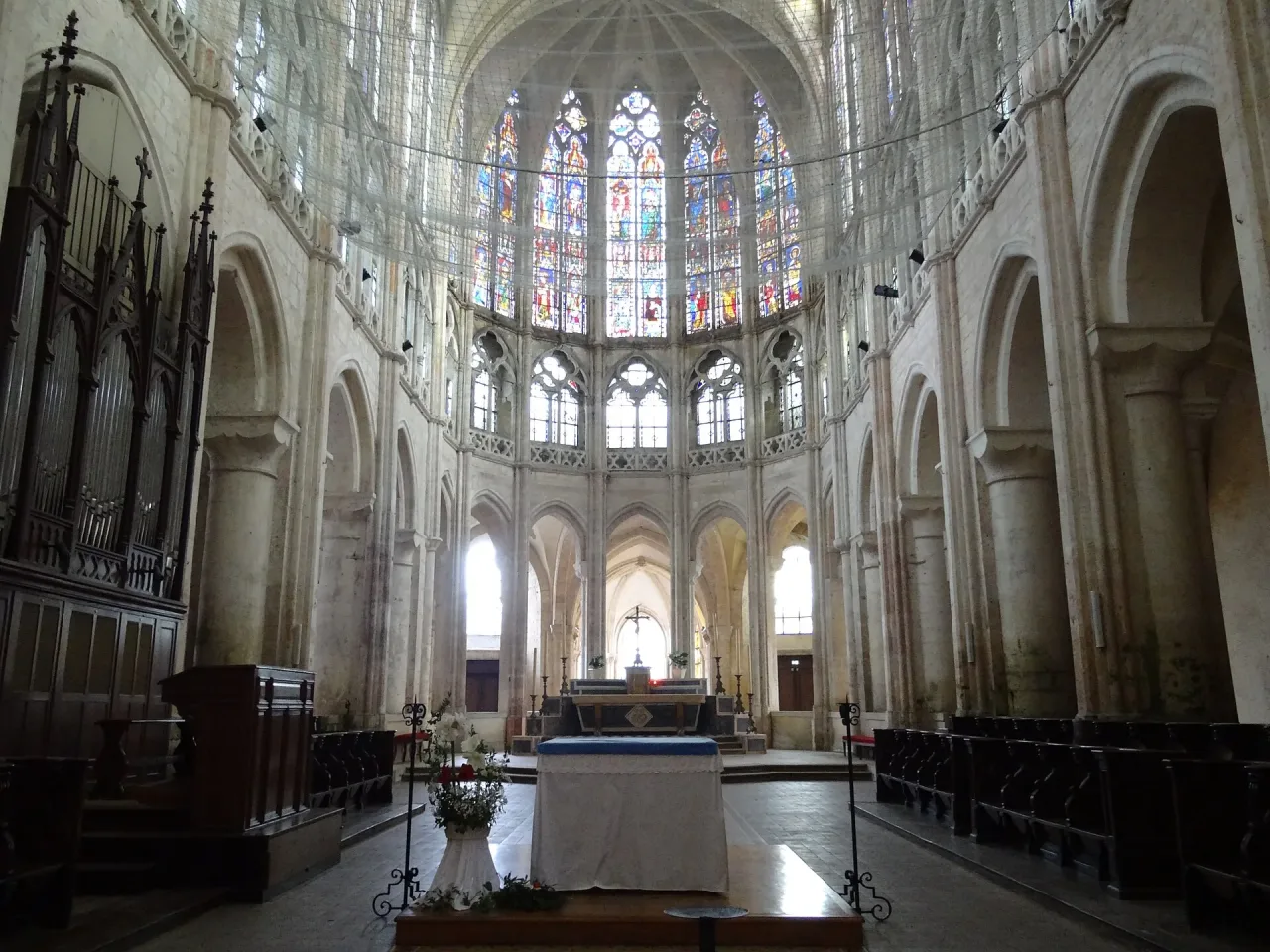
The fourteenth-century glass cycle
Medieval stained glassNot a devotional object; part of the fabric of the church
French Ministry of Culture monument recordsÉglise Saint-Pierre is the church of the Benedictine abbey of Saint-Père-en-Vallée, in the low town below the cathedral. Its tower stands from about the year 1000 and its fourteenth-century glass is among the finest in France.
Come here for the glass, and for the quiet. Chartres is a city where one building takes almost all the attention, and ten minutes downhill there is a church whose windows would be the pride of any other town. Saint-Pierre also tells a story the cathedral cannot: it is what is left of a Benedictine community that prayed on this ground for centuries and was dispersed at the Revolution.
A monastic foundation stood on this low ground by the Eure from an early date, and the abbey was rebuilt around 930 by Aganon, bishop of Chartres. The west tower dates from roughly the year 1000 and is the oldest fabric still standing. The Gothic church rose in stages from the twelfth century into the thirteenth, and the glazing followed: standing Old Testament figures in the straight bays of the choir, then the windows of the apse about 1300, then the nave between about 1305 and 1315. The abbey was suppressed at the Revolution and its buildings taken for other uses, but the church and its windows came through. It was classified as a historic monument in 1840.
The interest of the building is that it was not built at once. Walking from the choir to the west end you move through changing pier forms and window shapes, and the heavy Romanesque tower at the west stands apart from all of it, older than the church it now serves.
This is a monastic church in scale and intention. It was built for a community singing the office, and the wide, high choir is where the building puts its weight. It is still a church of the diocese, but it is not a busy one, and the silence is part of the visit.
Tall figures of patriarchs, prophets and apostles fill the upper windows of the choir. They are among the finest fourteenth-century windows in France, and they are almost always seen by an empty church.
A heavy Romanesque tower from about the year 1000, older than everything around it and older than the Gothic cathedral on the hill. It survives from the abbey that stood here first.
A slender stair turret crowned with a pointed stone roof, added at the turn of the fourteenth century. The local name means the marvel, and it is worth walking round the outside to find.
Choir, transept and nave were built across roughly two centuries, and the piers and windows change as you walk west. Few churches let you read a construction history so plainly.
The short visit: the Romanesque tower from the square, then straight to the crossing for the choir windows.
Come after the cathedral rather than before it, so the scale of the cathedral does not flatten this one. Stand outside first to see the tower, then go in and walk to the crossing before turning east.
Not a devotional object; part of the fabric of the church
French Ministry of Culture monument recordsNot applicable
French Ministry of Culture monument recordsSource note Traditional attributions are presented as tradition, with documentation named where it exists.
Written from the Diocese of Chartres parish listings, the French Ministry of Culture monument record, and C'Chartres Tourisme, with the Wikimedia image provenance given in the credits. Visiting hours are described as unreliable because the tourist office itself flags them that way.
August 5, 2026
Use this for corrections, broken links, missing places, and planning ideas.