Pontifical Sanctuary of the Holy House of Loreto

The Marian sanctuary of the Marche, where a great Renaissance basilica was built around three small stone walls.

ITALY · LORETO 43.4409° N · 13.6109° E
Location
Loreto, Italy 43.4409° N · 13.6109° E
Type
Pontifical sanctuary and basilica, under a papal delegate
Dedication
The Blessed Virgin Mary under the title of Our Lady of Loreto. The building exists to house and protect the Holy House.
Why Go

A basilica built around a house

Loreto is the reverse of almost every other great church. Elsewhere the building comes first and the relics are placed inside it. Here the walls came first, and everything else in the sanctuary was raised to protect and honor them: a marble screen carved by the best sculptors in Italy, a dome, a nave, a ring of fortified apses, and finally a square with a palace along one side.

What stands at the center is small and plain. Three walls of stone and brick, about eight and a half meters by four, roughly the size of a single room. Catholic tradition venerates them as the walls of the house at Nazareth where Mary lived and received the announcement of the angel. Pilgrims have come for that reason since the end of the thirteenth century, and popes have come with them.

The sanctuary is worth the journey for the same reason it has always been worth it: not because the stones settle a historical question, but because Catholics have prayed the Annunciation here for seven centuries, and the building around them is one of the most intelligent things the Italian Renaissance ever made.

Loreto is a shrine of the Incarnation before it is a shrine of a relic. What the Church asks a pilgrim to contemplate here is the event the house is remembered for, not a settled account of how the stones arrived.

What the walls are, and what is known about them

The Holy House is not a complete building. It is three walls with no fourth side of its own, and the sanctuary's own account explains why: at Nazareth the dwelling was a masonry front built against a grotto in the rock, and the grotto was the fourth room. That cave is still in Nazareth, beneath the Basilica of the Annunciation. The three walls at Loreto are traditionally identified with the built front of that same dwelling. A fourth wall was added at Loreto to close the room, and the image of Our Lady of Loreto stands against it.

Catholic tradition holds that the house was carried from Nazareth by angels, arriving on the laurel hill above the Adriatic in December 1294. That tradition is old, it is what the shrine has always taught, and the sanctuary itself had it carved in marble on the outside of the screen in the sixteenth century. The sanctuary also sets beside it a second reading of the same events: that after the crusader states fell in 1291, Christians saved the stones of the house and brought them west by sea, by way of Illyria, where the shrine at Trsat preserves the memory of that stage. Popular accounts often name a particular family as the carriers. The documents on which that identification rests were published only in the twentieth century, from copies rather than originals, and historians have questioned them, so Eternal Roam does not present the shippers as known.

What the excavations found is narrower and firmer. Between 1962 and 1965 the ground beneath the walls was opened under the direction of Nereo Alfieri of the University of Bologna, with the geologist Edmondo Forlani. The three walls have no foundations of their own. They stand on bare, uneven ground, over the line of what had been a public road. Whatever else is true, the structure was not built where it now stands. The sanctuary adds two further arguments from the material itself: that the stone does not match the building practice of the surrounding Recanati countryside but matches Palestinian work of the Roman period, and that the plan of the three walls corresponds to the perimeter of the grotto at Nazareth. It also cites graffiti of early Judeo-Christian character found on the stones. These are the shrine's arguments, and they are serious ones, but they belong to a case still argued rather than a matter closed.

What can be said plainly is this. The devotion is documented from the end of the thirteenth century. Clement V granted indulgences to pilgrims here in 1310, and Paul II wrote openly of the translation in 1464. The stones are old, they are foreign to the hill they rest on, and Catholics have prayed before them without interruption for seven hundred years.

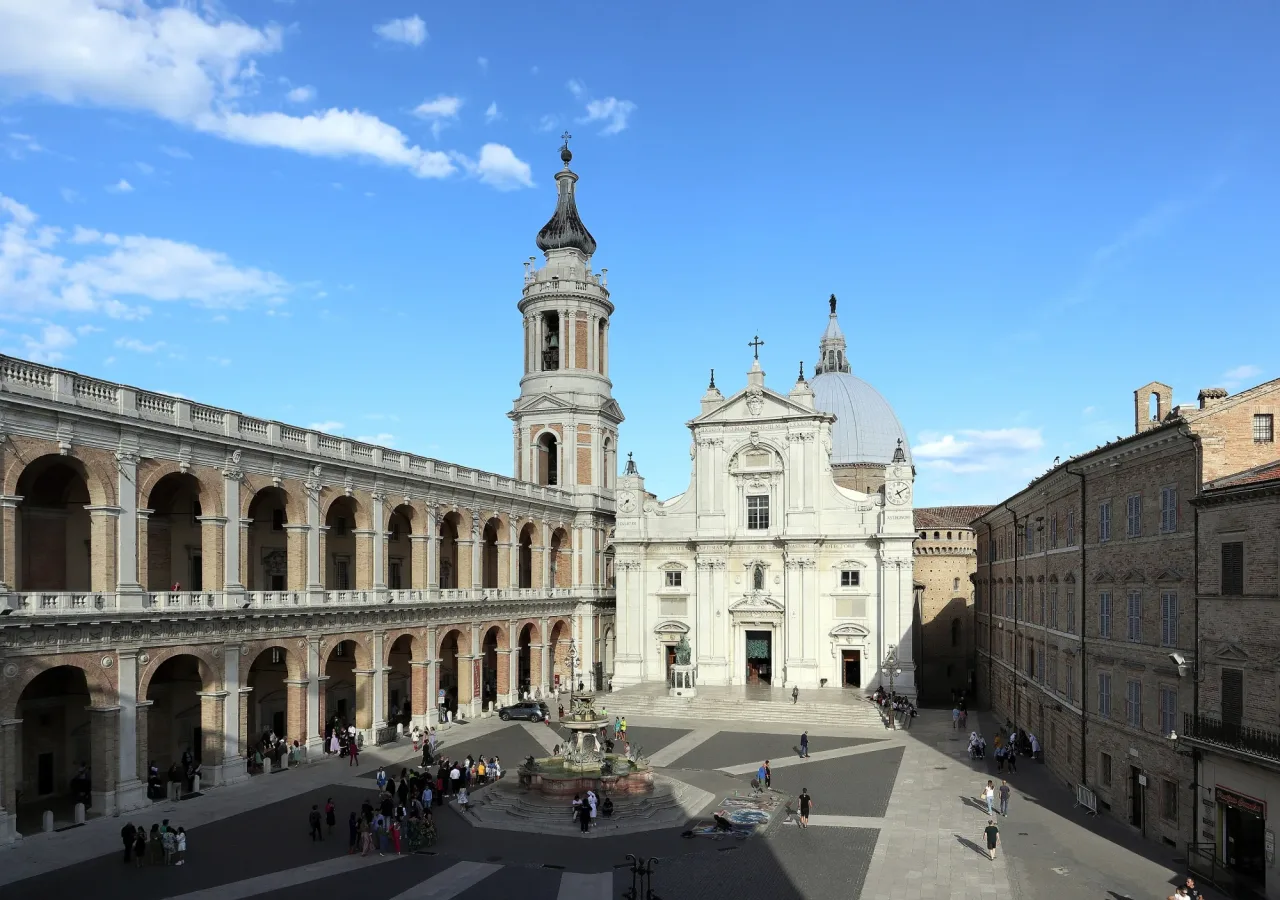
Approach from Piazza della Madonna and the sequence is legible in one view. The square gathers pilgrims in front of a white marble facade finished in 1587 under Sixtus V, with Vanvitelli's bell tower beside it and the dome behind. Walk around the east end and the building changes character entirely: brick, blank, ringed by round apses with battlements and a covered wall-walk. That is not decoration. Loreto stood exposed to Adriatic raiding, and the church was fortified because of what it holds.

Inside, the nave runs east and the dome marks the crossing. Under the dome stands a rectangular block of white marble about as tall as a house, carved on all four sides with prophets, sibyls, and scenes from the life of the Virgin. This is the screen, and it is not the Holy House. Julius II sent Bramante to design it in 1507. Andrea Sansovino directed the carving from 1513, and the work continued under Leo X, Clement VII, and Paul III, passing through Antonio da Sangallo the Younger, Girolamo Lombardo, Baccio Bandinelli, Raffaello da Montelupo, and others before it was finished. The Annunciation on the west face, toward the nave, is Sansovino's.

The walls that pilgrims come for are inside that marble box. You go in through a low door, and the change is the point of the whole building: from the most accomplished sculpture of the High Renaissance to rough stone, a lamp-darkened ceiling, and a room the size of a small kitchen.

Read the Place

How to read the sanctuary.

Four layers, from the outside in. Reading them in order keeps the marble from being mistaken for the house.

The square and the palace

Piazza della Madonna is the arrival room. The arcaded Apostolic Palace along its side was begun to Bramante's design as lodging for pilgrims and popes, and the square has been the gathering point for arriving pilgrimages for centuries.

The fortress at the east end

The apses and the wall-walk are defensive work of the late fifteenth century. Seen from behind, the basilica reads as a castle. It was built that way because a hill above the Adriatic holding a famous treasure was a target.

The marble screen

Designed by Bramante from 1507 and carved from 1513 under Andrea Sansovino, with Sangallo, Lombardo, Bandinelli and others after him. It is a Renaissance shell built to honor what is inside it. Nothing on its carved surface is claimed to be ancient.

The three walls

Inside the screen, through a low door. Undressed stone and brick, a single small room, a fourth wall added at Loreto with the Marian image above the altar. This is what the whole sanctuary was built to hold.

The east end from outside: round apses, battlements, and a covered wall-walk. The sanctuary was fortified because of what it holds.
Spiritual Significance

Benedict XVI, preaching at Loreto in 2012 on the fiftieth anniversary of John XXIII's pilgrimage here, called Mary's house a physical, tangible witness to the greatest event in our history, and said that in accepting the angel's word she offered her own body to become a living house for the Lord. That is the shrine's real subject. God asked, and a young woman in an ordinary room in an unimportant town said yes.

Benedict also noticed something the excavations had turned up and made it preaching: the house stands on a street. A dwelling open to the road, he said, is a reminder that we are always on the way to another home. The point of Loreto is not that a house flew. The point is that the Word was made flesh in a house, and that Catholics have wanted to stand in the smallest possible room to say so.

That is why the sanctuary has drawn popes and why it keeps drawing the young. Francis signed Christus vivit here in 2019, tying the Holy House to vocation and to Mary's answer, and in the same year Our Lady of Loreto was entered in the universal Roman Calendar on December 10.

Two smaller things belong to the same devotion. The Litany of the Blessed Virgin Mary is commonly called the Litany of Loreto, but it was not written here. It belongs to a family of Marian litanies circulating from the twelfth century, reached its fixed form around 1500, and became known by this name because it was sung at the shrine, recorded here by 1558, and carried away by the pilgrims who heard it; Sixtus V approved it in 1587. And in 1920 Benedict XV named Our Lady of Loreto patroness of air travelers, a patronage that follows from the translation tradition rather than from anything in the house itself.

The sanctuary is served by the Capuchin Friars Minor under a papal delegate, so the Mass, the confessional and the sacristy are the work of a resident community rather than of a monument staff.

The west face of the marble screen, seen from the nave. Andrea Sansovino's Annunciation is at the center, so the first thing the screen shows a pilgrim is the event the house is remembered for.
Do Not Miss · 5 stops

Five things to notice, in the order you meet them.

  1. The fortified apses from Via Marconi

    Walk the outside of the east end before you go in. Round brick towers, battlements, and a covered wall-walk explain the sanctuary's history in one look.

  2. The Translation relief on the screen

    On the outside of the marble, the house is shown borne over the sea by angels, carved by Tribolo and Francesco da Sangallo. The shrine put its own tradition into stone rather than hiding it.

  3. The grooves worn into the marble step

    Along the base of the screen, two channels are worn deep into the stone by pilgrims circling the house on their knees. It is the most direct evidence on the site of what people have actually done here.

  4. The change of surface at the door

    Step from Sansovino's carving into the room itself and the contrast is deliberate. Rough stone, a low ceiling, darkened walls. Stand still for a moment before looking for anything.

  5. The Annunciation on the west face

    Sansovino's relief faces the nave, so the first thing the screen shows an arriving pilgrim is the event the house is remembered for.

What to notice
  • The room is small enough that a group of twenty fills it. Movement is slow and mostly silent, and people leave when they have prayed rather than when they have finished looking.
  • The walls are darkened by centuries of lamps and candles, not by age alone.
  • Mass is celebrated inside the Holy House itself in the early morning. If you can attend it, that is the visit.
Visit Plans · 3 plans · add to a journey

How much time, and what to do with it.

  • Duration 60 to 90 minutes Best for A first visit, or a stop between Ancona and the south

    The house and the basilica

    5 ordered stops

    Arrive in the square, walk the outside of the east end to see the fortifications, then go in.

    1. Piazza della Madonna and the facade
    2. The fortified apses from outside
    3. The nave and the west face of the marble screen
    4. Inside the Holy House
    5. A slow circuit of the screen, reading the reliefs
  • Duration Half a day Best for Pilgrims who came for Loreto rather than past it

    Mass, confession, and the museum

    5 ordered stops

    The difference between a visit and a pilgrimage here is whether you receive the sacraments in the place.

    1. Morning Mass, in the Holy House if you can
    2. Confession
    3. The chapels of the nations around the ambulatory
    4. The Pontifical Museum in the Apostolic Palace
    5. The square, unhurried, at the end
  • Duration Overnight Best for Anyone arriving from Rome or heading on down the Adriatic

    Stay on the hill

    4 ordered stops

    Staying means the sanctuary at its two best hours, early morning and after the coaches have gone.

    1. Evening in the empty square
    2. Early Mass in the Holy House
    3. The museum without a queue
    4. The town walls and the view to the Adriatic

Come early. The sanctuary is at its best before the coaches arrive, and the Mass celebrated inside the Holy House is a morning one.

How to Visit

How to visit well.

Come in by the main door on the square and walk up the nave. Do not go straight to the low door in the marble; take the outside of the screen first, slowly, so that you understand what you are about to walk into. The reliefs run through the life of the Virgin, and the Translation is carved on the outer face.

The door into the Holy House is small and the room holds few people. Pilgrims go in, pray, and leave. There is no route to follow inside and nothing to look for. The walls are rough and dark, the fourth wall carries the altar and the Marian image, and that is the whole of it.

If the sanctuary is busy, the flow is controlled and the House closes while Mass is being celebrated inside it. Photography needs permission from the sanctuary, so plan to keep the camera down. Confession is heard through the day in several languages, and for most pilgrims that, with a Mass, is what makes the difference between having seen Loreto and having made the pilgrimage.

Current Practical Info · reviewed August 19, 2026

A free, working sanctuary with a small room at its center and a queue at busy hours.

Entry to the basilica and the Holy House is free. The sanctuary keeps long daily hours from early morning to evening, with Mass through the day and confession available in two long sittings. Exact times change with the season and the calendar, so take them from the sanctuary rather than from here.

Address
Piazza della Madonna 1, 60025 Loreto AN, Italy
Admission
Free to the basilica and the Holy House. The Pontifical Museum charges separately.
Entering the Holy House
Pilgrims go inside. Access pauses during Mass in the House and at busy feast times.
Photography
Permission is required from the sanctuary press office. Do not assume you may photograph inside the Holy House.
Getting there
Loreto station sits on the plain about two kilometers below the town, with a steady climb to the sanctuary. Local buses and taxis run up the hill.
Sanctuary hours
Long daily hours, from early morning to evening, with a shorter window at the sacristy. Confirm current opening on the sanctuary site before traveling.
Mass
Celebrated several times daily, including an early morning Mass inside the Holy House itself. Sunday and feast-day schedules differ. The Holy House Mass is the one to plan around.
Confession
Available daily in a long morning sitting and a long afternoon sitting, in several languages.
Entering the Holy House
Free and open to pilgrims, with access suspended while Mass is celebrated inside and controlled when crowds are heavy.
Additional schedule notes

Photography and filming

  • Treat the interior of the Holy House as a place of prayer first. Many pilgrims are praying at close quarters.
  • Requests are made to the sanctuary press office rather than at the door.

Busiest days

  • Youth pilgrimages gather here in numbers at set points in the year.
  • Outside those days the sanctuary is quiet enough for an unhurried visit, particularly early.

The museum

  • It holds the Lorenzo Lotto paintings and the sanctuary's collections.
  • Opening days are narrower than the basilica's. Check before counting on it.
Relics, Tombs, Sacred Objects

What is venerated here, and on what basis.

The marble screen, not the Holy House The marble screen under the dome. The Renaissance carving is the shell; the venerated walls are the small room inside it, entered through the low door.

The Holy House

Three stone walls, venerated as the house of Mary at Nazareth

The devotional center of the sanctuary and the reason the basilica exists. Catholic tradition venerates the three walls as the built front of the dwelling at Nazareth where Mary received the Annunciation, the grotto behind that dwelling remaining in Nazareth. Pilgrims enter through a low door, pray in the room, and many circle the outside of the marble screen on their knees.

Pontifical Sanctuary of the Holy House of Loreto; excavations of 1962 to 1965 directed by Nereo Alfieri, University of Bologna
Traditional

The devotion is documented continuously from the late thirteenth century and has been carried by the popes ever since. The material identification with Nazareth is argued rather than established: excavation showed the walls have no foundations and stand on an old road surface, so they were not built here, and the sanctuary cites masonry, stone type, and dimensional correspondences with the grotto at Nazareth. How the stones came west is not settled.

The image of Our Lady of Loreto

Devotional statue, carved 1922

Set against the fourth wall, the one added at Loreto, above the altar in the Holy House. The statue pilgrims see today was carved in 1922 after the earlier image was destroyed in a fire inside the Holy House in 1921.

Pontifical Sanctuary of the Holy House of Loreto
Documented

Documented by the sanctuary. The present image is modern and the shrine says so plainly.

Source note Traditional attributions are presented as tradition, with documentation named where it exists.

Map · Loreto, Italy

Plan your visit.

Editorial sources

Built from the Pontifical Sanctuary's own history and visitor material, read directly, with the Vatican text of Benedict XVI's homily at Loreto on October 4, 2012 for the theological framing and the anniversary of John XXIII's 1962 pilgrimage. The 1962 to 1965 excavation under Nereo Alfieri is reported as the sanctuary and the published accounts report it. The archaeological arguments for a Palestinian origin are attributed to the sanctuary rather than asserted, and the identification of who carried the stones west is left open because the documents behind the usual attribution are late copies whose authenticity historians dispute. Hours, Mass times, confession windows, and photography rules are described as patterns and linked to the sanctuary rather than transcribed.

Last reviewed

August 19, 2026

Photo credits
  1. Hero. Terragio67 / Wikimedia Commons. Source. CC BY-SA 4.0.
  2. Detail. Waldemar L / Wikimedia Commons (CC BY-SA 4.0). Source. CC BY-SA 4.0.
  3. Detail. Sailko / Wikimedia Commons (CC BY 3.0). Source. CC BY 3.0.
  4. The marble screen, not the Holy House. Helvio ricina / Wikimedia Commons (CC BY-SA 4.0). Source. CC BY-SA 4.0.
  5. The Translation relief on the screen. Sailko / Wikimedia Commons (CC BY 3.0). Source. CC BY 3.0.
  6. The grooves worn into the marble step. Sailko / Wikimedia Commons (CC BY 3.0). Source. CC BY 3.0.