
Eremo delle Carceri
The hermitage above Assisi where Francis withdrew to pray, kept by the Capuchin Franciscans at the modest scale he lived.
- Location
- Assisi, Italy
- 43.0784° N · 12.6432° E
- Type
- Franciscan hermitage in the custody of the Capuchin Franciscans
- Small 14th-century church enclosing the original oratory, hermit cells stacked into the hillside above a wooded ravine
- Monastic Tradition
- Franciscan hermitage in continuous custody since the 13th century
- Hermitage of Saint Francis and his earliest brothers, kept today by the Capuchin Franciscans
- Time Needed
- 1 hour to half a day
Above the Town, Among the Oaks
Come here for the silence, and for what the silence asks of the rest of the visit. The road climbs from above the Basilica of Saint Francis through oak woods to roughly 800 meters, and the air changes as it climbs. The buildings, once reached, are kept small. Approach after the basilicas, not before.
Carceri Means Enclosure
Carceri does not mean prison. It means enclosure: a place of withdrawal. Francis and his earliest brothers used the natural caves on this slope of Mount Subasio for solitary prayer, returning to the Porziuncola or San Damiano between retreats. A small oratory was built at the place; the present 14th-century church was raised around it, and Saint Bernardino of Siena enlarged the cells and the cloister in the 15th century without breaking the modest scale of the original. The Capuchin Franciscans have kept the hermitage in continuous custody since then.
The buildings are stacked into the hillside above a dry ravine, the Fosso delle Carceri, spanned by a short stone bridge at the entrance. The 14th-century church encloses the original oratory of Saint Mary. A narrow stair descends from the church into the grotto traditionally identified as the place where Francis slept. The Capuchin cells are arranged along the slope, none of them larger than they need to be. Beyond the buildings the hermitage gives way to the Bosco Sacro, the protected oak wood that has shielded the site for eight centuries.
Carceri means enclosures: places of retreat and prayer, not penal. Francis and his earliest brothers used the natural caves on this slope of Mount Subasio for solitary withdrawal.
Francis returned here repeatedly between his work in the towns and his stays at the Porziuncola.
Saint Bernardino of Siena enlarged the cells and the cloister in the 15th century without breaking the modest scale of the original.
The Capuchin Franciscans have kept the site as a hermitage rather than a museum, with strict silence inside the buildings and quiet asked for along the paths.
A monastery is best understood by the life it was built to sustain.
The Carceri is the quietest place in the Assisi geography. The Capuchins keep it as a hermitage rather than as a museum, and the woods around it absorb the visitor traffic that crowds the basilicas below. Silence is asked for inside the buildings and along the paths above them. The site is best entered slowly and left slowly.
- The change in air as the road climbs above the town. The Carceri is a measurable ascent, roughly 800 meters against Assisi's 424.
- The scale of the cells and the grotto, kept as Francis lived rather than enlarged into a monument.
- The dry ravine running beneath the bridge for most of the year. The Fosso fills only in heavy rain.
- How the woods absorb the pilgrim traffic that crowds the basilicas below.
What to notice.
-
01
The grotto of Saint Francis
Reached by a narrow stair descending from the church. The natural cave traditionally identified as the place where Francis slept.
-
02
The original oratory of Saint Mary
The small chapel around which the later church was built. The contemplative center of the hermitage.
-
03
The bridge over the Fosso delle Carceri
The dry stone ravine at the entrance; the bridge marks the threshold between the road and the hermitage.
-
04
The holm oak above the cells
The Leccio di San Francesco, traditionally associated with the sermon to the birds.
-
05
The Bosco Sacro
The protected oak wood above the hermitage. The site only opens fully when the woods are walked.
See all 5 · 2 more
- The holm oak above the cells The Leccio di San Francesco, traditionally associated with the sermon to the birds.
- The Bosco Sacro The protected oak wood above the hermitage. The site only opens fully when the woods are walked.
How much time, and what to do with it.
-
1 hour Pilgrims with limited time at the hermitage.
The Hermitage Itself
Cross the bridge into the piazzale, visit the church and the original oratory, descend to the grotto, and walk a short way into the Bosco Sacro before returning.
-
Half day Pilgrims who want the silence the basilicas alone do not give. Approached after the in-town churches, not before.
After the Basilicas: Ascending to the Carceri
Begin at the Basilica of Saint Francis, then climb from the Porta Cappuccini to the hermitage. Walk down through the woods at the end of the day.
- Pray at the tomb of Saint Francis in the lower basilica.
- Walk up through the old town to the Porta Cappuccini above the basilica.
- Take the road or the footpath through the oak woods up to the hermitage.
- Visit the church, the original oratory, and the grotto. Sit in the woods above the cells.
- Descend on foot through the Bosco Sacro if the season is mild, or by short taxi or bus.
-
Full day Pilgrims who want the two quietest sites in the cluster in one walked day.
The Two Quiet Sites: Carceri and San Damiano
The Carceri in the morning while the air is cool; San Damiano in the afternoon while the town basilicas are crowded.
- Begin at the Carceri in the morning. Walk up if possible.
- Sit in the hermitage and walk a short way into the Bosco Sacro.
- Return to Assisi for a midday rest while the town basilicas are busiest.
- Walk down to San Damiano in the late afternoon when the light softens.
- Sit in the garden behind the apse where the Canticle of the Creatures was composed.
Approach the Carceri after the basilicas, not before. If possible, walk at least one direction. Allow the buildings to be smaller and quieter than the basilicas; that is the point. Leave the climbing for the visit itself, not for the way back.
How to visit without rushing.
-
Silent pilgrim prayer in the small church and at the grotto
-
Liturgy of the Hours kept by the resident Capuchin community
-
Time of silence in the woods around the hermitage
-
Pilgrim Mass on the Franciscan feasts when announced
See all 4 · 1 more
- Pilgrim Mass on the Franciscan feasts when announced
What pilgrims come to notice and venerate.
Tomb and Burial
- No major tomb is preserved at the Carceri. The site is a place of prayer rather than of relics; Francis came here to withdraw, not to be remembered.
Relics and Sacred Tradition
- The grotto where Francis is traditionally said to have slept and prayed is the principal sacred object of the site.
- The cells of the earliest brothers are preserved at their original modest scale along the hillside.
Sacred Objects
- The original oratory of Saint Mary, around which the later 14th-century church was built.
- The small stone bridge spanning the dry ravine of the Fosso delle Carceri at the entrance to the hermitage.
- The holm oak (Leccio di San Francesco) above the buildings, traditionally associated with the sermon to the birds.
- The Bosco Sacro, the protected oak wood that has shielded the hermitage for eight centuries.
The lives remembered here.
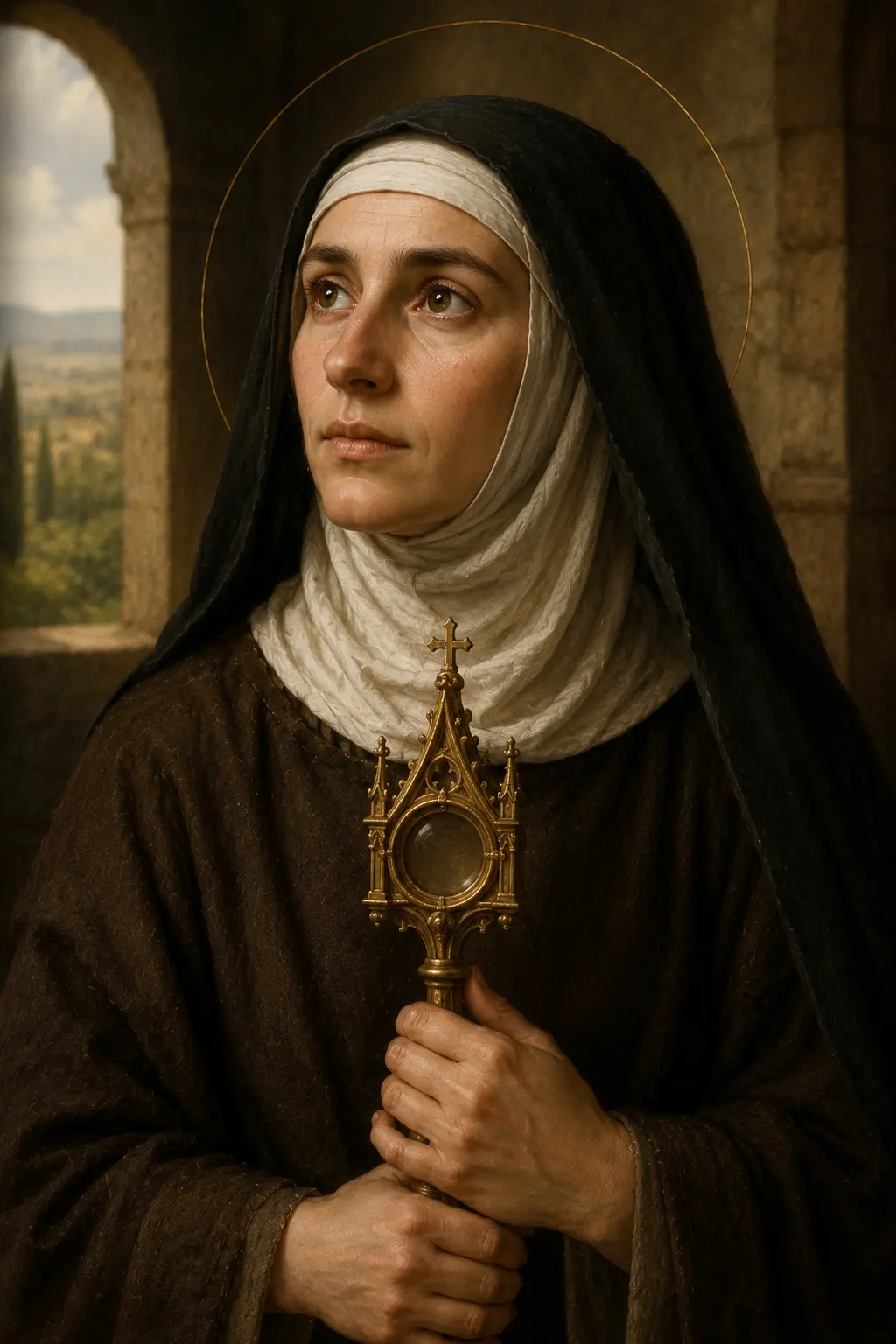
- Saint Clare of Assisi Francis's hermitage above the town Clare stayed within walls she had chosen. Francis withdrew to the woods above the town.
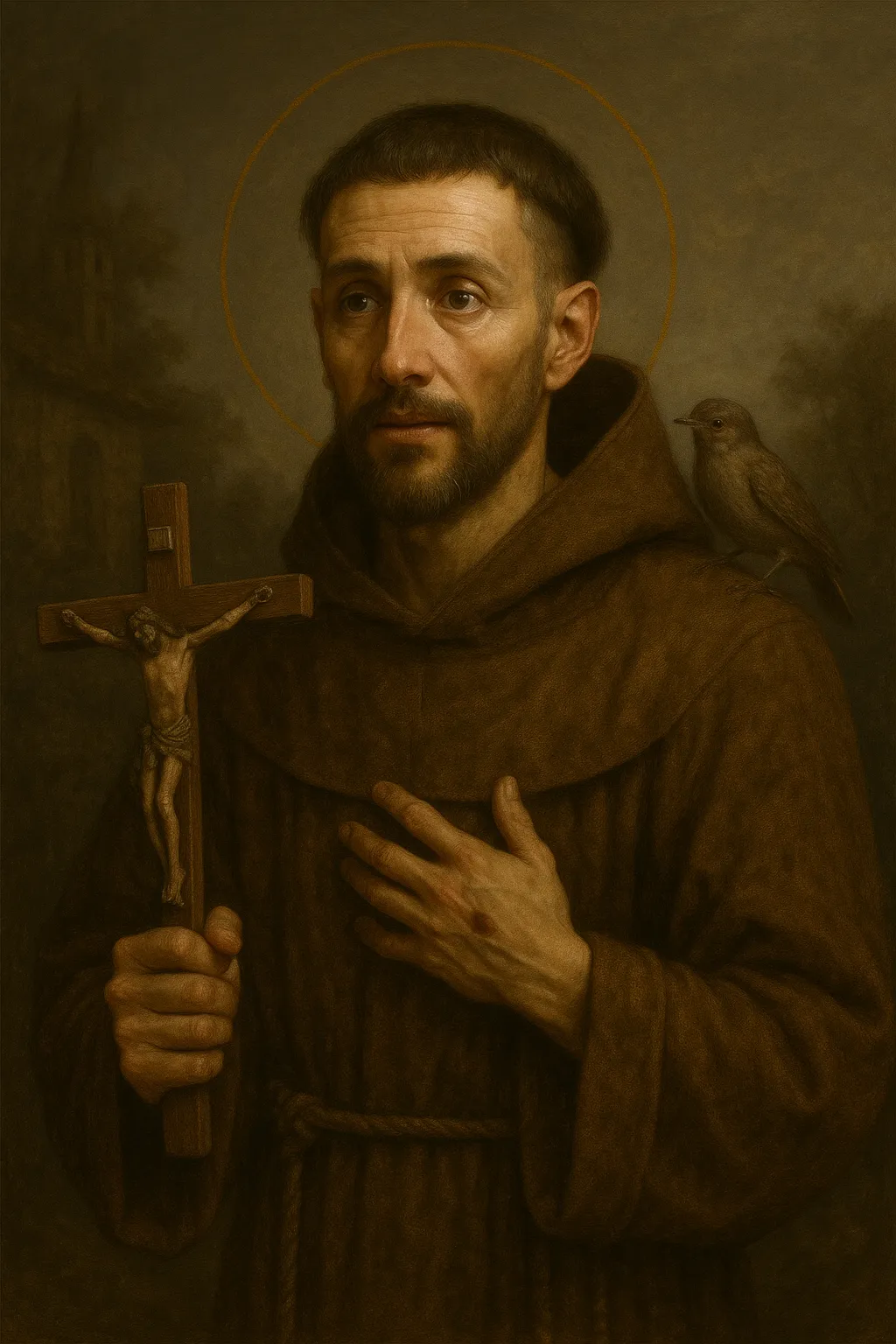
- Saint Francis of Assisi Hermitage of his withdrawal Francis used the caves on this slope of Mount Subasio for solitary prayer through the years of his ministry, returning here repeatedly between his work in the towns and his stays at the Porziuncola.
-
Saint Bernardino of Siena Enlarged the hermitage in the 15th century Bernardino of Siena enlarged the cells and the cloister of the Carceri without breaking the modest scale of the original. The hermitage has remained at the size he left it.
Within walking distance.
-
City hub
Assisi
Where this church sits within the wider Catholic geography of Assisi.
-
Sacred place
Basilica of Saint Francis
The climb to the Carceri begins above the basilica's piazza, at the Porta Cappuccini. The two sites are the eastern and western anchors of the Franciscan geography above the town.
-
Sacred place
San Damiano
The other quiet site in the cluster, below the southern walls. The pair often visited together.
-
Sacred place
Basilica of Saint Clare
The basilica over the tomb of Clare, on the southern slope of the old town.
-
Sacred place
Porziuncola at Santa Maria degli Angeli
The small chapel in the plain below. Francis moved between the Porziuncola and the Carceri throughout his life, the valley for the brothers, the woods for himself.
Plan your visit.
The Capuchin Franciscans keep the Eremo delle Carceri as a working hermitage. Visiting hours are seasonal and respect the brothers' prayer schedule; check the official schedule before going. Silence is observed inside the buildings and is asked for in the woods around them.
Pending review.
Photo credits
- Hero. Gunnar Bach Pedersen / Wikimedia Commons (Public domain). Source. Public domain.