
Siena

The city that raised Catherine, and holds half of her

Catholic Siena, for a pilgrim, is smaller than Catholic Siena for a tourist. Two places carry Saint Catherine: the house her family rented in Fontebranda, now a complex of oratories, and the Dominican basilica on the hill above it where the relic of her head is venerated. They are five to seven minutes apart on a steep street. The rest of her is in Rome.

Region
Tuscany
Suggested time
Half a day for the two Catherine places, or a full day with the rest of the city
Places
2
Saints
2
Visit plans
2

A saint's own district

How the two Catherine places fit together

Most saints' cities give you a shrine. Siena gives you a neighborhood. Catherine was a dyer's daughter from Fontebranda who never entered a convent, never held office, and could barely write, and the two places that matter here are the house she lived in and the parish-scale church at the top of her street. The distance between them is the distance she actually walked. What Siena does not have is her body, and that absence is part of the story rather than a gap in it: her relics were divided in the 1380s and have stayed divided since.

Slope and hill

Her Siena was vertical

Family and neighborhood

Dominican formation

Prayer and mystical life

Relics and veneration

Fontebranda and Camporegio

One street, top to bottom

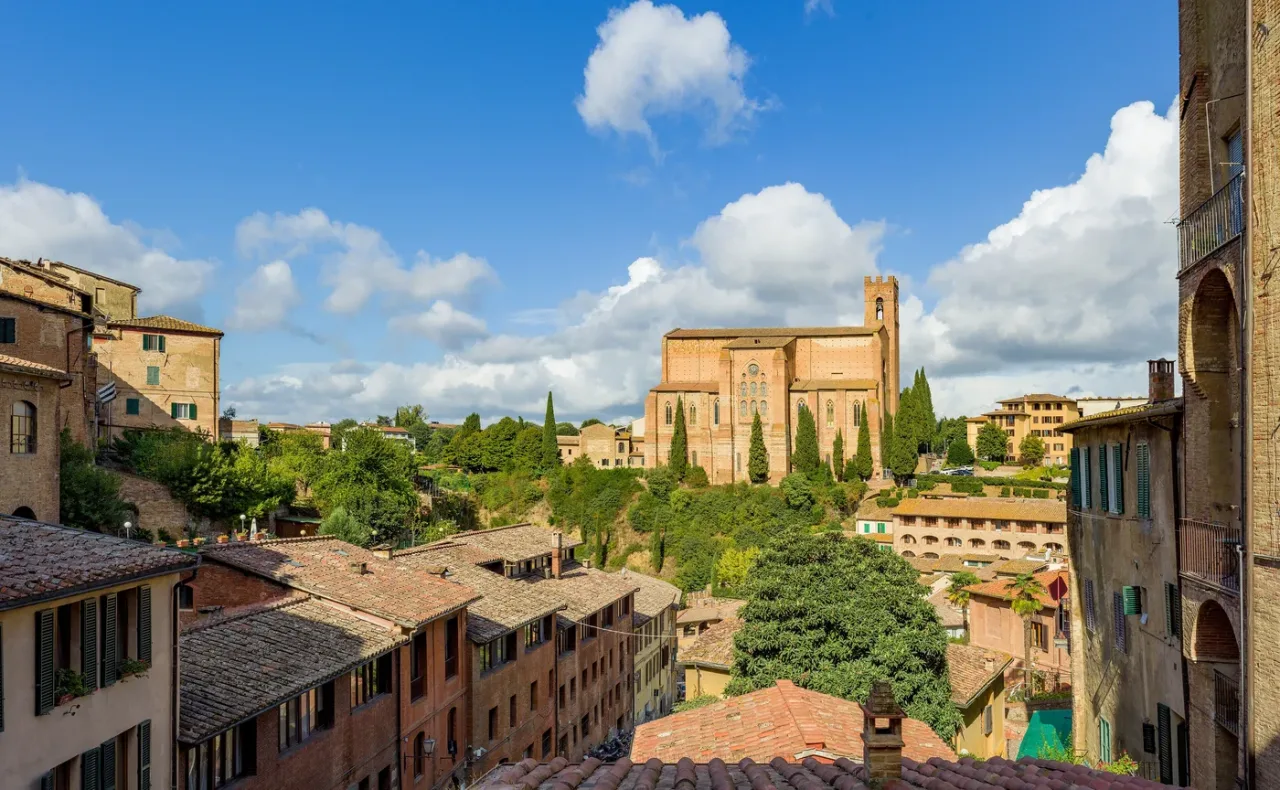
Catherine's Siena is not spread across the city. It is a single slope on the northwest side of the walled center. Fontebranda is at the bottom, named for the covered spring the wool guild built there, and it was a working district of dyers and weavers. The Benincasa house is a few steps above the spring, on Costa Sant'Antonio. The Camporegio hill rises directly behind it, and the Dominicans have been on top of that hill since 1225. From her door she could see the church; from the church you look down on the roof of her house. The whole of her Siena is about two hundred meters horizontally and a hard climb vertically.

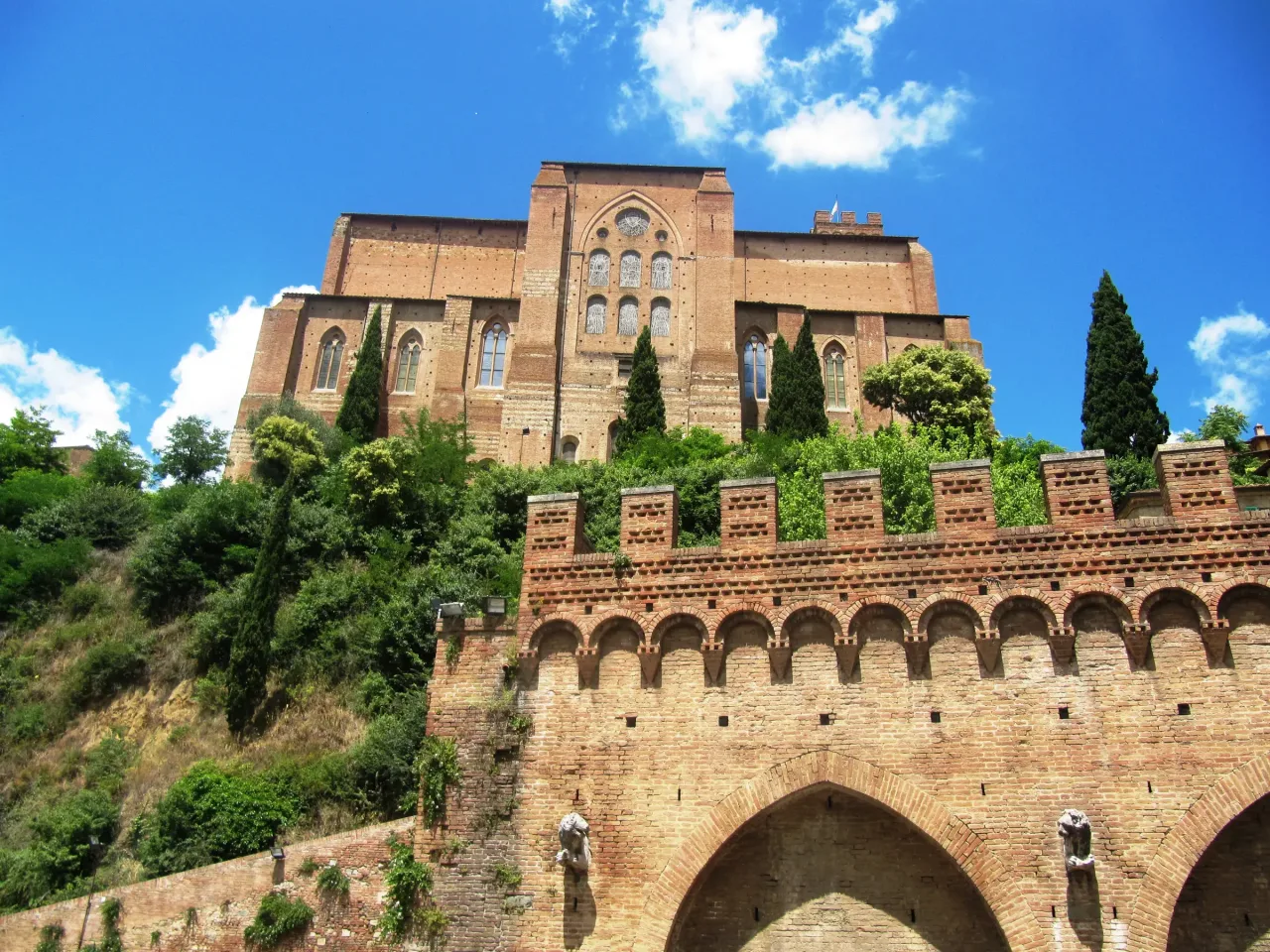
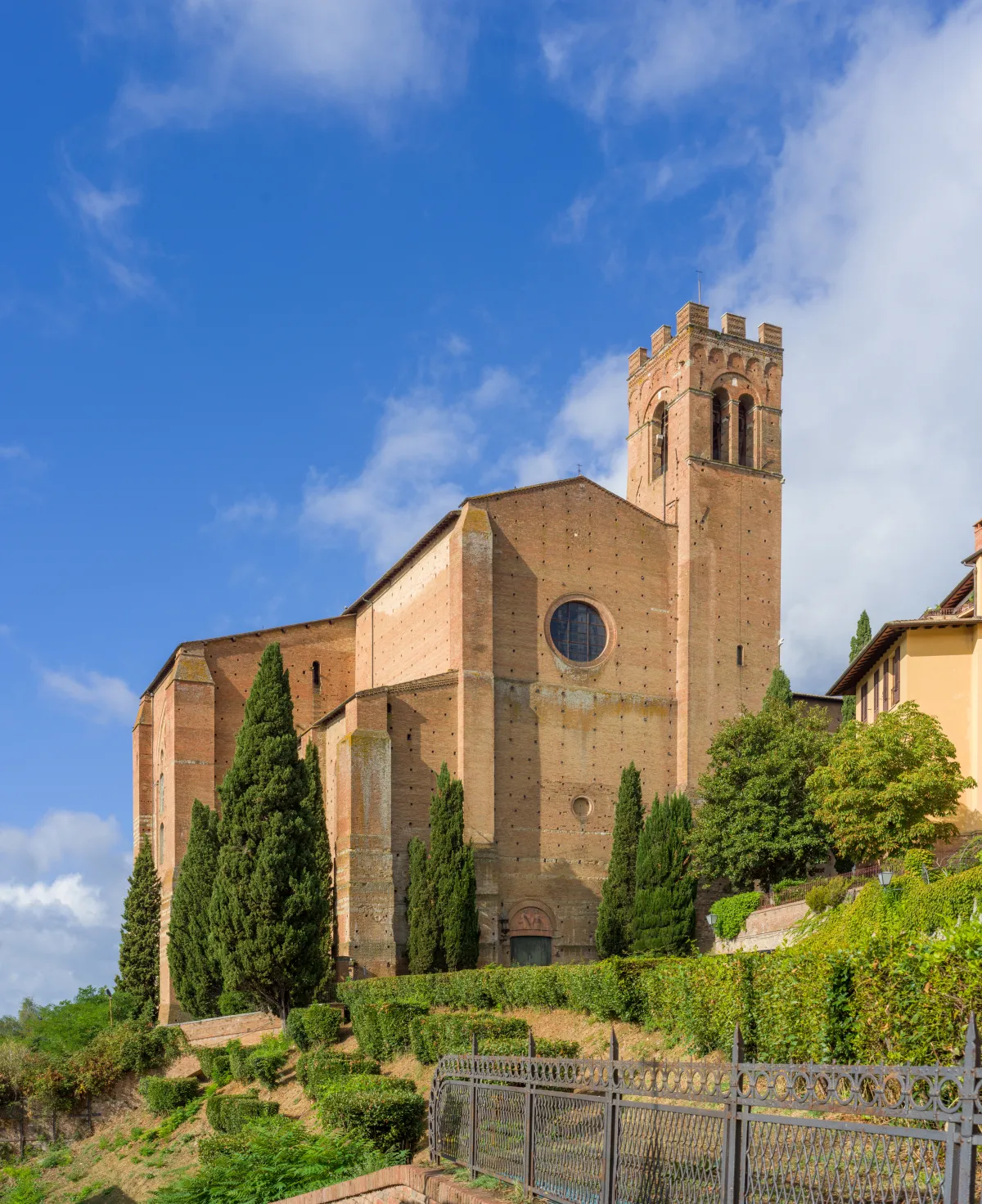
The brick flank and campanile of the Basilica of San Domenico in Siena rising above the slope.
The Dominicans took the Camporegio hill in 1225. The district Catherine was born in lies directly below this wall.

Fontebranda, at the bottom

The old wool and dyeing district, below the hill, built around the covered spring the guild raised in the thirteenth century. Narrow, steep, residential, and quiet outside Palio weeks.

On the ground Costa Sant'Antonio climbs out of the district toward San Domenico. It is short, steep and stepped.
Camporegio, on top

The flat shelf above Fontebranda, occupied by the Dominican convent and its enormous brick preaching church, with an open piazza in front of it and long views back over the city.

On the ground About ten minutes on foot from Piazza del Campo, and a few minutes down to Fontebranda.

The two places

Two buildings, five minutes and one hill apart

The house at the bottom, the basilica and the relics at the top. Everything else in Siena is optional for a Catherine pilgrimage.

basilica

Basilica of San Domenico

ON THE CAMPOREGIO HILL, ABOVE FONTEBRANDA

The Dominican preaching church where Catherine received the habit of the Third Order in the Cappella delle Volte, and where the relics of her head and thumb are venerated in a chapel built for them in 1466.

sanctuary

Sanctuary of Saint Catherine

COSTA SANT'ANTONIO, IN FONTEBRANDA

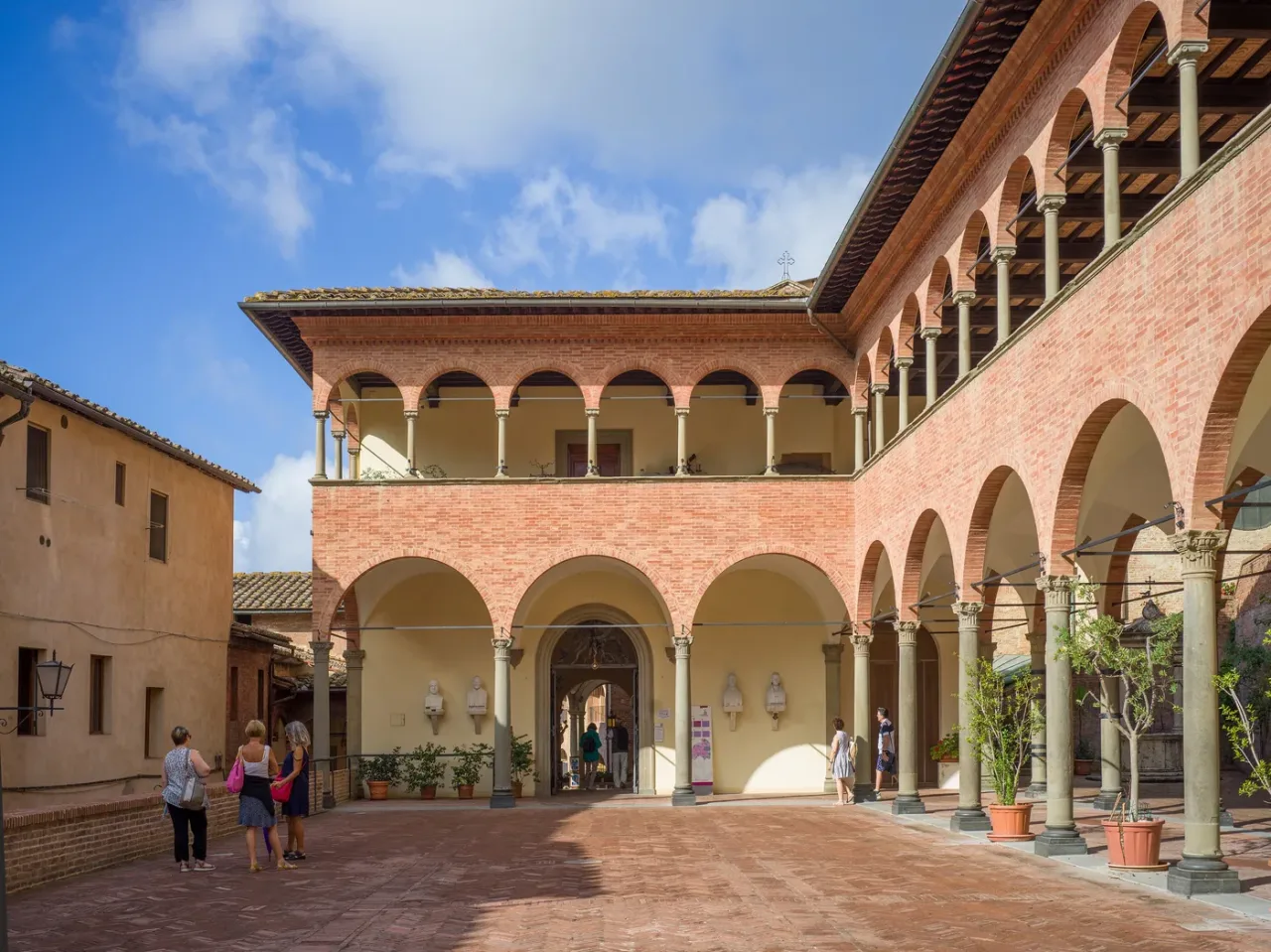
The Benincasa family house, bought by the city in 1466 and built up over four centuries into a stack of oratories. One cubicle, at the lowest level, is still substantially the room she used.

Suggested pilgrimages

Paths we've walked, ready to make yours.

2 in Siena

Suggested order. Verify opening hours, transit, and walking conditions before you go.

Suggested pilgrimage Ready to save

Catherine's Siena, downhill

2 hours · 2 STOPS

The two places, in the order that makes the hill work for you.

  1. 1 Basilica of San Domenico
  2. 2 Sanctuary of Saint Catherine

Saves the whole sequence to your journey. Shape it into a plan later.

Suggested order. Verify opening hours, transit, and walking conditions before you go.

Suggested pilgrimage Ready to save

In the order she lived it

Half a day · 2 STOPS

House first, then the church at the top of her street.

  1. 1 Sanctuary of Saint Catherine
  2. 2 Basilica of San Domenico

Saves the whole sequence to your journey. Shape it into a plan later.

Suggested order. Verify opening hours, transit, and walking conditions before you go.

How My Journey works →

Each entry named and sourced

Tombs, relics & sacred objects

Catherine's relics are divided between two cities, and have been since the 1380s. Siena holds the head and the thumb. Rome holds the body. A pilgrim who wants all of her has to travel.

Venerated at

THE CHAPEL OF SAINT CATHERINE, BASILICA OF SAN DOMENICO

The relic of Catherine's head

Documented custody by the Dominican community of San Domenico. The official material for the Catherine places in Siena gives 1384 and 1385 in different places for the relic's arrival; 1385 is the year of the dated announcement to the Consistory.

Catherine died in Rome in 1380 and her body remained there. Raymond of Capua, then Master of the Dominican Order, obtained permission from Urban VI for her head to be separated so that her own city could have a relic of her.

Visit Basilica of San Domenico
Venerated at

THE RELIQUARY NICHE BESIDE THE CHAPEL OF SAINT CATHERINE

The relic of her thumb, and the objects with it

Documented custody by the Dominican community of San Domenico, as published in the official material for the Catherine places in Siena.

A crystal and silver reliquary holds the relic of her thumb. Kept with it are the chalice she used, the cords of the discipline she practiced, and a consecrated stone for a portable altar. The bronze bust that originally enclosed the head is kept separately, in a case near the entrance to the chapel.

Visit Basilica of San Domenico
Venerated at

THE ORATORY OF THE BEDROOM, SANCTUARY OF SAINT CATHERINE

The silk bag, and her belongings

Documented custody by the Sanctuary of the House of Saint Catherine.

The bag in which the relic of her head was carried from Rome is kept in the sanctuary, with the handle of her walking stick, the jar she used for herbal preparations when she visited the sick, her lantern, and part of her veil.

Visit Sanctuary of Saint Catherine
  • Documented custody by the Dominican community of San Domenico. The official material for the Catherine places in Siena gives 1384 and 1385 in different places for the relic's arrival; 1385 is the year of the dated announcement to the Consistory. The relic of Catherine's head The Chapel of Saint Catherine, Basilica of San Domenico
  • Documented custody by the Dominican community of San Domenico, as published in the official material for the Catherine places in Siena. The relic of her thumb, and the objects with it The reliquary niche beside the Chapel of Saint Catherine
  • Documented custody by the Sanctuary of the House of Saint Catherine. The silk bag, and her belongings The Oratory of the Bedroom, Sanctuary of Saint Catherine
  • Documented shrine custody. The division of the relics between the two cities is not disputed. Her body, in Rome Santa Maria sopra Minerva, Rome

Visit rhythm

How long Catherine's Siena actually takes

Plan 1

The two Catherine places, downhill

San Domenico first, for the chapel where she was clothed and the chapel where her relics are, then the walk down Costa Sant'Antonio to the sanctuary built around her house. Two hours does both without hurrying, and taking them in this order means the steep part is a descent.

  1. san-domenico-siena
  2. sanctuary-of-saint-catherine-siena

Plan 2

One day, with the city around her

The same two places in the morning, then the rest of Siena in the afternoon on your own terms. The Catherine part of the day is genuinely short. What a full day buys you is time to sit in the relic chapel, and time in Fontebranda itself rather than a walk straight through it.

  1. san-domenico-siena
  2. sanctuary-of-saint-catherine-siena

Plan 3

Siena and Rome as one pilgrimage

Catherine is not complete in one city. Siena holds the head and the house; Rome holds the body and the room where she died, at Santa Maria sopra Minerva. Three hours by train separates them, and a pilgrimage that takes both is the only one that takes all of her.

  1. san-domenico-siena
  2. sanctuary-of-saint-catherine-siena
  3. santa-maria-sopra-minerva

Practical, not booking

Before you go

Both Catherine places are free to enter. The sanctuary keeps a donation box.

Published opening hours for both sites disagree between sources and change through the year. Check the basilica's own site and the sanctuary's own site rather than a remembered time.

San Domenico is a working Dominican church with regular Mass and confessions. The relic chapel is inside it and is not separately ticketed.

The walk between the two is five to seven minutes on Costa Sant'Antonio, which is steep and stepped. Via Camporegio and Via del Tiratoio are longer and step-free.

The basilica states that it has two access ramps and marked routes inside. The sanctuary's lowest oratory is reached by a staircase and no step-free route to it is published.

Catherine's feast is April 29. Expect a fuller liturgical schedule at San Domenico and more pilgrims in the relic chapel.

Siena has no airport and the station sits below the walled city. Most visitors arrive by bus from Florence, which stops close to Piazza San Domenico, or by train with a climb or escalator up into the center.

The Palio runs on July 2 and August 16. The city is extremely crowded for several days around each, and Fontebranda is a contrada district that is fully occupied with it.

Photo credits
  1. Siena; Siena city hero. Photo: Palickap, CC BY-SA 4.0, via Wikimedia Commons. Source. CC BY-SA 4.0.
  2. The Dominicans took the Camporegio hill in 1225. The district Catherine was born in lies directly below this wall.; One street, top to bottom. Photo: Wolfgang Moroder, CC BY-SA 3.0, via Wikimedia Commons. Source. CC BY-SA 3.0.
  3. Basilica of San Domenico. Photo: Wolfgang Moroder, CC BY-SA 3.0, via Wikimedia Commons. Source. CC BY-SA 3.0.
  4. Sanctuary of Saint Catherine. Photo: Wolfgang Moroder, CC BY-SA 3.0, via Wikimedia Commons. Source. CC BY-SA 3.0.