
Sanctuary of Saint Catherine
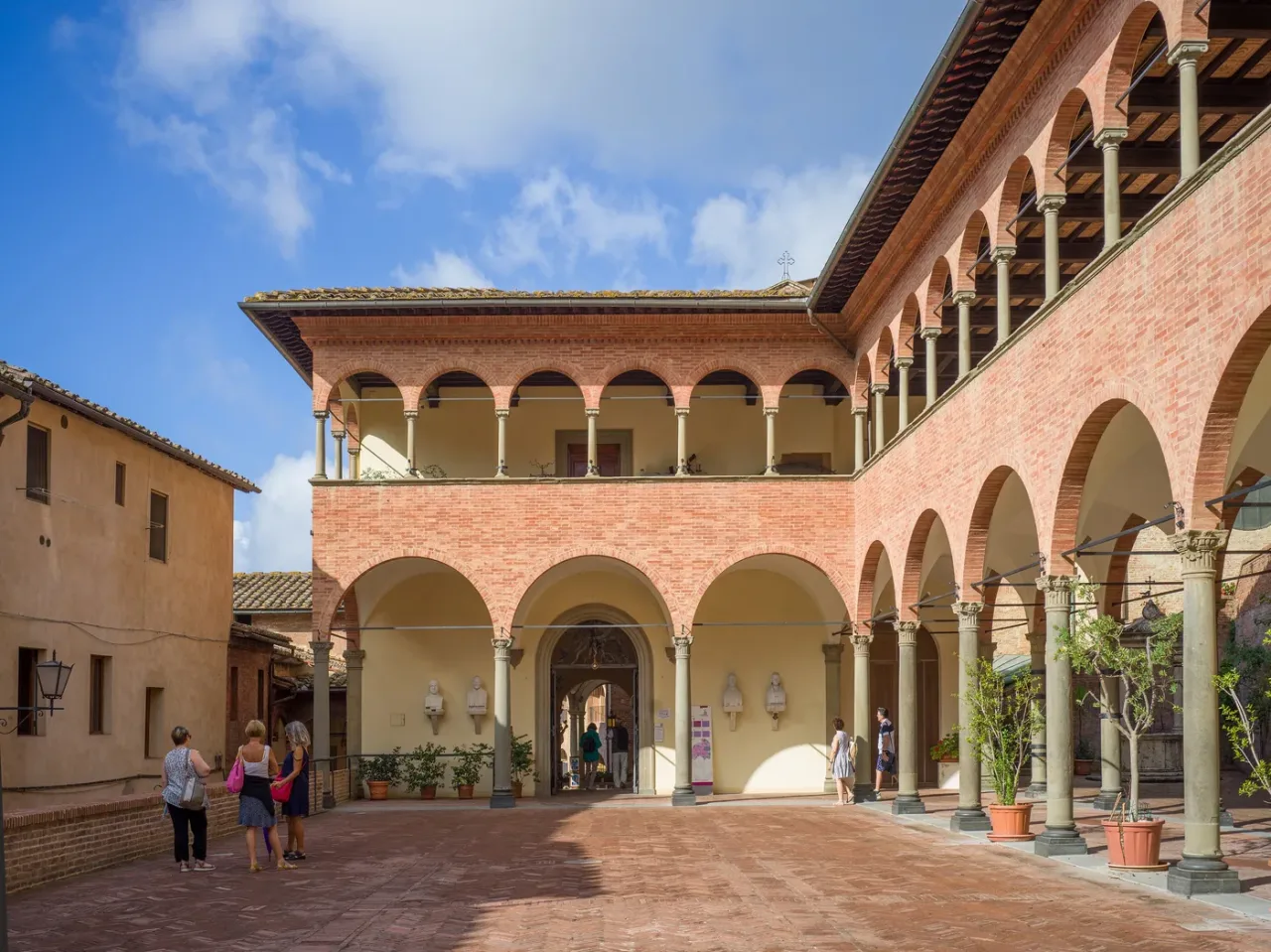
The house Catherine's father rented in the dyers' district, bought by the city in 1466 and progressively rebuilt into a set of oratories, a baroque church, and a modern portico. One small cubicle survives close to its original state.
- Location
- Siena, Italy 43.3187° N · 11.3279° E
- Type
- Sanctuary complex on the site of the Benincasa family house, containing several oratories and one baroque church.
- Dedication
- Saint Catherine of Siena, in the house her family rented.
A house the city could not leave alone
Siena wanted to keep the place its saint came from, and the way a fifteenth-century city kept a place was to build on it. What you walk through today is four and a half centuries of devotion laid over a dyer's house: a modern portico, two atria, a baroque church, a confraternity hall where the kitchen used to be, and, down a staircase, the cubicle where she actually slept. The complex is honest about being a complex. Going in expecting a medieval interior will disappoint; going in expecting to see what devotion does to a building over four hundred years will not.
Dyer's house, civic property, sanctuary
Jacopo Benincasa, a wool dyer, rented a three-level house on the slope below the Camporegio hill in the first half of the fourteenth century. It served as both a warehouse for dyeing cloth and a home for a very large family. The district is Fontebranda, named for the great covered spring at the bottom of the hill, and it belonged to the woolworkers' guild. Catherine was born there in 1347.
She was canonized in 1461. Five years later the commune of Siena bought the house. That purchase is what saved the site and also what began changing it: a building owned by a city for the sake of a saint does not stay a house. Around 1482 the Confraternity of Saint Catherine took the space where the family kitchen had been as its meeting room, and remodeled it into what is now the Kitchen Oratory. The original fireplace was not destroyed; what remains of it can be seen through a grille under the altar.
The largest addition came in the seventeenth century. Between 1614 and 1623 a baroque church was built into the complex to house the wooden crucifix before which, the tradition holds, Catherine received the stigmata at Pisa in 1375. That crucifix had been brought to Siena in 1565 and was formally installed here on May 21, 1623. A reliquary in the same church holds a fragment of her shoulder blade.
The last major work was the entrance. The Portico dei Comuni, built between 1941 and 1947 and paid for by Italian municipalities, is the brick loggia and courtyard visitors now come in through. A Confessional Chapel was added and inaugurated in April 2006. Almost nothing you see first is medieval, and almost all of it was built because of what happened here.
A vertical complex rather than a building, following the slope. The 1940s Portico dei Comuni opens into a small sixteenth-century atrium, then a second atrium. On the right of the second atrium are the Church of the Crucifix of 1614 to 1623 and the modern Confessional Chapel; on the other side is the Kitchen Oratory, a confraternity hall of the 1480s with a coffered ceiling, sitting on the footprint of the Benincasa kitchen. A staircase on the left descends to the Oratory of the Bedroom, the lowest and oldest level. The materials are Sienese brick throughout, which disguises how many different centuries are stacked here.
How to read the sanctuary.
The single most useful thing to understand is what is old and what is not.
The site is hers. Most of the rooms are not
The Benincasa family rented this house and Catherine was born in it. The interiors were rebuilt as oratories between the 1480s and the 1940s.
One room is close to original
The cubicle in the Oratory of the Bedroom was preserved when the room around it was remodeled in 1874. The stone she used as a pillow is behind the grille.
It was a working-class district
Fontebranda belonged to the woolworkers. Her father dyed cloth here, and the house was a warehouse as much as a home.
It is worth being exact about what survives, because the site is often described as though Catherine's house were simply still standing. The location is the family's, and the outline of the building is fourteenth century. The rooms, with one exception, are not: they were rebuilt as devotional spaces between the 1480s and the 1940s. The exception is in the Oratory of the Bedroom, where the small cubicle in which she prayed and slept was kept when the surrounding room was remodeled in 1874. Inside it, behind an iron grille, is the stone she is said to have used for a pillow. That cubicle, and the fireplace remnant under the Kitchen Oratory altar, are the two points where the domestic house is still physically present.
What to notice.
-
The Oratory of the Bedroom
Down the staircase from the second atrium. The cubicle where she prayed and slept, with the stone she used for a pillow behind an iron grille. The oldest thing in the complex.
-
Her belongings, kept with the cubicle
The round handle of her walking stick, the jar for the herbal preparations she brought to the sick, her lantern for night visits, and part of her veil.
-
The silk bag
The bag in which the relic of her head was carried from Rome to Siena in the 1380s. The head itself is at San Domenico, a few minutes uphill.
-
The Church of the Crucifix
Built 1614 to 1623 for the crucifix from which, the tradition holds, she received the stigmata at Pisa in 1375. Installed here on May 21, 1623. A reliquary in the church holds a fragment of her shoulder blade.
-
The Kitchen Oratory
The confraternity hall of the 1480s, built over the Benincasa kitchen. What survives of the original fireplace is visible through the grille under the altar.
- That you enter through a building from the 1940s. The Portico dei Comuni was paid for by Italian municipalities and is the newest part of the complex, not the oldest.
- That the levels descend as you go in. The house was built into a slope, and the further down you go the closer you get to what the Benincasa family actually used.
- That the fireplace under the Kitchen Oratory altar was kept deliberately. A confraternity remodeling a room in the 1480s could have removed it and chose to leave it visible.
How much time, and what to do with it.
-
The house, lowest room first
4 ordered stopsDown to the cubicle where she slept, then back up through the church and the confraternity hall.
- The Portico dei Comuni and the two atria
- The Oratory of the Bedroom and the cubicle
- The Church of the Crucifix
- The Kitchen Oratory
How to visit well.
Go down before you go across. The Oratory of the Bedroom is the reason to come and it is the easiest room to miss, at the bottom of the staircase off the second atrium. The cubicle is small and there is usually no one else in it. The objects kept with it are the ones that make her ordinary: the handle of her walking stick, the jar she carried herbal preparations in when she visited the sick, the lantern she used at night, part of her veil. The silk bag in which her head was carried from Rome to Siena is also here, which is where the two halves of her geography touch. Then come back up for the Church of the Crucifix and the Kitchen Oratory. Entry is free; a donation is the custom.
How this place gathers the saints.
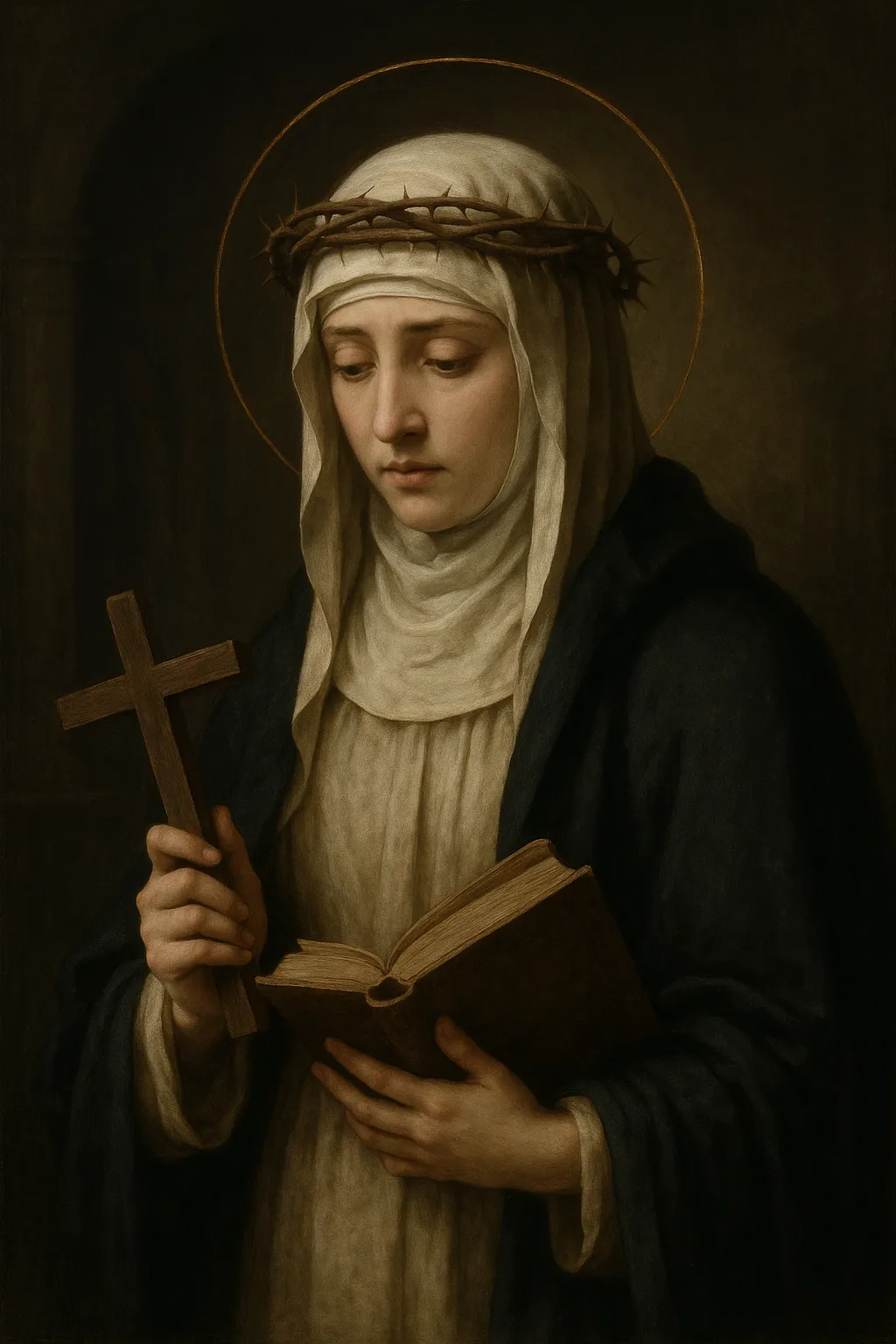
Uphill to her relics, and one spring at the bottom of the street.
-
City hub
Siena
Where this church sits within the wider Catholic geography of Siena.
-
Basilica
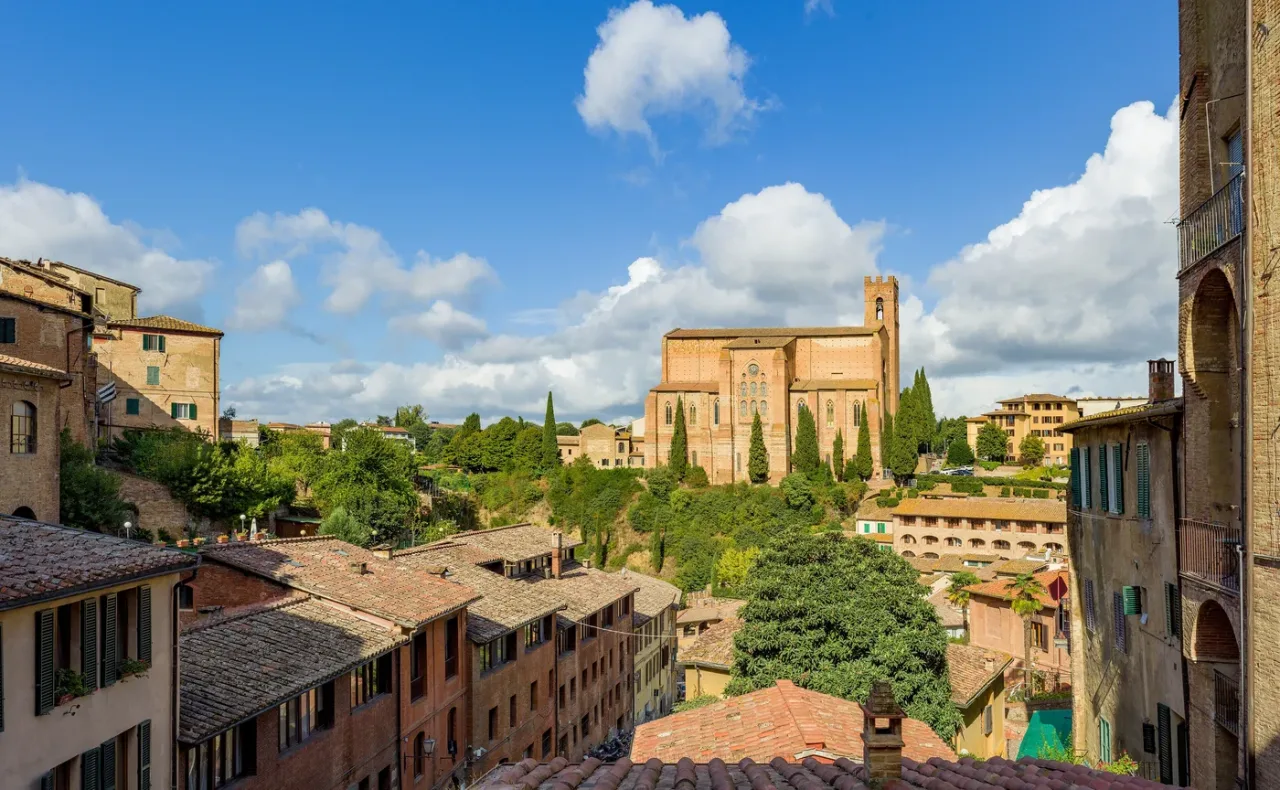
Basilica of San Domenico
Five to seven minutes uphill, and a real climb. Where she received the Dominican habit and where the relics of her head and thumb are venerated.
-
Basilica
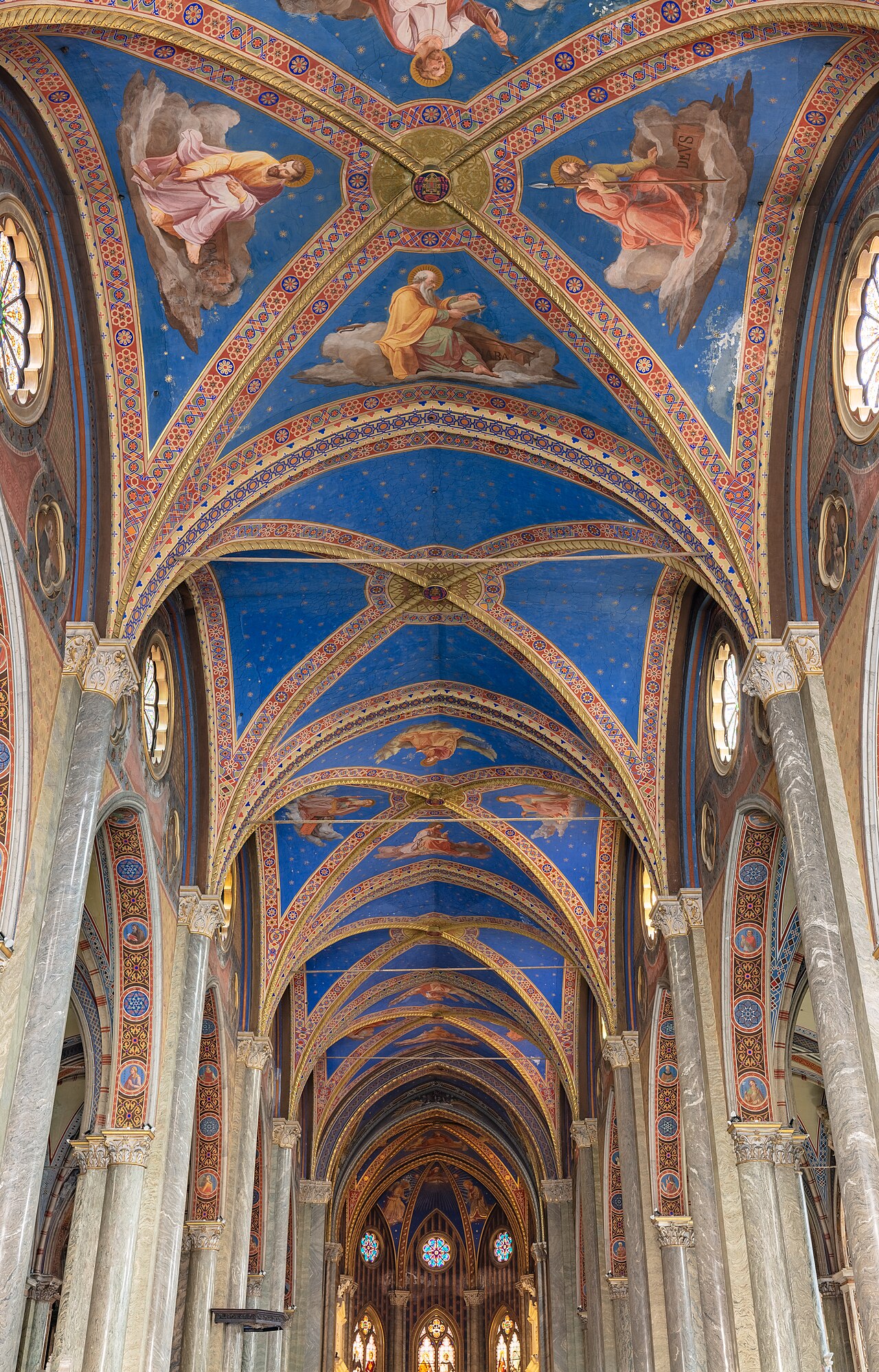
Santa Maria sopra Minerva, Rome
Where she died and where her body lies, beneath the high altar of the Dominican basilica behind the Pantheon.
Plan your visit.
The building sequence, the dates of the Kitchen Oratory remodeling, the Church of the Crucifix of 1614 to 1623, the installation of the crucifix on May 21, 1623, the 1874 remodeling that preserved the cubicle, the Portico dei Comuni of 1941 to 1947, the 2006 Confessional Chapel, the objects kept with the cubicle, and the shoulder blade reliquary all follow the official material published for the Catherine places in Siena at santacaterina.siena.it. Eternal Roam states the stigmata as what the tradition holds rather than as an established event, and is deliberate about separating the fourteenth-century site from the later devotional rooms built on it, because several widely circulated descriptions of this sanctuary present the complex as an intact medieval house. Travel sources were also found stating that the relic of Catherine's head is kept in this sanctuary; it is not, it is at San Domenico, and that error is corrected on both records. Hours are not published here because the available sources disagree; they are described as a pattern and linked to the sanctuary's own site instead.
August 19, 2026
Photo credits
- Hero. Wolfgang Moroder / Wikimedia Commons (CC BY-SA 3.0). Source. CC BY-SA 3.0.