
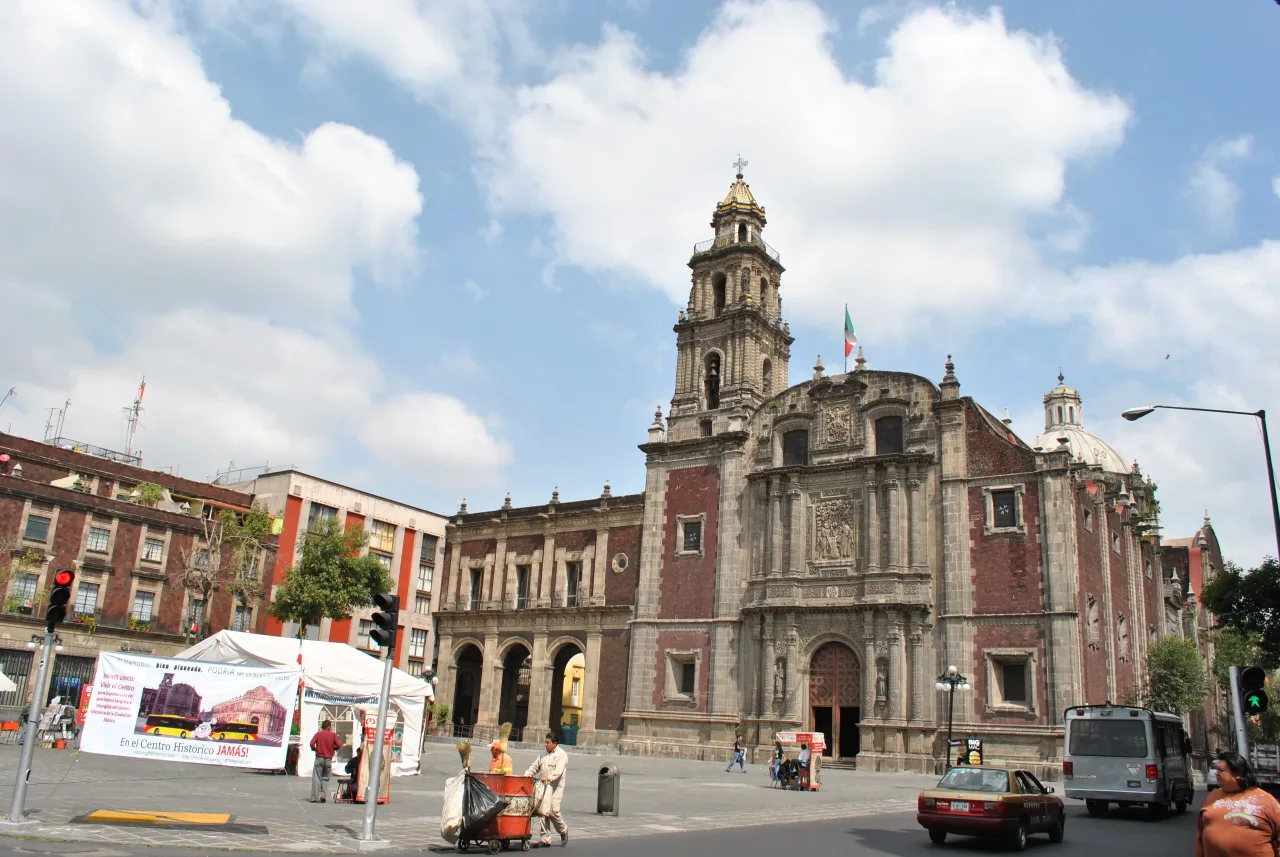
Templo de Santo Domingo
The church of Santo Domingo is what remains of the Dominican house in Mexico City. The order arrived in 1526 and their convent eventually filled several blocks; the present church was dedicated in 1736, and almost everything around it has since been demolished.
- Location
- Mexico City, Mexico 19.4382° N · 99.1338° W
- Type
- Church Late baroque, built between 1720 and 1736 in tezontle and cantera, with a single completed bell tower
- Dedication
- Saint Dominic de Guzmán
- Time Needed
- 30 minutes to half a day
What Is Left of the Dominican House
Come here to understand how the religious orders shaped this city, and how little of that survives above ground. Santo Domingo is an active church with fine baroque altarpieces, five minutes from the cathedral, on the calmest square in the historic centre. It is also the clearest place to see the difference between a church that is still a church and a convent that is now a street.
A House That Filled Several Blocks
The Dominicans reached Mexico in 1526, the second of the mendicant orders to arrive, and began building the following year. Their first churches were damaged by the floods that repeatedly troubled the drained lakebed, and the house was rebuilt more than once. The church that stands now was begun in 1720 and dedicated in 1736, work associated with Pedro de Arrieta and Miguel Custodio Durán. Around it stood a novitiate, cloisters, chapels, a garden and an atrium, the ordinary apparatus of a great colonial religious house. In the nineteenth century the suppression of the religious houses and the cutting of new streets through the block removed nearly all of it. The atrium became a public square and the conventual buildings came down. What survives is the church, the square, and the arcade along its western side where public scribes still sit.
What to notice.
-
The baroque altarpieces
The retablos in the nave and transept are the reason to come inside. They survived the suppression of the house and the demolition of the convent around it.
-
The Portal de los Evangelistas
The arcade along the west side of the square, where public scribes have written letters and documents for people who needed them for generations. It is still in use, and it is one of the oldest continuous trades in the city.
-
The tezontle and cantera front
Dark red volcanic stone framed with pale carved cantera, the combination that gives the historic centre its colour. The single tower is unusual; the second was never built.
-
The square itself
Plaza de Santo Domingo is small, shaded and far calmer than the Zócalo five minutes south. It is one of the better places in the centre to sit down.
- The church is a survivor, not a fragment of a working monastery. The Dominicans came to Mexico in 1526 and their house grew to fill several blocks; nineteenth-century suppression and street building removed nearly all of it.
- The present church was built between 1720 and 1736, so it is a late baroque building on a site the order had held for two centuries.
- The north side of the square holds the former palace of the Inquisition tribunal, which sat in Mexico from 1571 until its abolition. The building is now a museum. It is part of this square's history and worth naming plainly.
- Only one bell tower was completed, which is why the front looks slightly off balance.
How much time, and what to do with it.
-
The church and the square
A short stop that takes the square and the church together, which is the only way this place makes sense.
What pilgrims come to venerate here.
Tomb and Burial
- This is not a burial church of saints.
Relics and Sacred Tradition
- No major relic is presented here as a reason for pilgrimage. The church is visited for its altarpieces and for the history of the Dominican house.
Sacred Objects
- The baroque retablos of the nave and transept.
- The carved cantera portal set against tezontle.
Five minutes south, and ten minutes west
-
Cathedral
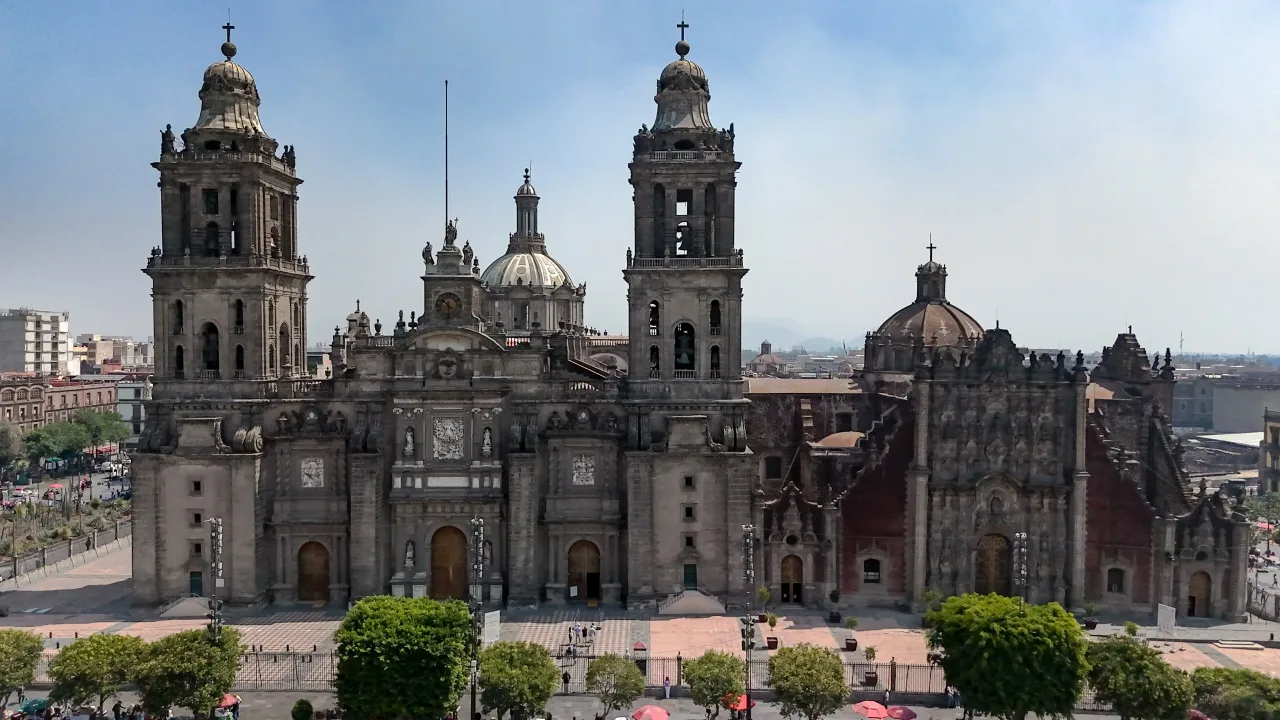
Metropolitan Cathedral
Five minutes south on the Zócalo, the seat of the archdiocese.
-
Church
Templo de San Francisco
Ten minutes south-west on Calle Madero, the Franciscan counterpart to this house.
Plan around this place.
Edited from the Archdiocese of Mexico, published architectural histories of the Dominican house, and Eternal Roam destination records. The lost convent and the surviving church are kept distinct. Confirm Mass times before visiting.
August 4, 2026
Photo credits
- Hero. Photo: ProtoplasmaKid, CC BY-SA 3.0, via Wikimedia Commons. Source. CC BY-SA 3.0.