Guide · Mexico City

One Day in Catholic Mexico City

Catholic Mexico City is more compact than the city around it suggests. Four of the five places on this day stand in a line running west from the Zócalo, and you can walk the whole of it. The fifth is a metro ride south to Colonia Roma, where a Jesuit priest shot in 1927 is buried. This is not the Guadalupe day. Tepeyac is a pilgrimage in its own right and belongs to its own guide.

  • 1 day
  • Five places, one day, on foot in the centre with one metro ride at the end
  • Reviewed August 2026

The argument

The shape of these days

Most pilgrims arrive in Mexico City, go straight to Tepeyac, and leave. This day argues that the city underneath is worth one full attention of its own. It was the first metropolitan see in the Americas; the mendicant orders worked from it for three centuries and left one church each where whole convents once stood; and in living memory the Church here was persecuted and produced a martyr whose body you can visit on a quiet street in Colonia Roma. The day is deliberately arranged so that it ends with him.

What this guide leaves out, on purpose

  • Tepeyac and the Basilica of Our Lady of Guadalupe. The great Marian sanctuary of the Americas is forty-five minutes north and needs a day of its own. Squeezing it into an afternoon here would do it a disservice. Eternal Roam carries it as a separate hub and a separate guide.
  • The Templo Mayor. The excavated Mexica sacred precinct is two minutes from the cathedral door and it is the necessary context for everything the Spanish built here. It is a museum rather than a church, so it sits outside this day, but if you have the time it belongs beside the cathedral.
  • La Profesa. The Oratorian church on Calle Madero is on the route and worth a look through the door, but its picture gallery has been closed since the 2017 earthquake and guided access is limited to a narrow Saturday window. It is not yet reliable enough to schedule.

Day 1

West from the Zócalo, and south to a martyr

Begin at the seat of the first metropolitan see in the Americas, walk west through what the religious orders left behind, and end at a grave from 1927.

  • Do not rush the cathedral because it is busy and does not feel like a church at first. Give it the time, and give the last stop of the day the time as well.
  • About four kilometres on foot across the flat historic centre, then a metro ride south to Colonia Roma.
  • See this day on the map
  1. Leave by the north side and walk five minutes up República de Brasil to Plaza de Santo Domingo.

  2. 09:00, when it is quietest and before the square fills

    Metropolitan Cathedral of Mexico City (Catedral Metropolitana)

    Plan on about 60 minutes for both churches

    The cathedral church of the first metropolitan see in the Americas, and the natural first stop. Work began in 1573 and did not finish until 1813, so the building is a record of two and a half centuries rather than one design. Two altarpieces carry it: the Altar of Forgiveness closing the choir in the middle of the nave, and the Altar of the Kings filling the apse, carved between 1718 and 1737 and among the earliest churrigueresque work anywhere in the Americas. Before you leave, walk round to the Sagrario Metropolitano attached to the eastern flank. It is a separate parish church with its own door and one of the finest carved fronts in Mexico, and most visitors walk straight past it.

    Give your time to the Altar of the Kings in the apse, the Altar of Forgiveness at the choir, the slope of the floor, and the Sagrario next door.

    Free to enter; tower and crypt access is ticketed and guided. The cathedral closes to sightseeing during Mass. Confirm current arrangements on the cathedral's official site.

  3. Walk back south and west onto Calle Madero, about ten minutes, to the carved gateway of San Francisco.

  4. around 10:30

    Templo de Santo Domingo

    Plan on about 35 minutes

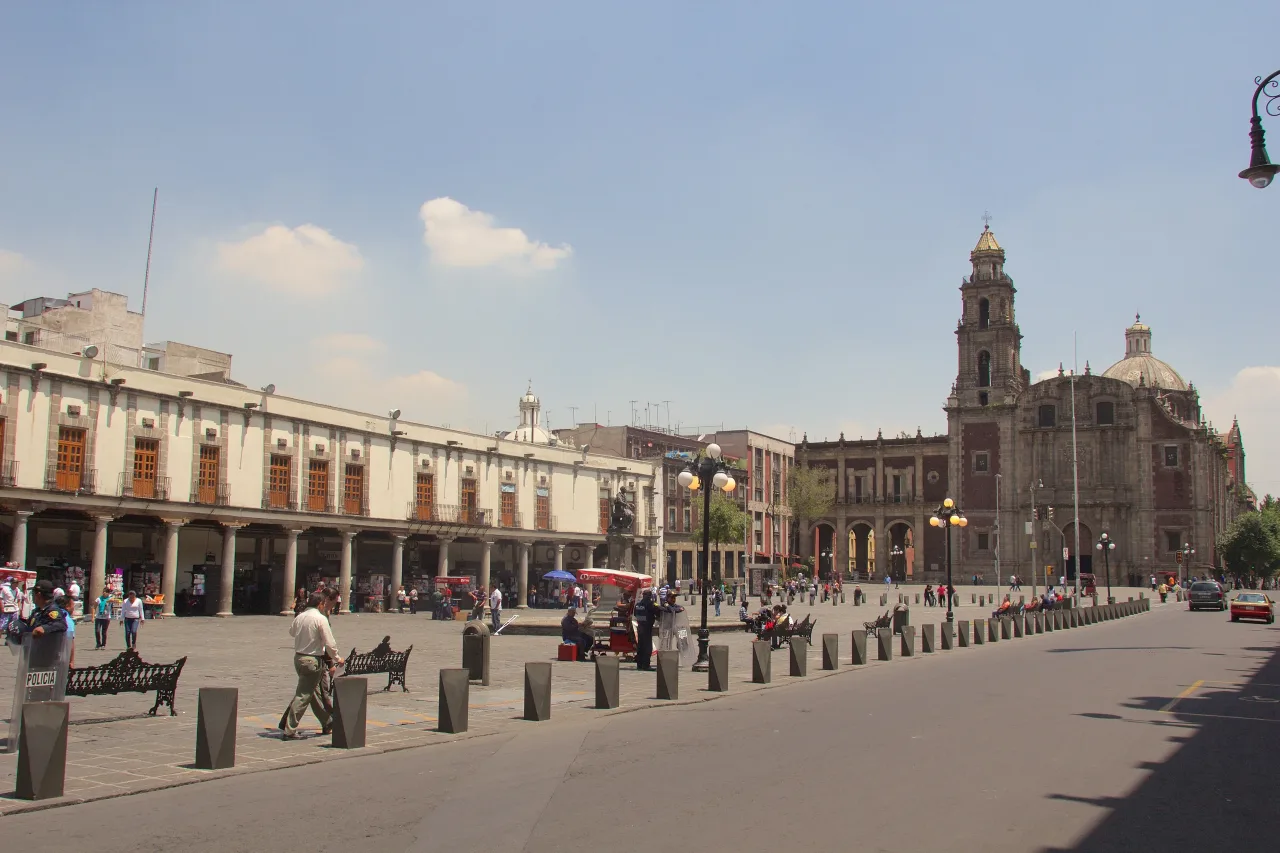
    The Dominicans reached Mexico in 1526 and their house eventually filled several blocks. The church that stands now was dedicated in 1736; nineteenth-century suppression and street building removed nearly everything around it. What is left is a fine late baroque church with its altarpieces intact, on the calmest square in the historic centre. Sit under the Portal de los Evangelistas on the west side for a minute before or after: public scribes have written letters and documents there for people who needed them for generations, and they are still working.

    Give your time to the baroque retablos in the nave and transept, and the arcade of the scribes on the square.

    Free. Keeps parish hours and may be closed in the early afternoon; confirm Mass times with the Archdiocese of Mexico.

  5. Continue west and skirt the Alameda on its north side, about fifteen minutes, to the corner of Reforma and Hidalgo.

  6. around 12:00

    Templo de San Francisco

    Plan on about 30 minutes

    The Franciscans were the first order sent to New Spain, and a group of twelve friars arrived in 1524 to begin the mission. Their house here became the largest religious complex in the territory, still covering more than thirty thousand square metres in the nineteenth century. It was then suppressed, broken up and partly demolished, and streets were cut through the grounds. Calle Madero, which you have just walked, runs across ground that was once inside the walls. What survives is one church, entered through a carved eighteenth-century gate and down into an atrium that now sits noticeably below the pavement, because the city has been sinking into the drained lakebed for four centuries.

    Give your time to the churrigueresque Balvanera portal on the street, the drop down into the atrium, and the main retablo.

    Free. Opening is irregular outside service times, so the morning is the safer bet. Confirm with the Archdiocese of Mexico.

  7. Metro from Hidalgo, or a taxi, south to Colonia Roma. About twenty minutes depending on traffic.

  8. around 13:30

    Templo de San Hipólito y San Casiano

    Plan on about 30 minutes on an ordinary day, far longer on the twenty-eighth

    This is where you meet Mexican Catholicism as it is actually practised. San Hipólito has become the centre of devotion to San Judas Tadeo in the country: a chapel was added in the 1950s, his image was given the central place at the main altar in 1982, and on the twenty-eighth of every month the crowds now close the surrounding streets. Saint Jude is invoked in Catholic tradition as the patron of desperate causes, and the people who queue here are very often people in difficulty. The building's own origin is harder: a hermitage was founded near this spot after the fall of Tenochtitlan in 1521, in memory of the Spanish dead of the retreat from the city the year before. That is a conquest memorial on ground that belonged to the Mexica city, and it is worth naming rather than passing over.

    Give your time to the image of San Judas Tadeo at the main altar, and the people who have come to it.

    Free. Ordinary days are quiet; the twenty-eighth is not. Keep belongings close in crowds and allow much more time if you come on a devotion day.

  9. The day ends here. Colonia Roma is a good place to stay for the evening.

  10. mid to late afternoon

    Templo de la Sagrada Familia

    Plan on about 40 minutes at the church

    The day ends with a grave. Miguel Agustín Pro was a Jesuit priest who ministered in secret in this city while public worship was suppressed under President Plutarco Elías Calles. In November 1927 he was arrested after a bombing attempt on a former president, on evidence that did not support the charge, and shot by firing squad without trial on the twenty-third. The government photographed the execution and published the images as a deterrent; they were circulated instead as the record of a man who refused the blindfold. Pope John Paul II beatified him as a martyr in 1988. He is Blessed, not canonized. He is buried in this Jesuit parish in Colonia Roma, and the small museum beside the church keeps the clothes he was wearing when he died.

    Give your time to the burial place of Blessed Miguel Pro, and the nave, which is a parish church of the 1910s rather than a colonial one.

    Church and museum are both free. The museum keeps short weekday morning hours; if it matters to you, reorder the day so this stop comes first.

Colonia Roma is full of places to sit down, and after a day that ends at a martyr's grave that is not a trivial thing. If you are going to Tepeyac tomorrow, an early night is the right call: the sanctuary rewards an early start.

When plans bend

Adapting these days

If you only have a morning

Take the cathedral with the Sagrario, then Santo Domingo, and stop there. They are five minutes apart, they carry the episcopal city and the religious orders between them, and together they are about two hours. Add San Francisco if you have three.

If the Padre Pro museum is why you came

Reverse the day. Start in Colonia Roma on a weekday morning so the museum is open, then take the metro north and walk the historic centre from San Hipólito back east to the Zócalo. The walking works just as well in that direction, and it is the only way to reach the museum.

If a church is closed

This will happen. These are parish churches keeping parish hours, several close in the early afternoon, and San Francisco in particular is unreliable outside service times. The day is built so that no single closure breaks it: the cathedral, Santo Domingo and San Hipólito are the load-bearing stops, and all three keep long hours.

If you cannot walk four kilometres

The centre is flat, which helps, but the altitude does not. Take the cathedral and Santo Domingo on foot, then use taxis for the two western stops. San Hipólito sits on a busy corner with an easy drop-off, and Colonia Roma is a ride in any case.

If you are adding Tepeyac

Give it the whole of the next day rather than an afternoon of this one. It is around forty-five minutes north by metro, the sanctuary has several parts, and the climb to the Cerrito is at altitude. The One Day at Tepeyac guide covers it properly.

My Journey

Make these days your own

The cathedral first thing while the square is still quiet, Santo Domingo mid-morning, San Francisco around midday, San Hipólito in the early afternoon, and Colonia Roma last. Confirm opening hours before you set the day; these are parish churches and several close in the early afternoon. If you want the Padre Pro museum, run the day in reverse.

  • 5 places across 1 days, each in the day and order the guide gives it
  • The days arrive already built; reorder them, move a place, or drop one whenever you like
  • Works without an account, in this browser

You choose the journey it joins before anything is saved.

Editorial responsibility

How this guide was prepared

Prepared by
Eternal Roam Editorial
Responsible editor
Luke Gordon, Eternal Roam
Last reviewed
August 2026
Verification
Desk researched

Researched from official and reliable sources, including the sanctuaries' own published information. This itinerary has not yet been field verified by an Eternal Roam contributor.

Built over Eternal Roam's canonical Mexico City place records, with institutional detail checked against the Metropolitan Cathedral's own history pages, the Archdiocese of Mexico, the Padre Pro museum and parish for Blessed Miguel Pro, and the Holy See record of the 1988 beatification. Construction chronologies for the cathedral, Santo Domingo and San Francisco were taken from published architectural histories rather than recalled, and the sixteenth-century episcopal seat is kept distinct from the present cathedral throughout. Walking distances and transitions between stops were checked against mapping. No contributor walked this itinerary. Opening hours, ticket arrangements and museum days are volatile and are described here only in terms that hold from year to year; exact times should be taken from each place shortly before travel.

Opening hours, Mass times and access change; each place page above carries its current sources. How Eternal Roam researches and reviews its guides is described in our editorial standards.

Sources consulted

Photo credits
  1. Guide hero: One Day in Catholic Mexico City. Mike Peel / Wikimedia Commons. Source. CC BY-SA 4.0.
  2. Day 1, photo 1: The cathedral and, at its right, the Sagrario Metropolitano. The day starts here because the archdiocese did. Photo: ProtoplasmaKid, CC BY-SA 4.0, via Wikimedia Commons. Source. CC BY-SA 4.0.
  3. Day 1, photo 2: The twenty-eighth of the month at San Hipólito. On any other day the church is quiet enough to pray in. Photo: ProtoplasmaKid, CC BY-SA 4.0, via Wikimedia Commons. Source. CC BY-SA 4.0.
  4. Day 1, photo 3: The Jesuit parish in Colonia Roma where Blessed Miguel Pro is buried. The day ends here on purpose. Photo: Nanahuatl, CC BY-SA 4.0, via Wikimedia Commons. Source. CC BY-SA 4.0.