
Carmel de Lisieux
The Carmel of Lisieux is where Thérèse Martin entered at fifteen in April 1888, took the name Thérèse of the Child Jesus and of the Holy Face, wrote what became Story of a Soul, and died on 30 September 1897 at twenty-four. It is still a living enclosed monastery.
- Location
- Lisieux, France
- 49.1417° N · 0.2283° E
- Type
- Monastery
- A nineteenth-century monastery with a classical chapel front, rebuilt and extended around the shrine after 1923
- Monastic Tradition
- Discalced Carmelite
- A monastery of Discalced Carmelite nuns in the Diocese of Bayeux and Lisieux, in continuous residence
Nine Years Behind a Wall
This is the quiet centre of Lisieux, and pilgrims who come only for the basilica miss it. Everything the world knows about Thérèse was worked out inside these walls, in a small community, mostly unnoticed, by a young woman who was often ill and often in the dark. The chapel is where her relics rest. It is a small building and it carries more than the basilica does.
Thérèse of the Child Jesus and of the Holy Face
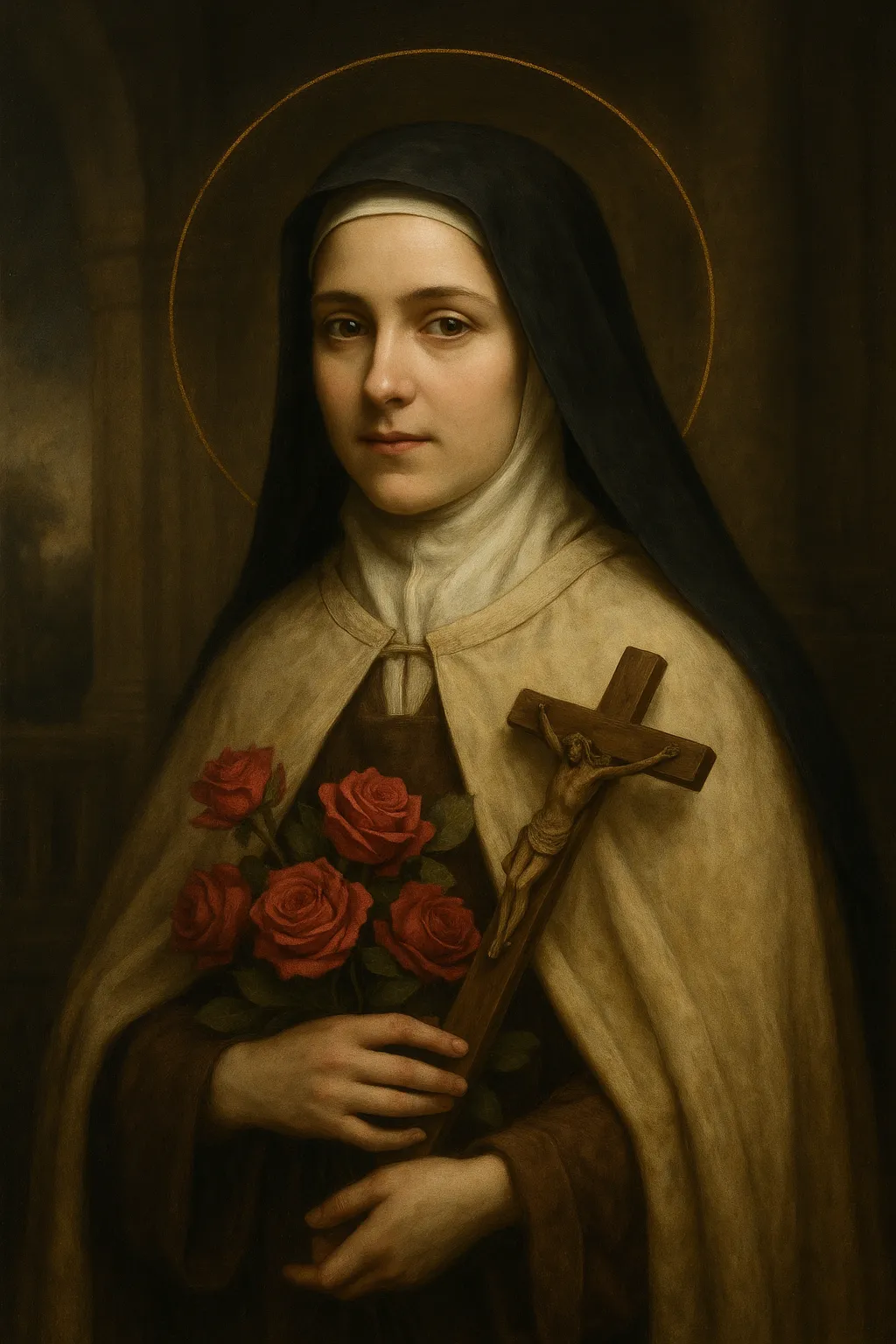
Thérèse Martin came down from Les Buissonnets and entered this Carmel on 9 April 1888, at fifteen, after asking permission of her father, her bishop and finally the Pope. She received the habit in January 1889 and made her profession in September 1890. Her sisters Pauline and Marie were already here, and Céline followed. She wrote her manuscripts under obedience: the account of her childhood for Pauline, then the pages on her Little Way, then the last manuscript written in illness. Tuberculosis was clear by 1896, and she spent her final months in the infirmary, in what she described as a night of faith rather than consolation. She died on 30 September 1897 and was buried in the town cemetery. Story of a Soul appeared the following year and the devotion spread quickly. She was beatified on 29 April 1923, and her relics were brought into this chapel that year. She was canonized on 17 May 1925, named patroness of the missions with Saint Francis Xavier in 1927, and declared a Doctor of the Church by Pope John Paul II in 1997.
The chapel front is classical and plain, standing behind a forecourt off the rue du Carmel, with the monastery buildings and their bell turret behind. The chapel was rebuilt and enlarged around the shrine after 1923, when the numbers arriving made the old one impossible.
A monastery is best understood by the life it was built to sustain.
This is an enclosed monastery with a community living in it, and it should be entered on those terms. The chapel is open and the Memorial is open. The cloister, the cells, the infirmary and the garden are not, and they are not going to be. What is offered here is prayer alongside a community rather than access to a saint's rooms.
What to notice, without rushing.
-
01
The châsse of Saint Thérèse
Her reliquary, in the chapel. Her body was buried in the town cemetery in 1897; the relics were carried here in 1923 at her beatification and have stayed. This, and not the basilica, is where most pilgrims find what they came for.
-
02
The Memorial
The museum of her religious life, with objects from her years in the community. Small, and unsentimental in a way that helps.
-
03
The community behind the grille
Carmelites still live here and still sing the office. If you are in the chapel at the right hour you will hear them, which is the truest thing that can happen to a visitor in Lisieux.
-
04
What you cannot see
The cloister, the cells, the garden and the infirmary where she died are inside the enclosure and are closed. That the community has kept its life rather than becoming a museum is part of why this place still works.
See all 4 · 1 more
- What you cannot see The cloister, the cells, the garden and the infirmary where she died are inside the enclosure and are closed. That the community has kept its life rather than becoming a museum is part of why this place still works.
How to visit without rushing.
-
Daily Mass in the chapel
-
The Carmelite office, sung by the community behind the grille
-
Continuous veneration of the relics of Saint Thérèse
-
Confessions and pilgrim welcome through the season
See all 4 · 1 more
- Confessions and pilgrim welcome through the season
The chapel and the Memorial are open. The monastery is not.
- Entry
- Free
- Chapel
- About 7:00 to 19:00, closing 18:30 in winter
- Memorial
- About 9:00 to 18:30, later in summer
- Enclosure
- Closed. The community lives here.
- Mass
- Usually 11:15 daily, with an earlier morning Mass
Additional schedule notes
Mobility
- The Carmel sits between the basilica and the town centre, about ten minutes' walk from either.
What pilgrims come to notice and venerate.
Tomb and Burial
- Thérèse was buried in the town cemetery of Lisieux after her death in 1897. Her relics were carried into this chapel in 1923, the year of her beatification, and have rested here since.
Relics and Sacred Tradition
- The châsse, the reliquary of Saint Thérèse, venerated in the chapel of the reliquary. It is her principal reliquary; the basilica on the hill venerates further relics.
Sacred Objects
- Objects of her religious life kept in the Memorial, including things from the infirmary where she died.
- The chapel itself, rebuilt and enlarged around the shrine after her beatification.
The lives remembered here.
The rest of Theresian Lisieux
-
City hub
Lisieux
Where this church sits within the wider Catholic geography of Lisieux.
-
Pilgrimage basilica
Basilique Sainte-Thérèse de Lisieux
The great twentieth-century pilgrimage church, with the relics of her parents in the crypt.
-
Former cathedral
Cathédrale Saint-Pierre de Lisieux
Her parish church before she entered, and the place of her first confession.
-
The Martin family home
Les Buissonnets
The family house she left to come here.
Plan around this place.
Written from the Carmel of Lisieux's own site and the Sanctuary of Lisieux, with the Wikimedia image provenance given in the credits. The enclosure is described as the community describes it: the monastery itself is not visited, and only the chapel and the Memorial are open.
August 5, 2026
Photo credits
- Hero. Photo: Chabe01, CC BY-SA 4.0, via Wikimedia Commons. Source. CC BY-SA 4.0.
- The Châsse. Photo: Chatsam, CC BY-SA 4.0, via Wikimedia Commons. Source. CC BY-SA 4.0.