Guide · Santiago de Compostela

After the Camino: A Pilgrim's Day in Santiago de Compostela

You have arrived. The question nobody prepared you for is what to actually do with the next few hours, in what order, and how much of it is possible today.

  • 1 day
  • Slow on purpose. This is a recovery day with a liturgy in it.
  • Reviewed August 2026

The argument

The shape of these days

Santiago rewards arriving badly and staying an extra night. The tomb and the sacraments are available to everyone on the day they walk in; the certificate, the tickets and the museums are not, and trying to force them all into one afternoon is how pilgrims end their Camino at a service counter instead of at a grave.

What this guide leaves out, on purpose

  • The Camino itself. This guide begins at the edge of the old town. The routes that reach it are covered on the Camino de Santiago route page.
  • Restaurants and where to eat. Lunch matters on this day and is treated as a rest, not a destination. Santiago's food is excellent and is somebody else's article.
  • Finisterre and Muxía. The walk to the coast is a separate journey of two or three days, not an extension of an arrival day.
  • The 2027 Holy Year programme. The Archdiocese has established a commission but has not published a programme. This guide covers what is fixed and says clearly what is not.

Day 1

The square, the tomb, the Mass, and the certificate, in that order

Put the pack down, go to the grave, stay for the liturgy, and treat the paperwork as the least important thing you will do today.

  • Reach the tomb before you look at anything else in the cathedral. Everything else in Santiago is a consequence of it.
  • Under three kilometres, all of it in the old town, with the steepest ground already behind you.
  • See this day on the map
  1. Then walk into the old town light. It changes the arrival.

  2. In passing · Whenever you reach the edge of the old town

    Deal with the pack before the square

    The cathedral does not admit backpacks. It states plainly that access to the temple with backpacks is not allowed for security reasons, and that only small bags may be carried in; the ticketed museum and Pórtico visits apply further restrictions of their own. A pilgrim who walks into the Obradoiro with a full pack, poles strapped on and a bicycle beside them has to solve this problem standing in the square with a queue behind them. Solve it first. The Spanish Post Office runs a pilgrim left-luggage service on the Rúa do Franco, a few minutes from the Obradoiro, which takes packs, poles and bicycles by the day. Many albergues and hotels will also hold a pack before check-in. Either way, arrive at the square carrying nothing but what you would take into a church.

  3. Enter the cathedral and go down, not along.

  4. Pause · Around midday, or whenever you arrive

    Praza do Obradoiro

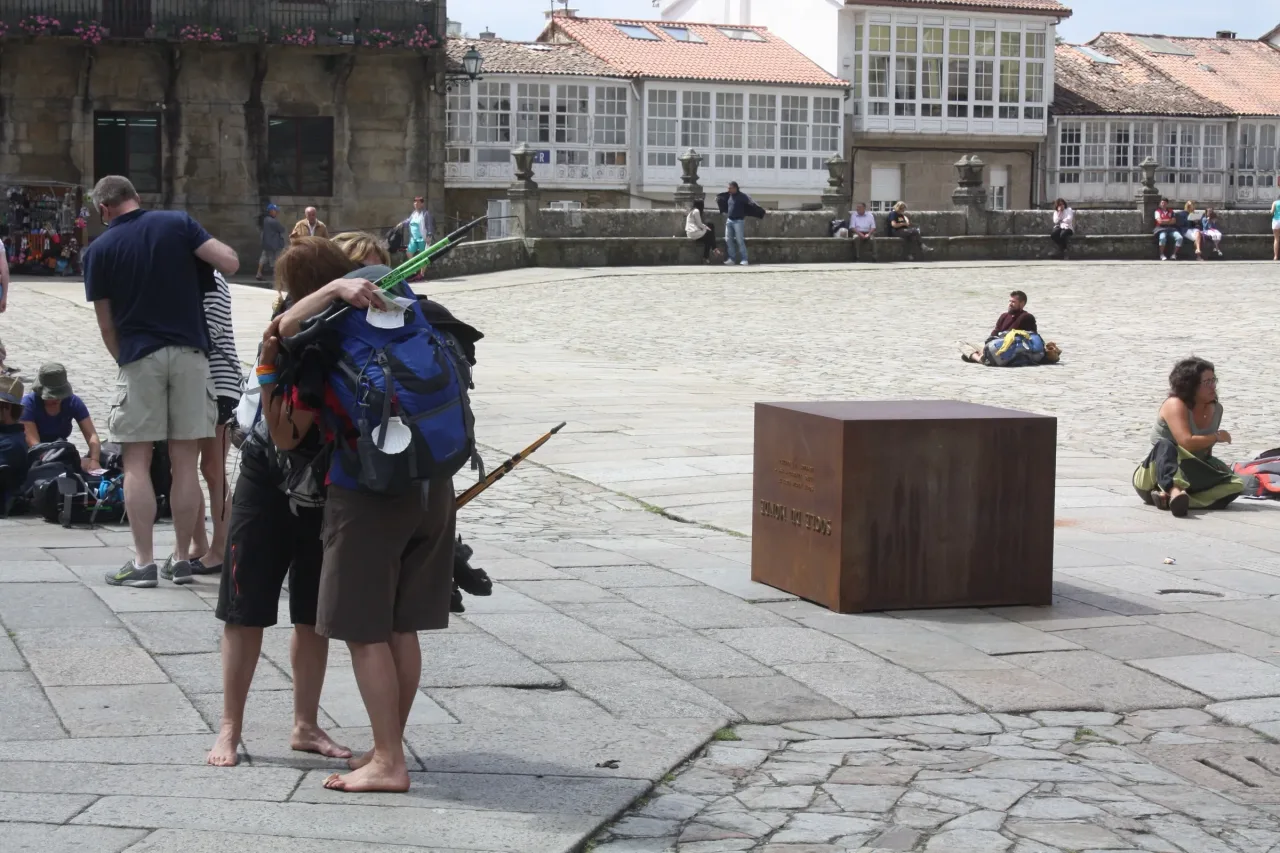
    This is the end of the road, and it is worth standing still in for longer than feels natural. Pilgrims arrive here and do very different things: some sit down on the paving, some cry, some photograph the facade and walk straight on. The square is deliberately empty, and the Baroque Obradoiro front by Fernando de Casas Novoa is a later screen thrown across a Romanesque cathedral, built to be the face of an arrival. If you walked here, this is the moment the walking stops. Give it ten minutes before you go in. The cathedral will not be less remarkable in ten minutes.

  5. Stay inside for the Mass rather than going out and coming back.

  6. Immediately on entering, before anything else

    Santiago de Compostela Cathedral

    Plan on thirty to forty-five minutes with both the crypt and the embrace

    Go straight down the stair to the crypt beneath the high altar, where a silver urn holds the remains venerated since the ninth century as those of the Apostle James. This is why the cathedral was built, why the roads were made, and why you are standing in Galicia. Catholic tradition in Spain holds that the Apostle's body was brought here after his martyrdom in Jerusalem and that the tomb was identified in the ninth century near Iria Flavia. Eternal Roam presents that as an ancient and continuous tradition honoured by centuries of pilgrims, not as a claim of modern forensic certainty. What is beyond argument is that people have prayed on this spot for eleven hundred years. Afterwards take the stair behind the high altar and make the traditional embrace of the Apostle's statue. The route runs down and then up, and that shape is the whole devotion.

    Give your time to the crypt first, the embrace second, and the architecture a distant third.

    Free entry, backpacks not admitted. The Pórtico da Gloria, museum, treasury, Gelmírez Palace and roofs are ticketed and timed; leave them for a second day.

  7. Then out into the city, and lunch before the Pilgrim Office.

  8. Pause · The cathedral publishes several a day; midday is the one most walkers aim for

    The Pilgrim Mass

    The Pilgrim Mass is what turns a long walk into a pilgrimage, and it is the part of the day that requires nothing of you but presence. The cathedral celebrates several Pilgrim Masses daily at the high altar, and confession is heard in the ambulatory chapels in a number of languages; for many arriving pilgrims the confession matters more than anything they will collect afterwards. About the Botafumeiro, be clear with yourself in advance: the cathedral publishes a fixed list of solemnities on which the great censer is used, including Epiphany, Easter Sunday, the Apparition of the Apostle at Clavijo on 23 May, Pentecost, the feast of Saint James on 25 July, the Assumption, All Saints, Christ the King, the Immaculate Conception, Christmas and the Translation of the Apostle's Remains on 30 December. Outside those days it may be used for a pilgrimage group that arranged it with the cathedral in advance. It is not part of every Pilgrim Mass. Walking eight hundred kilometres does not summon it, and a Mass without it is not a lesser Mass.

  9. Decide honestly whether you are going to the Pilgrim Office today or tomorrow.

  10. Pause · Early afternoon

    Eat, and stop moving

    This is a real stop, not filler. Most pilgrims arriving in Santiago are running on very little, have been awake since before dawn, and are about to make decisions about queues. Eat properly and sit down for an hour somewhere in the streets below the cathedral. The Rúa do Franco and the Rúa Nova are full of places; this guide is not going to name one, because the point is the sitting rather than the meal. If your body is telling you the day is over, believe it. Almost everything left can be done tomorrow morning, and tomorrow morning is quieter.

  11. Whatever happens here, the day is not finished until you have been somewhere quiet.

  12. Pause · Mid-afternoon, or the following morning

    The Pilgrim Reception Office and the Compostela

    The Pilgrim Reception Office on the Rúa das Carretas issues the Compostela, free, to pilgrims who completed at least one hundred continuous kilometres on foot or on horseback, or two hundred by bicycle, on a route recognised by the office, evidenced by a credential stamped in chronological and geographical order. The office states that the Compostela is for those arriving for Christian purposes, in a spirit of devotion, vow or piety; a journey undertaken purely as tourism does not qualify. A separate Certificate of Distance, issued for a small fee by the cathedral chapter and printed on parchment with decoration from the Codex Calixtinus, records your starting point, route, kilometres and dates, which the Compostela does not. The office opens daily and manages demand with a QR ticket system, and it says plainly that at times of great influx, collection of the Compostela on the same day cannot be guaranteed. Take that seriously rather than as a disclaimer. If the wait is long, take the QR ticket, go and pray somewhere, and come back tomorrow morning.

  13. Then round the cathedral to the eastern square.

  14. Late afternoon

    Monastery of San Martiño Pinario

    Plan on thirty minutes

    Cross the Praza da Inmaculada from the cathedral's north door and go down the stair into the great Benedictine church almost nobody enters. The Benedictines settled here in the generations after the tomb was identified, and by the fifteenth century this was the wealthiest monastery in Galicia; the church you walk into is its seventeenth and eighteenth-century rebuilding, with a high altarpiece by Fernando de Casas Novoa and Miguel de Romay that is among the summits of Galician Baroque, and the cathedral's own choir stalls standing in the transept where they were brought when the cathedral choir was dismantled. What matters more on an arrival day is that it is quiet. When the cathedral is full of people photographing a facade, this is where you can actually sit down and pray.

    Give your time to the high altarpiece and the choir stalls, and ten minutes of silence.

  15. Stay in the square as it empties. The Quintana at dusk is the quietest the centre of Santiago gets.

  16. Toward evening

    Monastery of San Paio de Antealtares

    Plan on thirty to forty-five minutes

    Come round to the cathedral's eastern square and finish the day at the oldest job in the city. Galician tradition holds that when the tomb was identified in the ninth century, Alfonso II established a monastic community here to guard the site and keep worship at it; the name Antealtares records the position, before the altars raised over the grave. Benedictine monks held the house until 1499, and enclosed Benedictine nuns have held it ever since. The long blank wall closing the Quintana is that enclosure. The museum keeps the Ara de Antealtares, a marble slab venerated in long tradition as the altar of the Apostle's first disciples, which is continuous Catholic memory rather than dated archaeology. Above the steps, the walled Holy Door will open in 2027. A community keeping watch for eleven centuries, and a door not yet open: the right place to end an arrival day.

    Give your time to the Ara if the museum is open, and the square itself if it is not.

    An enclosed monastery. Keep your voice down in the square, especially at night; people live behind that wall.

If you have a second night, keep the morning free. The cathedral's ticketed spaces, the Pórtico da Gloria, the Cathedral Museum and cloister, the treasury and relic chapel, Gelmírez Palace, and the roofs over the old town are all better on a rested morning with a booking, and the Pilgrim Office queue is shortest early. If you have appetite for one more thing after that, walk twenty minutes south along the river to Santa María a Real do Sar, the one great church here the Baroque never rebuilt, where the twelfth-century piers lean so far that later generations propped the whole north wall with flying buttresses to keep it standing.

When plans bend

Adapting these days

If you arrive in the late afternoon

Do less, in this order: put the pack away, stand in the square, go to the tomb, and stay for an evening Mass. Skip the Pilgrim Office entirely and go first thing tomorrow, when the queue is shortest. Nothing is lost. The certificate does not expire overnight and the tomb is the part that mattered.

If you did not walk the Camino

Almost everything in this guide is open to you, and the most important things are open to you completely. The tomb, the Pilgrim Mass, confession, the embrace of the Apostle and, in a Holy Year, the Jubilee indulgence require no credential, no distance and no certificate. Only the Compostela itself depends on how far you travelled and by what means. Do not let a certificate define whether you arrived here as a pilgrim; the Church never has.

If you have only one full day

Follow the day above but move the Pilgrim Office to first thing in the morning, take the midday Mass, and use the afternoon for San Martiño Pinario, San Francisco and San Paio. Leave the ticketed cathedral spaces out entirely rather than rushing them. A hurried Pórtico da Gloria is worse than no Pórtico da Gloria.

If you have two days

Day one as written. Day two: book the Pórtico da Gloria and the roofs in advance, give the monastic museums a proper morning, add the Church and Convent of San Francisco with its Museum of the Holy Land, and walk out to Santa María a Real do Sar in the afternoon. Two days is where Santiago stops being an endpoint and becomes a city.

If you want the Botafumeiro

Plan your arrival around one of the solemnities on which the cathedral uses it: Epiphany, Easter Sunday, 23 May, Pentecost, 25 July, 15 August, All Saints, Christ the King, 8 December, Christmas or 30 December. Otherwise it may be used for a pilgrimage group that has arranged it with the cathedral in advance, by writing to the cathedral. Any other plan is hoping, and hoping has ruined a lot of arrivals.

If you are travelling in the 2027 Holy Year

A Compostelan Holy Year falls whenever 25 July, the feast of Saint James, lands on a Sunday, a privilege traced to a twelfth-century grant of Pope Callixtus II. In 2027 it does; the last was 2021, extended into 2022, and the next after 2027 is 2032. The Holy Door on the Quintana, walled up between Jubilees, opens for it. The plenary indulgence of the Holy Year is granted to those who visit the Apostle's tomb in the cathedral, pray for the intentions of the Holy Father, and receive sacramental confession and Communion, which may be made within the days before or after the visit; it may be received once a day and may be applied to the faithful departed. Entering by the Holy Door and attending the Pilgrim Mass are strongly encouraged and are not among the conditions. None of it requires walking, a credential or a certificate, and receiving the Compostela does not confer it. What is confirmed for 2027 is the year itself and the Diocesan Commission the Archbishop has established to prepare it, working on evangelization, holiness and hope. What has not been published is the programme: no dates for ceremonies, no access arrangements, no reservation system, no crowd management. Anything you read specifying those is speculation. Book accommodation far earlier than you would in an ordinary year, and confirm everything else against the Archdiocese and the cathedral closer to the time.

Arriving well, in a city where people live

Santiago's official code of good practices asks visitors to celebrate their arrival without excessive noise out of respect for residents, to store walking sticks or tip them so they do not damage the granite pavement or carry sound down a street, to dismount bicycles in pedestrian zones and walk the last stretch, to keep large groups to the traffic rules, to use the bins and the free public facilities, and to remember that the historic centre is not a picnic area or a campsite. Inside the churches and the monastic houses, keep your voice down and sit rather than circulate if a Mass is starting. None of this is a scolding. It is the last stage of the Camino: arriving in someone else's city in a way they would recognise as prayer.

My Journey

Make these days your own

This saves the arrival day only. The Camino route that brought you here stays a separate saved item, so a multi-week walk does not get duplicated into a single afternoon.

  • 3 places across 1 days, each in the day and order the guide gives it
  • The days arrive already built; reorder them, move a place, or drop one whenever you like
  • Works without an account, in this browser

You choose the journey it joins before anything is saved.

Editorial responsibility

How this guide was prepared

Prepared by
Eternal Roam editorial
Responsible editor
Eternal Roam
Last reviewed
August 2026
Verification
Desk researched

Researched from official and reliable sources, including the sanctuaries' own published information. This itinerary has not yet been field verified by an Eternal Roam contributor.

Cathedral of Santiago de Compostela liturgy and visits pages, the Pilgrim Reception Office rules for the Compostela and Certificate of Distance, the Archdiocese of Santiago on the 2027 Holy Year, the city's published code of good practices for visitors, and Eternal Roam destination records. Operational details change; the guide separates fixed principles from current schedules and says which is which.

Opening hours, Mass times and access change; each place page above carries its current sources. How Eternal Roam researches and reviews its guides is described in our editorial standards.

Sources consulted

Photo credits
  1. Guide hero: After the Camino: A Pilgrim's Day in Santiago de Compostela. Photo: P.Lameiro, CC BY-SA 3.0, via Wikimedia Commons. Source. CC BY-SA 3.0.
  2. Day 1, photo 1: The cathedral from the old town. Every road of the Camino narrows to the crypt beneath its high altar. Luis Miguel Bugallo Sánchez (Lmbuga) / Wikimedia Commons (CC BY-SA 4.0). Source. CC BY-SA 4.0.
  3. Day 1, photo 2: San Martiño Pinario, sixty seconds from the cathedral's north door and almost always quiet. Photo: Diego Delso, CC BY-SA 4.0, via Wikimedia Commons. Source. CC BY-SA 4.0.
  4. Day 1, photo 3: The Holy Door on the Quintana. It opens in 2027, and what lies behind it is a Jubilee grace, not a certificate. Photo: P.Lameiro, CC BY-SA 3.0, via Wikimedia Commons. Source. CC BY-SA 3.0.