
Relics of St. Padre Pio at San Giovanni Rotondo
The body of Padre Pio, exhumed in 2008 and since kept in a transparent urn for public veneration, moving each year between the lower church of San Pio and the crypt of Santa Maria delle Grazie. The face is an acknowledged silicone reconstruction.
Why pilgrims come
The one saint in these pages who is not always at the same address.
San Giovanni Rotondo is a small town on the Gargano that receives millions of people, and almost all of them come for one friar who spent fifty years of his life in it. Padre Pio died here on 23 September 1968 and was buried in the crypt beneath Santa Maria delle Grazie, the modest church he knew. Forty years later, in March 2008, the body was exhumed, and since then it has been kept in a transparent urn where pilgrims can see it. In April 2010 it was carried to the lower church of the vast new church built for him to Renzo Piano's design, and laid in a crypt lined with gold mosaic.
That would be the end of the story, except that it is not where he stays. Since 2017 the friars have moved him twice a year. Each winter the urn goes back down to the old crypt at Santa Maria delle Grazie, and each spring it returns to the lower church of San Pio. The reason given by the friars is entirely practical and rather moving: in winter, pilgrims found the great new church hard and sometimes impossible to reach, so the saint goes to where the people can get to him.
Which means the single most useful thing this page can tell you is not where he is. It is that you should check which church before you set out.
What is venerated here
One body, two churches, and several things that are commonly run together. The page separates them.
The remains of Padre Pio, exhumed on 2 March 2008 and since kept in a transparent urn for public veneration. This is a genuine body relic and it is ordinarily visible without appointment.
The features pilgrims see are a silicone mask made after the exhumation, not the saint's own face. This record states that because leaving it out would let the page suggest incorruption by silence. No claim of incorruption is made here.
The crypt of the modern church built to Renzo Piano's design, its walls covered in gold mosaic by Marko Rupnik. Wide approaches and easier circulation; this is where the urn rests for the warmer half of the year.
The older, plainer crypt where he was buried in 1968 and lay until 2008. The urn returns here from about late November until around the last Sunday of Lent, for pastoral reasons the friars state openly.
The convent where he lived, the confessional where he spent his days, and the hospital he founded are part of the same site and the same visit, but they are not relics and are not described as such.
What a pilgrim can actually see
Stated honestly, with access caveats. Nothing here promises more than the shrine ordinarily offers.
The urn, in whichever church holds it
Open hoursPilgrims file past the urn in a continuous slow circuit. No appointment is needed and there is no charge.
·Which church holds it depends on the time of year. Queues around the September feast can be very long in either building.
The church of San Pio
Open hoursRenzo Piano's church above the crypt, one of the largest built in Italy in the last century, designed for the crowds this town receives.
Santa Maria delle Grazie and the old friary
Open hoursThe church Padre Pio actually knew, with the friary beside it, on a scale entirely unlike the new church. Most pilgrims find this the more affecting of the two buildings.
How to visit
A short, practical posture. The shrine will guide you the rest of the way.
Confirm which church before you travel
This is the practical heart of the visit. The urn is in the lower church of San Pio for roughly spring and summer and in the crypt of Santa Maria delle Grazie for roughly winter, with the change around late November and around the end of Lent. Check with the sanctuary rather than trusting a guidebook.
Give the old church its due
The new church is the one people photograph. The old one is the one he lived in. Pilgrims who spend all their time in the crypt of the Renzo Piano building often leave without having seen the place his life actually happened.
Expect a queue near the feast
Around 23 September, and around the anniversary of the stigmata, this is one of the busiest pilgrimage sites in Italy. An ordinary weekday outside those windows is a completely different experience.
Do not plan around a journey of the relics
The body has left San Giovanni Rotondo on rare occasions, notably for the Jubilee of Mercy in Rome. Those were exceptional events and are not something a visitor should expect or plan for.
Check hours at the source
The sanctuary publishes current opening, Mass times and the arrangements for veneration, and they change with season and feast. Access details on this page were last reviewed on 11 August 2026.
Connected saints & places
Every relic belongs to a saint, a church, and a city. Follow the connections outward: each one names its relationship to what is kept here.
Nearby sacred places
Each carries an honest travel cost. "Nearby" means reachable on the same pilgrimage, not merely thematically linked.
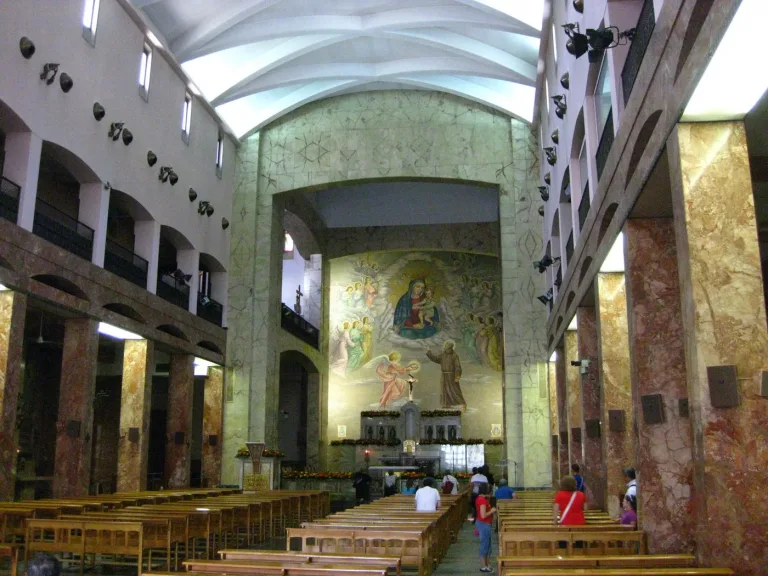
Sanctuary of Saint Pio, San Giovanni Rotondo
The whole complex: the old church of Santa Maria delle Grazie, the friary where he lived and heard confessions, and Renzo Piano's church above the gold crypt.
How we hold this record
Nothing about the custody of this body is disputed. What is unstable is its address, and almost every account written about it fixes the saint to one church and is therefore wrong for half the year. This record was checked immediately before it was written, and is built to stay true between checks by refusing to name a single location.
- Official The Capuchin friars of San Giovanni Rotondo, who keep the sanctuary and carry out the transfers, and the official Padre Pio portal, which publishes them. Linked below.
- Historical Padre Pio died on 23 September 1968 and was buried in the crypt beneath Santa Maria delle Grazie. The body was exhumed on 2 March 2008 and prepared for permanent public veneration.
- Historical On 19 April 2010 the body was translated to the lower church of the new church of San Pio, designed by Renzo Piano, whose crypt carries gold mosaic work by Marko Rupnik.
- Official Since 2017 the friars move the urn seasonally. The stated reason is pastoral: pilgrims found it difficult, and in some cases impossible, to reach the Church of San Pio during the winter period. The urn goes to the crypt of Santa Maria delle Grazie for the winter and returns to the lower church of San Pio around the end of Lent.
- Historical The face pilgrims see is a silicone reconstruction made after the 2008 exhumation, and not the saint's own features.
- Careful note Which church holds the urn depends on the season, so it is worth asking the friars before travelling. Any source that names one church without naming the season is out of date, or will be within months. Last reviewed 11 August 2026.
- Convent and Sanctuary of Saint Pio of Pietrelcina, official site
- The urn of Padre Pio is in the Crypt of Santa Maria delle Grazie, official Padre Pio portal
- The Capuchin friars carried the urn to the Church of San Pio, official Padre Pio portal
- On 2 March 2008 the body of Saint Pio was exhumed, official Padre Pio portal
The face pilgrims see is a reconstruction, and no claim is made here about the condition of the remains.
Public access varies with liturgy, security, and (where noted) reservation requirements. The official sources above should be consulted for current access before planning around it.