
St. Patrick's Grave at Downpatrick
The traditional burial place of Patrick on the Hill of Down, marked since 1900 by a slab of Mourne granite. The marker and the tradition are documented; the identification of Patrick's remains beneath it is traditional, and no authenticated bodily relic is venerated here.
Why pilgrims come
A stone that was put there to stop people taking the hill away.
The marker is plain to the point of bluntness: a single rough slab of Mourne granite lying on the highest ground of the cathedral graveyard, cut with a ringed cross and one word, PATRIC. It has nothing of a shrine about it, and it was never meant to. It was laid in the early nineteen hundreds for a practical reason, because pilgrims had been carrying the grave away in handfuls. The Saint Patrick Centre puts it without ceremony: people took scoops of earth from the grave abroad with them when they emigrated.
That detail is worth standing with for a moment, because it says what Downpatrick actually is. Long before anyone could have authenticated anything, the Irish treated this hill as the place where their apostle was buried, and treated the soil of it as worth carrying to Boston and Sydney and Liverpool. Down Cathedral, which holds the site, still calls it what it has always been called: the traditional burial place of Saint Patrick. It makes no claim beyond that, and neither does this page.
Pilgrims come to pray for Ireland at a grave that history cannot verify and devotion never doubted. Holding both of those at once is the whole discipline of the place.
What is venerated here
The distinction here matters more than at almost any other site in these pages, so the record states it in parts rather than in a sentence.
A large slab of Mourne granite, cut with a Celtic cross and the name PATRIC, laid in the early nineteen hundreds to protect the site from pilgrims removing earth. The stone is modern, and it is a marker, not a tomb.
The tradition that Patrick was buried on the Hill of Down is old, continuous and geographically specific, and by the early medieval period the grave was already a site that mattered to the Irish church. It is a tradition. No archaeological identification of Patrick's remains has been made here.
An old couplet holds that in Down, three saints one grave do fill: Patrick, Brigid and Columcille. Medieval accounts report that the relics of all three were found in 1185 and solemnly translated on 9 June 1186. Historians read the episode in the light of the Anglo-Norman politics of John de Courcy, who presided over it.
There is no reliquary, no shrine and no authenticated bodily relic of Patrick at Downpatrick. Whatever the medieval shrine held did not survive: the cathedral and the shrine were destroyed in 1538 and 1539 under Lord Leonard Grey, and the contents were scattered.
What Downpatrick offers is a place rather than an object: a named hill, a continuous memory, and a church that has stood over it in one form or another for eight centuries.
What a pilgrim can actually see
Stated honestly, with access caveats. Nothing here promises more than the shrine ordinarily offers.
The grave marker
OutdoorsThe slab lies in the open graveyard on the highest part of Cathedral Hill, a short walk uphill from English Street. Pilgrims can stand at it freely and unhurriedly.
·It is a working graveyard and a working cathedral. Funerals, services and grounds maintenance can affect access without notice.
Down Cathedral
Weekday hoursThe Cathedral Church of the Holy Trinity, medieval in origin and substantially rebuilt in the Georgian period, stands beside the grave. Inside are its box pews, the Saint Patrick window and a font made from the base of a tenth or eleventh century cross.
·This is a Church of Ireland cathedral, not a Roman Catholic one. Hours are limited and Saturdays are ordinarily by appointment. Catholic visitors come as guests.
The view from the hill
OutdoorsFrom the graveyard the ground falls away toward the town and the road out to Saul, where tradition places Patrick's first church and his last days. The landscape does more work here than any object.
How to visit
A short, practical posture. The shrine will guide you the rest of the way.
Read the stone for what it is
The slab is a twentieth century protection over a much older tradition. Pilgrims who arrive expecting a tomb are sometimes disappointed by it. Pilgrims who arrive knowing what it is ordinarily find it moving for exactly that reason.
Go up to the cathedral as a guest
Down Cathedral belongs to the Church of Ireland and is used for worship. Check its published weekday hours, do not walk in during a service to sightsee, and let the community's own use of the building take priority over yours.
Take Saul and the Centre with it
Saul, where tradition places Patrick's first church, and the Saint Patrick Centre in the town below are both close. The three together make an unhurried half day and tell the story better than the grave alone.
March 17 is different
A wreath is laid at the grave each Saint Patrick's Day and the town is busy. Pilgrims wanting quiet at the stone should come on any other day of the year.
Check hours at the source
The grave is outdoors, but the cathedral's opening varies and Saturday access is ordinarily by appointment. The cathedral's own site is the authority. Access details on this page were last reviewed on 11 August 2026.
Connected saints & places
Every relic belongs to a saint, a church, and a city. Follow the connections outward: each one names its relationship to what is kept here.


Nearby sacred places
Each carries an honest travel cost. "Nearby" means reachable on the same pilgrimage, not merely thematically linked.
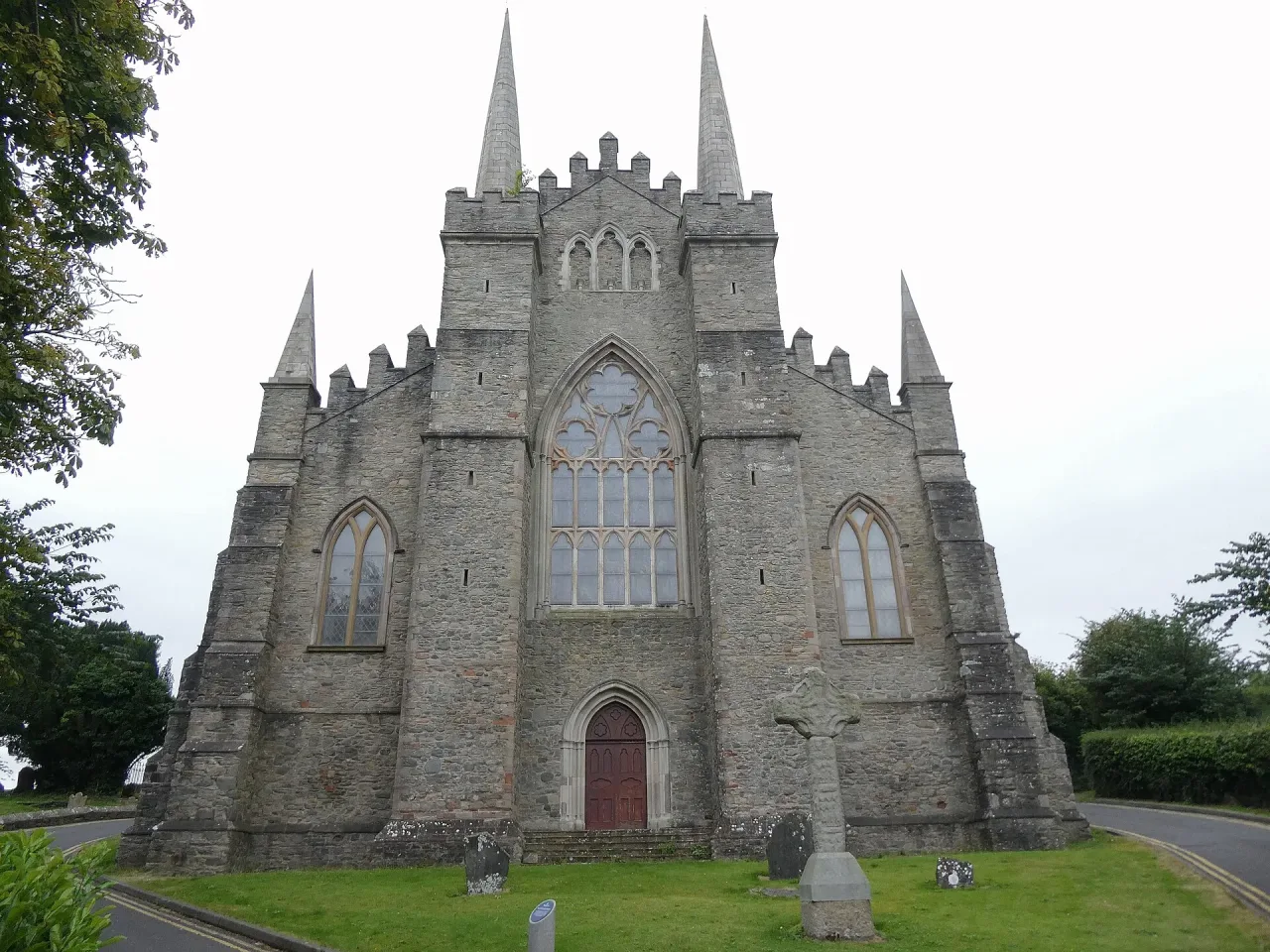
Down Cathedral and Saint Patrick's Grave
The Church of Ireland cathedral beside the grave, medieval in origin and Georgian in its restoration, standing on the Hill of Down.

St. Patrick's Catholic Cathedral, Armagh
The primatial cathedral of the see Patrick founded, about an hour west, and the other place in Ireland that carries his name with authority.
How we hold this record
Downpatrick is a real, documented, continuously venerated site. It is not an authenticated tomb, and it holds no relics. Those are two different claims and only the first is established.
- Official Down Cathedral, the Church of Ireland cathedral that holds the site, which describes it in its own words as the traditional burial place of St Patrick, marked by the large Mourne granite slab, and records the laying of a wreath each Saint Patrick's Day. Linked below.
- Official The Saint Patrick Centre in Downpatrick records that the granite stone was erected in the early nineteen hundreds to protect the grave from pilgrims, some of whom took earth from it abroad when they emigrated. The date 1900 and the Belfast Naturalists' Field Club are commonly given; the custodian sources do not themselves state either.
- Tradition The tradition that Patrick lies on the Hill of Down is old and continuous, and by the early medieval period the grave was already a site of consequence for the Irish church.
- Historical Medieval accounts report the finding of the relics of Patrick, Brigid and Columba in 1185 and their solemn translation on 9 June 1186 under the Anglo-Norman lord John de Courcy. Historians read the episode as serving his political position, and this page reports it as a medieval claim rather than as fact.
- Historical The cathedral and its shrine were destroyed in 1538 and 1539 under Lord Leonard Grey, and the contents were scattered. Nothing from the medieval shrine is venerated at Downpatrick today.
- Careful note The marker is documented and modern. The identification of the remains beneath it rests on tradition rather than on excavation, and the two are not the same claim.
- Careful note Down Cathedral is a Church of Ireland cathedral. Catholic pilgrims visit a site of shared Christian memory that predates later division, and do so as guests of its present community. Last reviewed 11 August 2026.
No authenticated bodily relic of Patrick exists at Downpatrick and none is claimed here.
Public access varies with liturgy, security, and (where noted) reservation requirements. The official sources above should be consulted for current access before planning around it.