Guide · Fátima

How to Visit Fátima from Lisbon

Fátima is an easy day from Lisbon by coach. The harder question is whether one day is the visit you actually want.

  • 1 day
  • One sanctuary, one day, out and back from Lisbon
  • Reviewed August 2026

The argument

The shape of these days

Fátima sits about 120 kilometres north of Lisbon on the limestone plateau above Ourém, and the practical answer is short: take the coach. Rede Expressos runs direct services from the Sete Rios terminal in Lisbon to the Fátima coach terminal in roughly an hour and a half, several times a day, and the terminal at the far end is about ten minutes on foot from the sanctuary. No car, no transfer, no planning beyond a seat.

The rail answer is the one that catches people out. There is a station named Fátima. It is Fátima-Chão de Maçãs, it is roughly 25 kilometres from the sanctuary, and its onward connections are thin. Caxarias, about 20 kilometres out, is the more useful railhead and is linked to the town by Rodoviária do Tejo on weekdays. Either way the train costs more time and money than the coach and solves nothing. If you are choosing, choose the coach or drive.

What a day trip cannot give you is the evening. The Rosary and candlelight procession at the Chapel of the Apparitions happens after dark, and the last coach back to Lisbon leaves before it. That is the honest trade. A day trip from Lisbon holds the sanctuary well: the Capelinha, the two basilicas, the tombs of the shepherd children, Mass, confession. It does not hold the procession, and it does not comfortably hold Aljustrel and the country sites where the children lived. If either of those is why you are going, stay the night.

This guide keeps to the sanctuary, because that is what one day from Lisbon actually contains. The wider Fátima landscape has its own two-day guide.

What this guide leaves out, on purpose

  • Aljustrel, Valinhos, and Loca do Cabeço. The hamlet where the children lived and the two country apparition sites lie about two kilometres south of the sanctuary on uneven ground. Fitting them around a return coach turns them into a rush, and they are the part of Fátima that least rewards one. They belong to the two-day guide.
  • The evening Rosary and candlelight procession. It takes place after dark, and coaches back to Lisbon do not wait for it. Leaving it out of a day trip is honest rather than regrettable; if the procession is why you are going, book a night in Fátima.
  • Batalha, Alcobaça, and Nazaré. Organized tours routinely bundle these with Fátima. They are worth seeing, but a day that carries four stops carries none of them properly, and Fátima becomes a photograph stop rather than a pilgrimage.

Day 1

Out from Lisbon, and the sanctuary in a day

Take an early coach, give the whole morning to the Cova da Iria, and let the afternoon be unhurried rather than crowded with more places.

  • Keep the day to the sanctuary. One enclosure, walked slowly, is more than a day trip usually manages.
  • About an hour and a half each way by coach. On the ground, level walking across one large esplanade, with no climbs and no transfers.
  • See this day on the map
  1. Direct coach, no transfer. Drivers on the A1 leave the motorway a few minutes from the sanctuary.

  2. In passing · Leave Lisbon early, around 08:00

    Lisbon Sete Rios to Fátima coach terminal

    Rede Expressos runs direct coaches from the Sete Rios terminal to Fátima in about an hour and a half. Book a seat in advance for the 12th and 13th of the month and in the summer, when services fill. The Fátima terminal sits at the western edge of the sanctuary, roughly ten minutes on foot and downhill toward the esplanade, so you arrive beside the Trinity basilica and walk the length of the Cova da Iria to reach the Chapel of the Apparitions. Confirm departure times and the return timetable on the operator's site before you travel; frequencies change with the season and with the pilgrimage calendar.

  3. Mid-morning, first thing on arrival

    Chapel of the Apparitions

    Plan on 45 to 60 minutes

    Walk the length of the esplanade and begin here, before anything else. This is the still point of Fátima and the reason the rest of the enclosure exists. The Rosary is prayed aloud through the day in a rotation of languages, so wait for one you can follow and pray a decade with it rather than passing through. Light a candle at the offering place beside the chapel for a named intention. A day trip is short enough that the temptation is to keep moving; resist it here, because everything else you see today takes its meaning from this open-sided chapel and the column that marks the spot.

    Give your time to the column and the image above it; joining the continuous Rosary for at least one decade.

    Mass and confession run to a published daily schedule that varies by season and language. Check the sanctuary's own timetable shortly before you travel rather than relying on any secondhand listing.

  4. A level walk of a few minutes across the esplanade from the Chapel of the Apparitions.

  5. Late morning, at the far end of the square

    Basilica of Our Lady of the Rosary

    Plan on 30 to 45 minutes

    Cross to the older basilica that closes the eastern end of the esplanade. The shepherd children are buried in the aisles of the nave, and Sister Lúcia lies near them, so this is where the Fátima story stops being an event and becomes three people. Pause at each tomb rather than photographing the row of them. Read the church against the Capelinha you have just left: one is open to the weather at the place the message was given, the other is enclosed around the people who carried it. If a pilgrim Mass falls while you are here, stay for it.

    Give your time to the tombs of Saints Francisco and Jacinta Marto, and the tomb of Sister Lúcia beside them.

    Sister Lúcia is Venerable and not canonized. The sanctuary's own signage is careful about this and so should any account of the visit be.

  6. A few minutes on foot from the esplanade into the streets behind it.

  7. Pause · Around midday

    Lunch in the town

    Fátima is a working pilgrimage town and eats early. There are simple places within a few minutes of the sanctuary on the streets behind the colonnade. Take a proper break rather than a sandwich on the esplanade: the afternoon is easier for it, and the sanctuary is quieter when you come back.

  8. Back down the esplanade toward the coach terminal end of the sanctuary.

  9. Early afternoon

    Basilica of the Most Holy Trinity

    Plan on 30 to 45 minutes

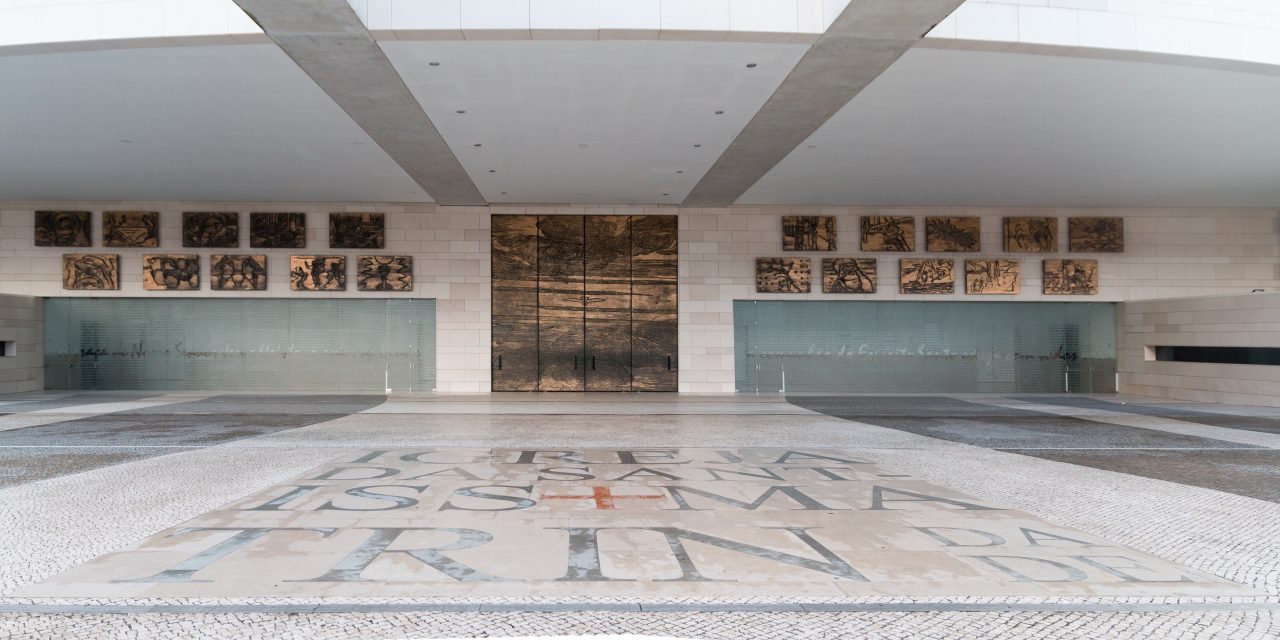
    The vast circular church at the western end of the square is the one most day visitors walk past, and on a short visit it is the most useful building at Fátima. It is seated, it is warm, it is entirely step-free, and it is where the sanctuary holds its largest Masses. Look at the twelve bronze doors of the Apostles from outside and at the church's name set into the paving, then go down into the gallery beneath it, where five small chapels hold the quiet that the open esplanade cannot. The Chapel of the Blessed Sacrament there is the most peaceful room in Fátima and the one almost nobody finds.

    Give your time to the doors of the Apostles from outside; the Chapel of the Blessed Sacrament in the gallery below.

    In rain or cold this church is the reason a winter day trip still works. It is also the easiest space at the sanctuary for anyone using a wheelchair or unable to stand for long.

  10. A short walk back up the esplanade, then ten minutes on to the coach terminal.

  11. Pause · Before the return coach

    A last visit to the Capelinha

    Go back to the Chapel of the Apparitions for a few minutes before you leave. The sanctuary is built so that everything returns here, and a day trip that ends where it began has a shape that a checklist does not. If your coach is late enough in the day, this is also where the evening begins to gather, and you will see what staying the night would have given you.

The last coaches to Lisbon leave in the late afternoon and early evening, before the candlelight procession. Confirm the final departure when you book, and give yourself more margin than the walk needs.

When plans bend

Adapting these days

By coach, which is what most people should do

Rede Expressos operates direct services from Lisbon Sete Rios to the Fátima coach terminal, taking about an hour and a half. Services run through the day, more often in summer and around the monthly pilgrimages. Book ahead for 12 and 13 May and October, when both directions sell out. Buy the return at the same time and note the last departure. There are also direct services from Lisbon Airport, which suit an arrival day. Timetables and fares change; take them from the operator rather than from any guide, including this one.

By car

Fátima lies on the A1 between Lisbon and Porto, with an exit a few minutes from the sanctuary, and the drive is about an hour and a half in normal traffic. The A1 is tolled, and most hire cars in Portugal carry an electronic transponder; confirm how yours is billed before you set off. There is a large amount of parking around the sanctuary, and on ordinary days it is straightforward. On the 12th and 13th of the month it is not, and the roads into the town are managed. Driving is the right choice if you also want Aljustrel and the country sites, which are awkward on foot from the sanctuary.

By train, and why it usually is not worth it

There is no railway station at Fátima. The station called Fátima is Fátima-Chão de Maçãs, about 25 kilometres away, with sparse onward connections into the town. Caxarias, about 20 kilometres out, is served by Intercidades trains on the Lisbon lines and connected to Fátima by Rodoviária do Tejo on weekdays. Either route costs more time and money than the direct coach and adds a transfer at the end of it. Rail makes sense only if you are already travelling by train for another reason, and even then check the connecting bus times first, because on Sundays and holidays they thin out sharply.

Organized tour or independent visit

Fátima is one of the easiest pilgrimage destinations in Europe to reach independently: a coach ticket and a ten-minute walk. Day tours from Lisbon almost always pair Fátima with Batalha, Alcobaça, Nazaré, or Óbidos, which means an hour or two at the sanctuary in a fixed group. That suits a traveller who wants to see central Portugal. It does not suit a pilgrim who wants to pray the Rosary at the Capelinha without watching a clock. Choose a tour for the region; go independently for Fátima.

When to stay the night instead

Stay if you want the evening Rosary and candlelight procession, which no day trip from Lisbon reaches. Stay if you want Aljustrel, Valinhos, and Loca do Cabeço, which need unhurried time and better footwear than a city day. Stay if you are travelling on or near the 12th and 13th of a month between May and October, when the sanctuary is at its fullest and the day is long. Accommodation in Fátima is plentiful and plain, much of it run for pilgrims, and the sanctuary keeps its own booking service.

Mobility and walking

The sanctuary is the most accessible part of a Fátima visit. The esplanade is level and step-free from end to end, and the Basilica of the Most Holy Trinity has level access throughout with lifts to the chapels beneath it. The older Basilica of Our Lady of the Rosary has steps at the main door and level access from the sides. The distances are longer than they look on a plan: the esplanade is a large open space and crossing it repeatedly adds up. Aljustrel, Valinhos, and Loca do Cabeço are a different proposition, on uneven tracks and stony ground, and are not accessible.

Feast days and crowds

The pilgrimage months run from May to October, with the anniversary pilgrimages on the 12th and 13th of each month. The two great dates are 13 May and 13 October, when hundreds of thousands come and the town changes character entirely. On those days travel, accommodation, parking, and access are all managed differently, the vigil runs through the night, and a day trip is not a realistic plan. Coming near a pilgrimage date is a decision to make deliberately rather than to discover on arrival.

What to check again before you travel

Three things move and are worth confirming close to the date rather than early: the coach timetable in both directions, including the last departure; the sanctuary's schedule of Masses, confession times, and languages, which changes with the season; and any arrangements for a pilgrimage date if you are travelling in the days around the 13th. All three are published by the operator and the sanctuary themselves. Nothing else in this guide should change much from one year to the next.

My Journey

Make these days your own

The Capelinha first, the tombs next, the Trinity basilica after lunch, and back to the Capelinha before the coach. Confirm the sanctuary's Mass and confession schedule and your return departure time before you set the day.

  • 3 places across 1 days, each in the day and order the guide gives it
  • The days arrive already built; reorder them, move a place, or drop one whenever you like
  • Works without an account, in this browser

You choose the journey it joins before anything is saved.

Editorial responsibility

How this guide was prepared

Prepared by
Eternal Roam Editorial
Responsible editor
Luke Gordon, Eternal Roam
Last reviewed
August 2026
Verification
Desk researched

Researched from official and reliable sources, including the sanctuaries' own published information. This itinerary has not yet been field verified by an Eternal Roam contributor.

Built over Eternal Roam's canonical Fátima place records, with transport options checked against the Sanctuary of Fátima, the municipal and regional tourism sources for Fátima and Ourém, and Comboios de Portugal for the rail position. Distances between the coach terminal, the sanctuary buildings, and the parish church were checked against mapping rather than recalled. No contributor travelled this itinerary. Timetables, fares, and liturgical schedules are volatile by nature and are described here only in the terms that hold from year to year; exact times should be taken from the operator and the sanctuary shortly before travel.

Opening hours, Mass times and access change; each place page above carries its current sources. How Eternal Roam researches and reviews its guides is described in our editorial standards.

Sources consulted

Photo credits
  1. Guide hero: How to Visit Fátima from Lisbon. Daniel VILLAFRUELA / Wikimedia Commons. Source. CC BY-SA 3.0.
  2. Day 1, photo 1: The esplanade runs the length of the Cova da Iria, and crossing it is most of the walking a day trip asks of you. Berthold Werner / Wikimedia Commons (CC BY-SA 4.0). Source. CC BY-SA 4.0.
  3. Day 1, photo 2: The Trinity basilica is where the sanctuary seats a whole pilgrimage at once, and where a day trip finds shelter and a seat. JP Bennett / Wikimedia Commons (CC BY 2.0). Source. CC BY 2.0.
  4. Day 1, photo 3: The tombs of the shepherd children lie in the aisles of the older basilica at the far end of the square. Vitor Oliveira / Wikimedia Commons (CC BY-SA 2.0). Source. CC BY-SA 2.0.