
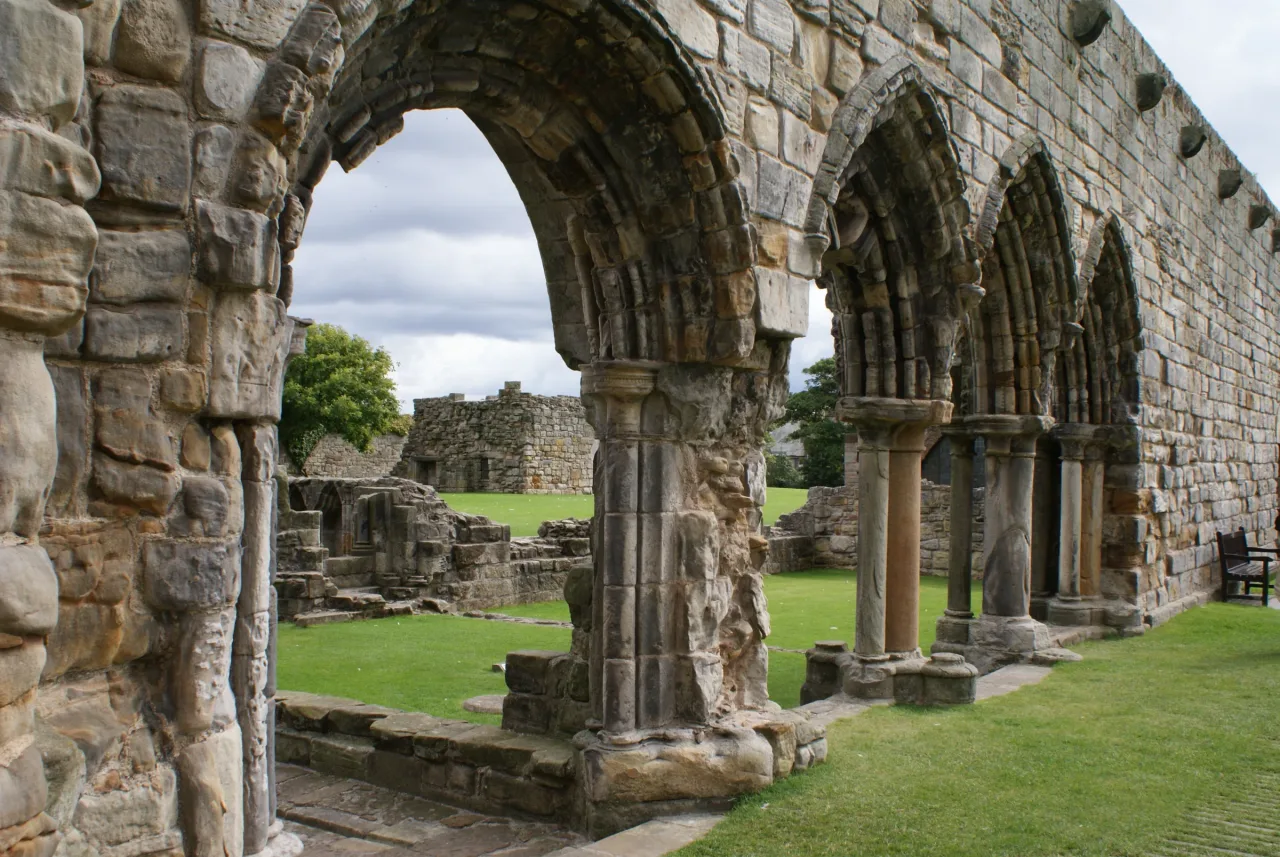
Guide · Scotland
Six Days across Sacred Scotland
Six days from Andrew's ruined apostolic shrine to Margaret's royal abbey, Columba's island, and Ninian's pilgrim road to the Galloway shore.
The argument
The shape of these days
Scotland's Catholic sacred geography cannot be reduced to one city or one continuous road. The pilgrimage begins in the east with Andrew and Margaret, crosses by road and ferry into Columba's western island, then ends in the south-west at Whithorn. Each movement belongs to a different kind of Christian memory: an apostolic relic shrine, a royal saint's documented foundation and burial, an early monastic landscape, and a missionary cult whose written evidence and archaeology do not fit into a simple biography.
The route therefore protects transfer time. Iona is not a mainland stop, and Whithorn is not a quick detour. Two days repeat a canonical place because the ferry crossing and cave walk are themselves part of pilgrimage and cannot be compressed responsibly. Current access, worship, conservation, ferry status, and weather remain with the official custodians.
The journey ends with Ninian because Whithorn teaches a Catholic confidence spacious enough for historical humility. The Gospel truly took root here, even where the exact life behind a beloved name remains partly hidden.
What this guide leaves out, on purpose
- Dunkeld Cathedral. The transfer of Columba relics to Dunkeld in 849 is historically important, but the present church is later and access can be limited. It belongs to a future Columba network rather than a rushed road stop.
- Saint Mary's Metropolitan Cathedral, Edinburgh. The active Catholic national shrine of Saint Andrew deserves a distinct city pilgrimage with its own liturgical and relic context.
- Saint Margaret's Chapel, Edinburgh Castle. The chapel was built in Margaret's memory and is not her tomb. It belongs to an Edinburgh chapter rather than to the Dunfermline shrine day.
Day 1
Andrew at the edge of the sea
Begin with the apostle whose medieval shrine gave St Andrews its name and gathered Scotland toward one sacred coast.
- Give the cathedral precinct and old town a full day rather than treating the ruins as a brief photograph stop.
- Walk within central St Andrews. Expect outdoor ground, graves, coastal wind, and conservation restrictions.
-
Morning and early afternoon
St Andrews Cathedral and Saint Andrew's Shrine
Plan on about 2 hours in the precinct
Begin where Andrew's Scottish cult became a national pilgrimage. The great cathedral is ruined and the relic shrine dispersed, but St Rule's Tower, the church footprint, graves, and sea still show how apostolic memory shaped the town. Pray for Scotland and for Christian unity without claiming surviving relic custody in the ruins.
Give your time to St Rule's Tower, the full cathedral footprint, the former shrine end, and the relationship to the sea
Check the current Historic Environment Scotland conservation notice before travel.
Stay in St Andrews or central Fife. Keep the second morning clear for Dunfermline.
Day 2
Margaret's royal mercy
Receive Dunfermline as Margaret's foundation, burial place, and broken shrine before crossing west toward the islands.
- Do not hurry the abbey, but leave enough daylight for the long road toward Oban.
- Drive across Fife to Dunfermline, visit the abbey complex, then continue west toward Oban for the next day's ferry chain.
-
Morning
Dunfermline Abbey and Saint Margaret's Shrine
Plan on about 2 hours
Margaret's holiness becomes tangible at Dunfermline because her prayer, charity, royal household, foundation, burial, and medieval cult meet here. The abbey and surviving shrine setting make a truthful centre even though her relic history was disrupted after the Reformation. Enter as a Catholic guest within shared Christian custody.
Give your time to the Romanesque nave, abbey church, shrine setting, and the distinction between documented burial and later relic uncertainty
Check the parish and Historic Environment Scotland arrangements because the active church and monument areas may differ.
-
Allow a substantial westward drive and stay near Oban. Do not book a tight final ferry connection after the abbey visit.
-
In passing · Afternoon and evening
Drive toward Oban
Sleep near Oban and check the next day's Oban to Craignure and Fionnphort to Iona service status.
Day 3
Cross the water to Columba
Let the ferry chain and island approach become part of the pilgrimage rather than dead time before the abbey.
- Protect every connection and accept that disruption may move the abbey visit into the following day.
- Sail Oban to Craignure, drive across Mull to Fionnphort, then take the passenger ferry to Iona. Times and booking rules must be checked with CalMac.
-
Afternoon if connections hold
Iona Abbey and Saint Columba's Shrine
Plan on at least 2 hours
Iona is not an optional flourish after a ferry ride. Columba founded his community here in 563, died here in 597, and became the centre of a pilgrim landscape that outlived raids, relic dispersal, Reformation, and restoration. Begin with the abbey, shrine, and crosses, keeping the visible medieval fabric distinct from the first monastery.
Give your time to the abbey church, Saint Columba's shrine, Saint Martin's Cross, and the first reading of the early enclosure
Confirm abbey opening and both ferry legs. Sunday access follows a different pattern.
Stay on Iona when lodging permits. Otherwise use Fionnphort or Mull without promising a late mainland return.
Day 4
Iona without haste
Give Columba's island a second movement for the early enclosure, worship, and a weather-led return to the mainland.
- Leave the wider walk aside when ferry timing, wind, rain, or mobility makes it imprudent.
- Walk only the island sections suited to the day, then reverse the Fionnphort, Mull, Craignure, and Oban sequence with generous margins.
-
Morning
Iona Abbey and Saint Columba's Shrine
Plan on 2 to 3 hours before departure
The second Iona day is intentional. The first belongs to arrival and shrine; the second lets the early landscape, common prayer when available, and the practical return find their proper scale. Walk beyond the restored abbey only as conditions allow, and do not turn a missed ferry into a test of devotion.
Give your time to the early enclosure, Hill of the Abbot, worship when scheduled, and a calm return to the pier
Work backward from the confirmed return ferries and keep weather margin.
Return toward Oban and stay there or begin a modest southward move only if daylight and fatigue permit.
Day 5
Ninian at Whithorn
End the national crossing where written memory, archaeology, medieval shrine, and living Catholic pilgrimage meet.
- Use the road day for Whithorn itself and reserve the cave decision for the following morning.
- Drive south into Dumfries and Galloway. The transfer is substantial, so arrive for the priory and museum rather than adding another sacred site.
-
Afternoon
Whithorn Priory and Saint Ninian's Shrine
Plan on about 2 hours
Whithorn is firm ground for a careful devotion to Ninian. Bede's account is early but not contemporary; archaeology confirms an important Christian centre without settling every later life story; and the medieval shrine is securely documented. Begin with evidence in the museum, then pray in the crypts and receive the saint's tradition without forcing certainty.
Give your time to the early Christian stones, archaeological interpretation, priory remains, and shrine crypts
Check seasonal museum and crypt access with Historic Environment Scotland and the Whithorn Trust.
Stay in Whithorn or the Machars and read the current diocesan and weather guidance for the cave route.
Day 6
The cave road, if conditions permit
Finish with a bodily pilgrimage toward the shore, accepting the church alternative as prudence rather than failure.
- Wear strong footwear, carry weather protection, and turn back when ground, tide, health, or exposure requires it.
- Return first to Whithorn for orientation, then drive to the signed cave-walk area. The route runs through a glen to a pebble shore and has no shelter.
-
Morning decision point
Whithorn Priory and Saint Ninian's Shrine
Plan on Half a day with the cave extension
The final day begins again at Whithorn because the cave is a devotional extension of the shrine town, not an isolated attraction. Use the official pilgrimage guidance, conditions, and your own health to decide whether to walk. If the route is unsuitable, pray in Whithorn and receive the alternative Mass arrangements when offered.
Give your time to a safe decision, prayer before departure, the glen and shore only when suitable, and a reverent return
The annual pilgrimage notice and current local conditions govern this day. There is no cover on the shore route.
Finish in Dumfries and Galloway. Do not schedule a long onward flight or rail connection the same evening.
When plans bend
Adapting these days
Four-day accessible historical route
My Journey
Make these days your own
Six days from St Andrews to Whithorn. Keep both Iona days and the final cave day flexible for ferries, weather, opening, and mobility.
- 6 places across 6 days, each in the day and order the guide gives it
- The days arrive already built; reorder them, move a place, or drop one whenever you like
- Works without an account, in this browser
You choose the journey it joins before anything is saved.
Editorial responsibility
How this guide was prepared
- Prepared by
- Eternal Roam Editorial
- Responsible editor
- Luke Gordon, Eternal Roam
- Last reviewed
- August 2026
- Verification
- Desk researched
Researched and editorially reviewed from official Church, shrine, transport, and other reliable sources. Confirm current practical details with the official sources before travel.
Built from official Historic Environment Scotland, CalMac, Diocese of Galloway, Vatican, and local custodian sources over Eternal Roam's canonical saint and destination records. Driving and transfer sequences are planning allowances rather than promises. The complete route is desk-researched; verify ferry status, access, worship, weather, and trail conditions before setting dates.
Opening hours, Mass times and access change; each place page above carries its current sources. How Eternal Roam researches and reviews its guides is described in our editorial standards.
Sources consulted
- St Andrews Cathedral Historic Environment Scotland
- Dunfermline Abbey and Palace Historic Environment Scotland
- Iona Abbey and Nunnery Historic Environment Scotland
- Oban to Craignure and Fionnphort to Iona services Caledonian MacBrayne
- Whithorn Priory and Museum Historic Environment Scotland
- Saint Ninian pilgrimage and diocesan notices Diocese of Galloway
Photo credits
- Guide hero: Six Days across Sacred Scotland. Fred Cunha / Wikimedia Commons. Source. CC BY-SA 4.0.
- Day 1, photo 1: St Rule's Tower and the cathedral gable still announce the apostolic shrine town beside the sea. Andy Hawkins / Wikimedia Commons. Source. CC BY-SA 2.0.
- Day 1, photo 2: The earlier tower and later cathedral must be read as distinct layers of one shrine precinct. Steven1991 / Wikimedia Commons. Source. CC BY-SA 4.0.
- Day 2, photo 1: Dunfermline gathers Margaret's royal foundation, burial, shrine memory, and living Scottish devotion. L E X commons / Wikimedia Commons. Source. CC0.
- Day 3, photo 1: The Sound of Iona makes the final crossing visible before the abbey comes into reach. Jan Smith / Wikimedia Commons. Source. CC BY 2.0.
- Day 3, photo 2: The small shrine offers a focus for prayer while Columba's dispersed relic history remains open. Tom Parnell / Wikimedia Commons. Source. CC BY-SA 4.0.
- Day 5, photo 1: The roofless priory stands among graves above the crypts of Ninian's medieval shrine. Tom Parnell / Wikimedia Commons. Source. CC BY-SA 4.0.
- Day 5, photo 2: The crypt preserves the shrine's spatial memory without proving the survival of authenticated bodily relics. Billy McCrorie / Wikimedia Commons. Source. CC BY-SA 2.0.