Guide · Nagasaki

One Day in Catholic Nagasaki

Three places, in chronological order, in one day. The hill where twenty-six people were killed in 1597, the church built two and a half centuries later facing that hill, and the parish of the community that walked into it in 1865 and was deported for it.

  • 1 day
  • Three places, one day, with two tram legs and two real climbs
  • Reviewed August 2026

The argument

The shape of these days

Walk the sequence, not the map. Martyrdom, then the mission's return, then the community that carried the cost.

What this guide leaves out, on purpose

  • Sotome: Shitsu and Ono. Roughly eighty minutes each way by bus from Nagasaki Station. Nearly three hours of travel cannot be added to this day without wrecking it. It is the obvious second day.
  • Peace Park and the Atomic Bomb Museum. Both are within walking distance of Urakami Cathedral and both deserve unhurried time. Folding them into this day would turn a pilgrimage into a survey and would not serve either.
  • The Ōura Cathedral Christian Museum in full. The museum in the former Latin Seminary is included in the Ōura ticket and rewards an hour. This day gives it thirty minutes. If the history is what you came for, take the hour and shorten Urakami.

Day 1

Nishizaka, Ōura, Urakami

Begin at the killing ground, go south to the church that was built to face it, then north to the parish that lived the consequences.

  • Give Nishizaka's museum its time. It is the part of the day most visitors underuse, and without it Ōura and Urakami are just two churches.
  • Ten minutes on foot from the station to Nishizaka, then two tram legs. Under three kilometers of walking, all of it with a climb at the end.
  • See this day on the map
  1. Walk back down to the station area and take the streetcar south. You will normally change at Shinchi Chinatown. Fifteen to twenty minutes.

  2. 09:00, on foot from Nagasaki Station before the day warms up

    Nishizaka Martyrs' Shrine and Saint Philip Church

    Plan on about 1 hour 30 minutes

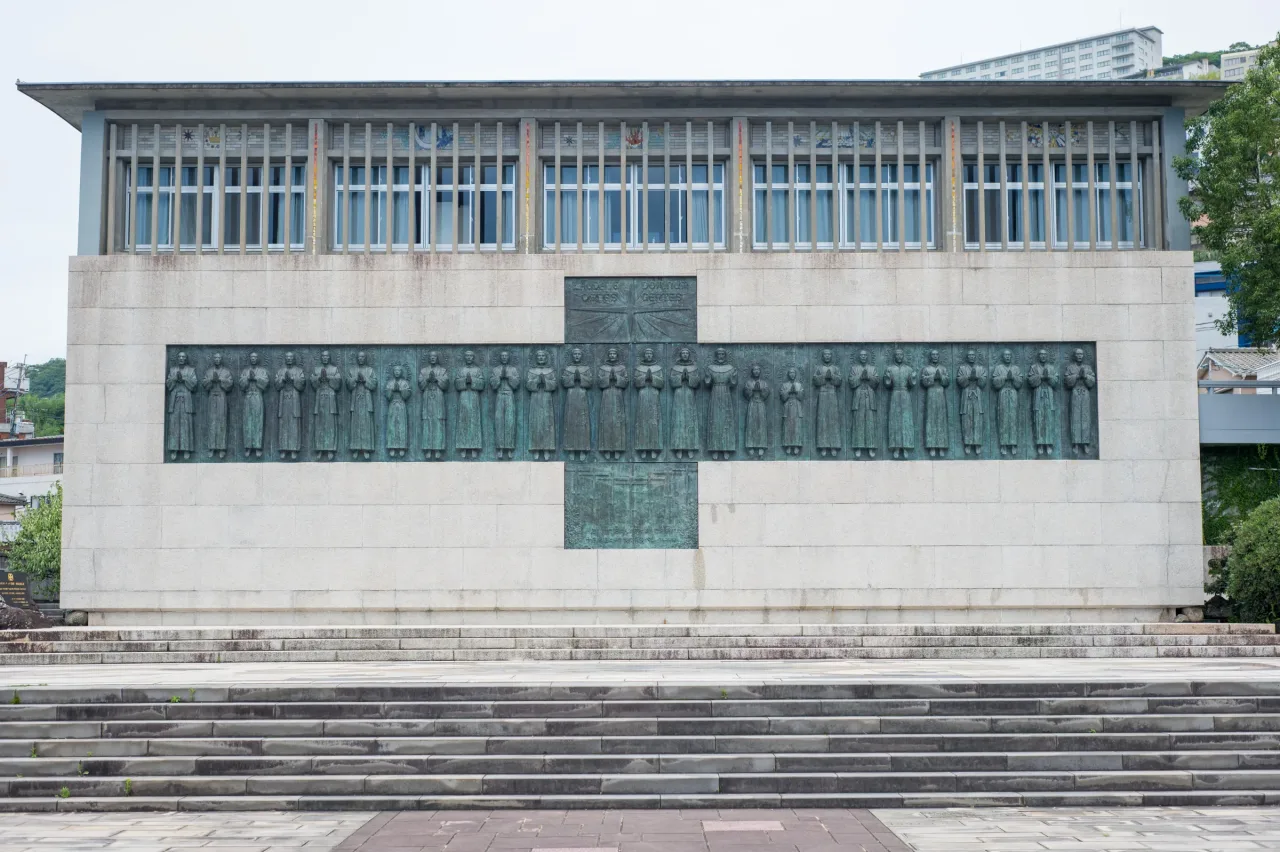
    This is the documented execution ground. On February 5, 1597, twenty-six Catholics were bound to crosses here and killed with lances: six Franciscans, three Japanese Jesuits including Paul Miki, and seventeen Japanese lay Catholics, among them two boys of about twelve and thirteen. They had been arrested in Kyoto and Osaka and marched here through the snow, because the hill stands above the harbour and could be seen from the town. Read every name on Funakoshi's bronze relief before following any single story. Then go into the museum, which holds fumie, the bronze plaques suspects were made to tread on, Maria Kannon figures used by concealed Christians as images of Our Lady, and original letters of Saint Francis Xavier. Those three object types are the whole rest of the day in miniature.

    Whose life this is Saint Paul Miki

    Give your time to the twenty-six names on the relief, the fumie, the Maria Kannon figures, and the Xavier letters

  3. Back down to the tram, and north through the city to Peace Park. Around thirty minutes, and the longest single leg of the day. Eat somewhere near Shinchi if you are changing there anyway.

  4. 11:30, after the tram from the station end

    Ōura Cathedral

    Plan on about 1 hour 15 minutes including the museum

    The Paris Foreign Missions Society built this church for Nagasaki's foreign settlement, finishing it at the end of 1864 and dedicating it on February 19, 1865. They named it for the twenty-six you have just come from and set it facing their hill. A month after the dedication, on March 17, 1865, about fifteen people from Urakami came in, asked where the statue of the Virgin Mary was, and told Father Bernard Petitjean that their hearts were the same as his. That is why this small white church matters more than its size suggests. Know before you go that it is not a parish: the Archdiocese states that ordinary Mass, Sunday Mass included, is not celebrated inside. Prayer is welcome; a scheduled liturgy is not on offer. The parish church, Ōura Church, stands on the same grounds and was built in 1975.

    Give your time to the direction the church faces, the statue in the niche above the door, and thirty minutes in the Christian Museum

  5. Peace Park and the Atomic Bomb Museum are a short walk away. They hold the civic account of August 9 and are worth a separate afternoon rather than the last hour of this one.

  6. 14:30, allowing for lunch and the tram

    Urakami Cathedral

    Plan on about 45 minutes

    The people who walked into Ōura came from here. What happened next was not freedom. In 1867 the villagers told their headman they would bury their dead as Catholics, and sixty-eight were arrested and tortured. The Meiji government kept the prohibition and deported more than three thousand of them across Japan, where many died. The edict boards came down in 1873 and the survivors came home. They built a small church in 1879, began the brick cathedral in 1895, and finished the towers in 1925. On August 9, 1945, the bomb detonated a short distance away and the cathedral and much of the parish were gone. They rebuilt on the same ground in 1959. Walk the grounds first: the damaged stone saints and the fragments of the earlier wall are outside, and they are the oldest thing here. This is a working cathedral, so the visit ends as a visit to a parish rather than to a monument.

    Whose life this is Saint Magdalene of Nagasaki

    Give your time to the damaged stone figures and brick fragments in the grounds, then the church itself

When plans bend

Adapting these days

If you only have a morning

Take Nishizaka and Ōura and stop there. They are the hinge of the whole story: the martyrdom and the church built to remember it. Roughly three and a half hours including the tram. Urakami is the first thing to add when you have longer.

If steps are a problem

Ōura's approach is a long flight of steps and there is no step-free alternative, so plan around it rather than hoping. A day of Nishizaka and Urakami is a real pilgrimage: the martyrdom site and the parish that carried the consequences. Both still involve a rise from the road, but neither has Ōura's staircase. Contact the site in advance if you are unsure.

If you want Mass

Ōura Cathedral does not hold ordinary Mass. Urakami is a working cathedral with a regular schedule, and Ōura Church, alongside the basilica, is the parish for that part of the city. Check times with the Archdiocese of Nagasaki and build the day around the liturgy rather than the other way round.

If you have a second day

Go to Sotome. The bus from Nagasaki Station takes roughly eighty minutes each way up the coast to Shitsu, where the Hidden Christian communities actually were. The city sites keep pointing at those villages, and the second day is what makes the first one land.

If you are here on February 5 or March 17

February 5 is the feast of the Twenty-Six Martyrs, kept at Nishizaka. March 17 is the anniversary of the 1865 encounter, one of the two days in the year when Mass is celebrated inside Ōura Cathedral. Either date changes what the day can be; confirm arrangements in advance.

If the weather is against you

Nishizaka's museum and Ōura's Christian Museum are both indoor, and the two of them together are the documentary heart of the city. A wet day spent properly in those two collections is better than a dry day spent hurrying past them.

If you want the atomic-bomb sites in depth

Reverse the day. Start at Urakami in the morning, give Peace Park and the Atomic Bomb Museum the middle of the day, and finish at Ōura in the afternoon. You will lose Nishizaka, which is the price. Nishizaka is the one stop this guide would not drop.

My Journey

Make these days your own

Nishizaka first thing, on foot from the station. Ōura in the middle of the day, by tram with a change at Shinchi Chinatown. Urakami in the afternoon, from the Peace Park stop. Confirm the museum hours at Nishizaka and the current admission at Ōura before you set the day, and check the Mass schedule at Urakami so you are not arriving during a liturgy.

  • 3 places across 1 days, each in the day and order the guide gives it
  • The days arrive already built; reorder them, move a place, or drop one whenever you like
  • Works without an account, in this browser

You choose the journey it joins before anything is saved.

Editorial responsibility

How this guide was prepared

Prepared by
Eternal Roam Editorial
Responsible editor
Luke Gordon, Eternal Roam
Last reviewed
August 2026
Verification
Desk researched

Researched and editorially reviewed from official Church, shrine, transport, and other reliable sources. Confirm current practical details with the official sources before travel.

Built over Eternal Roam's canonical Nagasaki place records. Historical detail was checked against Nagasaki Prefecture's official heritage material for the Hidden Christian World Heritage property, the Twenty-Six Martyrs Museum, and the official site of Ōura Cathedral, which is the source for the statement that ordinary Mass is not celebrated in the basilica. Distances between stops were computed from verified coordinates; tram and bus timings are desk-researched. Obtain current opening hours, admission, and Mass times shortly before travel.

Opening hours, Mass times and access change; each place page above carries its current sources. How Eternal Roam researches and reviews its guides is described in our editorial standards.

Sources consulted

Photo credits
  1. Guide hero: One Day in Catholic Nagasaki. BigCheddah / Wikimedia Commons. Source. CC BY-SA 4.0.
  2. Day 1, photo 1: Ōura was dedicated to the twenty-six killed at Nishizaka and set facing the hill where they died, two kilometers north. Suicasmo / Wikimedia Commons (CC BY-SA 4.0). Source. CC BY-SA 4.0.
  3. Day 1, photo 2: Damaged stone saints from the destroyed cathedral stand in the grounds of the church rebuilt in 1959. ぱちょぴ / Wikimedia Commons (CC BY-SA 3.0). Source. CC BY-SA 3.0.