Guide · Kraków

Two Days in Catholic Kraków: Wawel, Divine Mercy, and Saint John Paul II

Kraków has two Catholic centres and they are six kilometres apart. Two days is what it takes to give each one a morning that is not a rush.

  • 2 days
  • Unhurried on day one, one long move on day two
  • Reviewed August 2026

The argument

The shape of these days

Kraków only makes sense when its two centres are kept apart and then joined by one person. The historic city is arranged around a bishop killed in 1079. Łagiewniki is arranged around a sister who died in 1938. Karol Wojtyła worked at the second, was ordained at the first, and came back as pope to consecrate the basilica at the second. Two days lets that shape emerge instead of collapsing into a coach tour.

What this guide leaves out, on purpose

  • Wadowice and Kalwaria Zebrzydowska. Both belong to John Paul II's story and both are day trips out of Kraków. Adding either to two days means giving up one of the two centres.
  • Częstochowa and Jasna Góra. Poland's greatest Marian sanctuary is over two hours away and deserves its own journey, not an afternoon.
  • Auschwitz and Saint Maximilian Kolbe. Oświęcim is about ninety minutes away, and a visit there cannot be honestly compressed into a pilgrimage day that also does something else.
  • Skałka, the Paulite church where St. Stanislaus was killed. It is ten minutes below Wawel and worth an hour, but on two days the cathedral shrine carries the story and Skałka is the first thing a third day should add.
  • Most of Kraków's other churches. The Old Town has dozens. Four is the number that can be entered properly rather than passed through.

Day 1

Historic Catholic Kraków, from Wawel to the Main Square

Begin at the martyr's shrine and walk north through eight hundred years of the same city.

  • Give Wawel the first slot of the day, before the ticketed route fills and before it closes. Everything else on day one can absorb a delay; the cathedral cannot.
  • About two kilometres on foot, all inside the old city and all on cobbles. No transport is needed at any point.
  • See this day on the map
  1. Leave the hill by the ramp and walk north along Grodzka. The next stop is about ten minutes away, on the left.

  2. 09:00, when the visitor route opens

    Wawel Cathedral

    Plan on about 90 minutes, or 45 if you skip the ticketed route

    The cathedral of Kraków was raised around the body of a bishop killed in 1079, and the shrine still stands at the centre of the nave rather than at the east end. Everything else on this hill, the coronations from 1320, the royal sarcophagi, the nineteen chapels, gathered afterwards around that one grave. Two other things belong to a pilgrim here: Saint Jadwiga's tomb in the north aisle, where Mass is offered at her relics, and St. Leonard's Crypt below the choir, the oldest room in the building, where Karol Wojtyła celebrated his first Masses on 2 November 1946.

    Give your time to the confession of St. Stanislaus at the crossing, the tomb of Saint Jadwiga in the north aisle, and St. Leonard's Crypt if you buy the ticket.

    The cathedral is not part of the castle ticket and is sold separately. The visitor route closes for ordinations and funerals, sometimes at short notice, so confirm on the official site that morning.

  3. Cross to the papal window above the palace door opposite, then walk four minutes east along Dominikańska.

  4. 11:00, and stay for as long as it holds you

    Basilica of St. Francis of Assisi, Kraków

    Plan on about 40 minutes

    Conventual Franciscans have held this site since the 1230s and have never left it. The medieval interior burned in the Kraków fire of 1850, and when it was rebuilt the friars gave Stanisław Wyspiański the whole church: painted ornament through the nave, windows of Saint Francis and Blessed Salomea, and above the west choir the enormous God the Father. The chapel of Our Lady of Sorrows on the north side is where the devotion actually lives. And the archbishop's palace at Franciszkańska 3 is directly across the street, where Karol Wojtyła lived from 1963 until his election in 1978; the pew he used is marked.

    Give your time to the God the Father window above the choir, the chapel of Our Lady of Sorrows, the marked pew, and the papal window across the street.

    The Gothic cloister is reached from the friary and is not reliably open. Ask at the porter's lodge rather than counting on it.

  5. Walk north up Stolarska. The Main Square is six minutes away.

  6. 12:00, before the lunch break

    Dominican Basilica of the Holy Trinity, Kraków

    Plan on about 30 minutes

    The Order of Preachers came to Kraków in 1222 and has held this corner ever since. Jacek Odrowąż, whom the Church calls Hyacinth, received the habit from Saint Dominic himself, brought the order to Poland, and died in this priory in 1257; he was canonized in 1594. His relics rest in the chapel above the sacristy, on the site the community has always identified as his cell, with a baroque cycle of his life and miracles painted round the walls. The nave you stand in is a reconstruction after the same 1850 fire, and the surviving baroque side chapels are the oldest fabric in the building.

    Give your time to the chapel of Saint Hyacinth if it is open, the Rosary chapel, and the friars' office if the hour catches it.

    Do not build the morning around reaching Saint Hyacinth's chapel. It is often shut, and the loss is real but survivable.

  7. Cross to the north-east corner of the square.

  8. Pause · 12:45 to 13:45

    Lunch on or near the Main Square

    A real break, and a necessary one: the altarpiece at St. Mary's is not opened until late morning on weekdays and the early afternoon on Sundays and holy days, so the hour spent here is what makes the last stop work. The square and the streets off it are full of places to eat, and the Dominican and Franciscan churches you have just left are two minutes behind you if you want to go back.

  9. Step out onto the square for the hejnał on the hour.

  10. 14:00, once the altarpiece is open

    St. Mary's Basilica, Kraków

    Plan on about 60 minutes

    The Marian parish of the Main Square, and the day's argument about sacred art. Between 1477 and 1489 Veit Stoss carved a folding altarpiece more than eleven metres high, showing the Virgin falling asleep among the apostles and taken up into glory. It was removed to Germany in the war and brought back. What makes it worth the ticket is that the wings are opened every morning and closed every evening, over an altar where Mass is said daily. This is not a museum that happens to be a church.

    Give your time to the opened altarpiece, the faces of the apostles around the sleeping Virgin, the chancel glass, and the Gothic crucifix on the nave pier.

    Altarpiece opening times shift with the liturgical calendar and are published by the basilica. If it matters to you, confirm it the morning of, not the week before.

The Main Square empties slowly and the hejnał sounds from the taller tower every hour into the night. If day one has left an appetite for one more church, Skałka is fifteen minutes south, below Wawel, where St. Stanislaus was killed; it is the honest first addition to a third day. Otherwise stop here. Day two is a longer day than it looks.

Day 2

Łagiewniki: Saint Faustina, and the ground John Paul II worked on

One journey south, two sanctuaries, and the small chapel before the large basilica.

  • Go into the convent chapel before anything else at Łagiewniki. The tomb and the venerated image are in there, and the site's own layout will steer you to the basilica first.
  • About half an hour south by city transport each way, then roughly two kilometres on foot within Łagiewniki, including the eight hundred metres between the two sanctuaries across open ground.
  • See this day on the map
  1. Leave the sanctuary on the south side and take the path across the open ground.

  2. 09:30, before the coaches

    Divine Mercy Sanctuary, Kraków-Łagiewniki

    Plan on about 1 hour 45 minutes for both buildings

    Helena Kowalska entered the Sisters of Our Lady of Mercy in 1925, took the name Faustina, and came to this convent permanently in 1936. She died here on 5 October 1938 and was buried in the sisters' cemetery; her remains were brought into the convent chapel on 25 November 1966, as her cause opened under Archbishop Karol Wojtyła. That chapel, consecrated in 1891, is small and dim and holds two things: her tomb beneath the side altar, and above it the venerated image of the Merciful Jesus, painted by Adolf Hyła and blessed in 1944. The basilica beside it is a different and later building, raised between 1999 and 2002 for a pilgrimage the chapel could no longer hold. John Paul II consecrated it on 17 August 2002 and entrusted the world to Divine Mercy. Faustina never saw it.

    Give your time to the convent chapel first, always: the tomb beneath the side altar and the venerated image above it. Then the basilica, and the Hour of Mercy at three if your day can be shaped around it.

    The image made under Faustina's own direction in Vilnius in 1934 is a different painting and is not here. The site's layout steers arrivals toward the basilica, and the shop sits between the two buildings, so go left to the small chapel first. Divine Mercy Sunday gives the whole site over to the feast and alters access to the chapel; it is the hardest day of the year to reach the tomb quietly.

  3. The sanctuary tower is visible ahead for most of the walk.

  4. Pause · 11:45 to 12:30

    The walk across Białe Morza

    Eight hundred metres of open ground separate the two sanctuaries, with the Stations of the Cross laid out along the path. It is the only part of the day that is neither a building nor a bus, and it is the ground Karol Wojtyła crossed as a labourer at the Solvay works before he crossed it as anything else. Taking it slowly, station by station, is a better use of forty minutes than a longer stay in either church.

  5. City transport back to the centre from the sanctuary, roughly half an hour.

  6. 12:30, after the walk

    Sanctuary of Saint John Paul II, Kraków

    Plan on about 60 minutes

    This is a different sanctuary, with its own custody, its own liturgy and its own website, and it stands where it does for a specific reason. Between 1940 and 1944, under the German occupation, Karol Wojtyła laboured at the Solvay soda works whose white spoil heaps gave this district its name, Białe Morza. He walked from here to the convent at Łagiewniki. After his beatification, Cardinal Stanisław Dziwisz erected the sanctuary on 11 June 2011 and brought in the relics; the upper church was consecrated on 23 June 2013. The lower Church of the Relic holds an ampoule of his blood, taken during his final illness, enclosed in the marble altar at its centre. The upper church is covered in mosaic, including a series of the Marian shrines he visited.

    Give your time to the lower Church of the Relic first, then the mosaics above, and the Stations of the Cross on the walk in.

    Check this sanctuary's Mass times separately from the Divine Mercy sanctuary's. They are not one complex and they do not share a schedule.

Back in the centre by mid-afternoon, which leaves the option of Mass at St. Mary's or the Dominicans, where confession runs into the evening. If Poland's wider Catholic geography is now the question, Częstochowa and Jasna Góra are over two hours north, Wadowice and Kalwaria Zebrzydowska are day trips west, and Oświęcim is about ninety minutes away. Each of them wants a day of its own, and none of them belongs in these two.

When plans bend

Adapting these days

One day only

Take Wawel first thing, allow ninety minutes, and go straight south to Łagiewniki after it. Do the convent chapel and the basilica, skip the Sanctuary of Saint John Paul II, and accept that the Old Town churches are lost. This is the honest one-day shape: the martyr's shrine and Faustina's tomb, with one long transit between them and nothing decorative attached.

A shorter historic centre

If day one has to compress, keep Wawel and the Franciscan basilica and drop the Dominicans and St. Mary's. Those two carry the cathedral and the Wojtyła thread between them, and both are free, so the day survives without a single ticket.

Łagiewniki without the walk

The path between the two sanctuaries is open, exposed and sloped. City transport connects them, and taking it costs nothing but the Stations of the Cross. If mobility, heat or weather makes the walk unwise, take the bus and give the extra time to the convent chapel.

Three days

Add Skałka below Wawel, where St. Stanislaus was killed and where the May procession from the cathedral ends, and give a morning to the churches this guide leaves out. A third day is also the first honest room for Wadowice or Kalwaria Zebrzydowska as a half-day out.

Around Divine Mercy Sunday

If you are here for the Sunday after Easter, invert the guide: do Łagiewniki on a weekday morning when the chapel is reachable, and keep the feast itself for the basilica and the open-air liturgy. Trying to pray at the tomb on the day itself is the one thing this site cannot easily give you.

My Journey

Make these days your own

Saved as two days: the historic centre from Wawel to the Main Square, then Łagiewniki and the two sanctuaries. The lunch interval is kept because the altarpiece opening time depends on it.

  • 6 places across 2 days, each in the day and order the guide gives it
  • The days arrive already built; reorder them, move a place, or drop one whenever you like
  • Works without an account, in this browser

You choose the journey it joins before anything is saved.

Editorial responsibility

How this guide was prepared

Prepared by
Eternal Roam editorial
Responsible editor
Eternal Roam
Last reviewed
August 2026
Verification
Desk researched

Researched from official and reliable sources, including the sanctuaries' own published information. This itinerary has not yet been field verified by an Eternal Roam contributor.

Official sites of Wawel Cathedral, St. Mary's Basilica, the Kraków Conventual Franciscan community, the Kraków Dominican priory, the Divine Mercy Sanctuary and the Congregation of the Sisters of Our Lady of Mercy, and the Sanctuary of Saint John Paul II, with the Vatican text of the homily and Act of Entrustment of 17 August 2002. Sequencing was set from the published opening patterns rather than from distance alone.

Opening hours, Mass times and access change; each place page above carries its current sources. How Eternal Roam researches and reviews its guides is described in our editorial standards.

Sources consulted

Photo credits
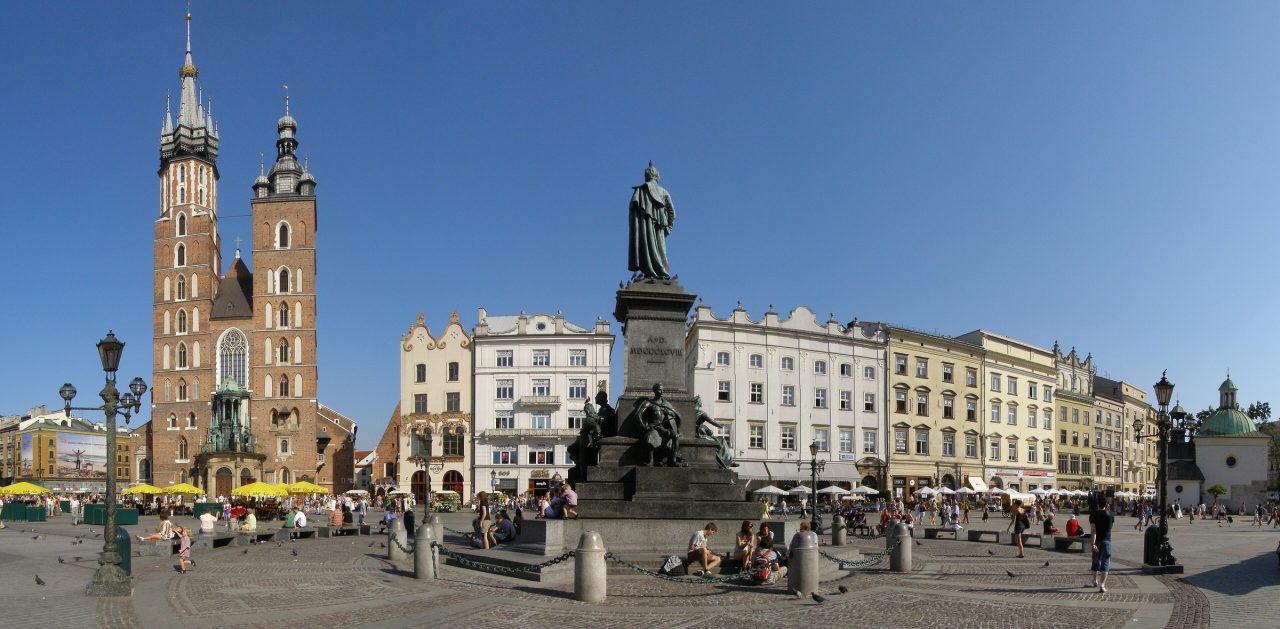
  1. Guide hero: Two Days in Catholic Kraków: Wawel, Divine Mercy, and Saint John Paul II. Andrzej Otrębski / Wikimedia Commons. Source. CC BY-SA 4.0.
  2. Day 1, photo 1: The confession of St. Stanislaus stands at the centre of the nave. The day starts here because the city did. Photo: Strumyczek, CC BY-SA 4.0, via Wikimedia Commons. Source. CC BY-SA 4.0.
  3. Day 1, photo 2: Wyspiański's God the Father above the Franciscan choir. Karol Wojtyła prayed in this church for fifteen years. Photo: DIMSFIKAS, CC BY-SA 3.0, via Wikimedia Commons. Source. CC BY-SA 3.0.
  4. Day 1, photo 3: The Veit Stoss altarpiece, open, during Mass on the Assumption. The last stop of the day, timed to the opening of the wings. Photo: Silar, CC BY-SA 4.0, via Wikimedia Commons. Source. CC BY-SA 4.0.
  5. Day 2, photo 1: The convent chapel of St. Joseph, consecrated in 1891. Faustina's tomb and the venerated image are inside this building, not in the basilica. Photo: Zygmunt Put, CC BY-SA 4.0, via Wikimedia Commons. Source. CC BY-SA 4.0.
  6. Day 2, photo 2: The modern basilica, consecrated by John Paul II on 17 August 2002. Faustina never saw it. Photo: Zygmunt Put, CC BY-SA 4.0, via Wikimedia Commons. Source. CC BY-SA 4.0.
  7. Day 2, photo 3: The Sanctuary of Saint John Paul II, eight hundred metres south and a separate institution. Photo: Mathieu Mars, CC BY-SA 4.0, via Wikimedia Commons. Source. CC BY-SA 4.0.